Marina Edelman is a Licensed Marriage and Family Therapist and the founder of TrueMe® Counseling, a couples and relationship therapy practice serving clients in Westlake Village, Thousand Oaks, and throughout California.
Marina specializes in couples therapy, affair recovery, and relationship repair, drawing on a carefully integrated set of evidence-based approaches:
Gottman Method — Research-based tools for reducing conflict and building friendship and intimacy
AEDP — Processing deep emotional wounds with compassion and precision
Her counseling is best suited for couples and individuals seeking structured, research-backed support for relationship repair, affair recovery, anxiety, communication challenges, and premarital or marriage counseling — in person or via telehealth across California.
As a Founder of TrueMe Counseling, Marina proudly works with the following therapists with additional specialties:
These therapists see clients in Culver City, and Westlake Village Office as well as virtually all throughout California.
Cheryl Baldi, LMFT
Individuals | Grief | Families | Trauma
Cheryl Baldi is a Licensed Marriage and Family Therapist with a Master's Degree in Clinical Psychology who works with individuals, couples, and families in a warm, empathetic, and collaborative environment.
Specializations: Anxiety, depression, grief, trauma, hopelessness, and family systems.
Best suited for: Individuals who feel stuck in unhealthy patterns and are looking for a compassionate, strengths-based therapist to help them build practical tools and reclaim a more peaceful life.
Dr. Rachel Chistyakov, PsyD, LMFT
Trauma | Kids & Teens | Families
Dr. Rachel Chistyakov brings both doctoral-level training in psychology and LMFT licensure to her work with couples, families, children, and individuals. Her practice centers on healing, connection, and emotional insight.
Specializations: Trauma, PTSD, anxiety, depression, family therapy, and specialized work with children and teenagers.
Best suited for: Individuals and families seeking a highly credentialed therapist with broad clinical range, including parents looking for specialized support for children and adolescents.
Chris Calandra, AMFT
Individuals | Men's Issues | Substance Abuse
Chris Calandra is an Associate Marriage and Family Therapist offering grounded, non-judgmental support to individuals and couples navigating anxiety, relationship tension, addiction, and feeling stuck.
Specializations: Anxiety, substance use and addiction, relationship issues, and men's mental health.
Best suited for: Individuals who want direct, down-to-earth support and are ready to do meaningful work. Particularly well-suited for men who may be approaching therapy for the first time.
Frequently Asked Questions About Couples Therapy
Explore answers to frequently asked questions about the benefits and processes of couples therapy.
What issues can couples therapy help with?
Couples therapy can help with communication issues, emotional disconnection, infidelity, and conflict patterns.
Is online therapy effective?
Yes—research shows online therapy can be just as effective as in-person sessions for many couples.
What approach do you use?
I integrate Emotionally Focused Therapy (EFT) and the Gottman Method, both research-backed approaches.
Why People Stay After Infidelity: A Psychological Perspective on Attachment and Betrayal
Staying after infidelity is not irrational—it is deeply human.
Infidelity is often viewed in binary terms: leave or stay. Yet for those inside the experience, the decision is rarely simple.
From a psychological perspective, infidelity is not just a breach of trust. It is an attachment injury—one that disrupts a person’s sense of safety, identity, and emotional grounding within the relationship.
Infidelity as an Attachment Injury
Attachment theory helps explain why betrayal feels so destabilizing.
Romantic relationships function as primary attachment bonds in adulthood. When that bond is violated, the nervous system responds similarly to other forms of relational trauma—through heightened anxiety, vigilance, or withdrawal.
Why People Stay after Infidelity
1. Attachment Bonds Do Not Dissolve Immediately
Emotional attachment persists even in the presence of betrayal.
2. Loss Extends Beyond the Partner
Ending the relationship often means losing a shared life structure, future plans, and identity.
3. Family and Systemic Considerations
Children, finances, and community ties introduce additional layers of complexity.
4. Identity Investment
Long-term relationships become intertwined with one’s sense of self.
The Emotional Paradox of Staying
Individuals often experience:
simultaneous love and anger
hope alongside profound distrust
a desire for repair coupled with fear of further harm
When Staying Becomes Harmful
Without structured repair, staying can reinforce:
chronic hypervigilance
emotional dysregulation
repeated cycles of conflict
What Healing Actually Requires
Research-informed approaches emphasize:
accountability from the partner who violated trust
transparency and consistency
emotional processing of the injury
rebuilding of secure attachment
Can Relationships Recover after Infidelity?
Yes—but recovery is not passive. It is an active, structured process that unfolds over time.
Marina Edelman is a Licensed Marriage and Family Therapist and the founder of TrueMe® Counseling, a couples and relationship therapy practice serving clients in Westlake Village, Thousand Oaks, and throughout California.
Marina specializes in couples therapy, affair recovery, and relationship repair, drawing on a carefully integrated set of evidence-based approaches:
Gottman Method — Research-based tools for reducing conflict and building friendship and intimacy
AEDP — Processing deep emotional wounds with compassion and precision
Her counseling is best suited for couples and individuals seeking structured, research-backed support for relationship repair, affair recovery, anxiety, communication challenges, and premarital or marriage counseling — in person or via telehealth across California.
As a Founder of TrueMe Counseling, Marina proudly works with the following therapists with additional specialties:
These therapists see clients in Culver City, and Westlake Village Office as well as virtually all throughout California.
Cheryl Baldi, LMFT
Individuals | Grief | Families | Trauma
Cheryl Baldi is a Licensed Marriage and Family Therapist with a Master's Degree in Clinical Psychology who works with individuals, couples, and families in a warm, empathetic, and collaborative environment.
Specializations: Anxiety, depression, grief, trauma, hopelessness, and family systems.
Best suited for: Individuals who feel stuck in unhealthy patterns and are looking for a compassionate, strengths-based therapist to help them build practical tools and reclaim a more peaceful life.
Dr. Rachel Chistyakov, PsyD, LMFT
Trauma | Kids & Teens | Families
Dr. Rachel Chistyakov brings both doctoral-level training in psychology and LMFT licensure to her work with couples, families, children, and individuals. Her practice centers on healing, connection, and emotional insight.
Specializations: Trauma, PTSD, anxiety, depression, family therapy, and specialized work with children and teenagers.
Best suited for: Individuals and families seeking a highly credentialed therapist with broad clinical range, including parents looking for specialized support for children and adolescents.
Chris Calandra, AMFT
Individuals | Men's Issues | Substance Abuse
Chris Calandra is an Associate Marriage and Family Therapist offering grounded, non-judgmental support to individuals and couples navigating anxiety, relationship tension, addiction, and feeling stuck.
Specializations: Anxiety, substance use and addiction, relationship issues, and men's mental health.
Best suited for: Individuals who want direct, down-to-earth support and are ready to do meaningful work. Particularly well-suited for men who may be approaching therapy for the first time.
Frequently Asked Questions About Couples Therapy
Explore answers to frequently asked questions about the benefits and processes of couples therapy.
What issues can couples therapy help with?
Couples therapy can help with communication issues, emotional disconnection, infidelity, and conflict patterns.
Is online therapy effective?
Yes—research shows online therapy can be just as effective as in-person sessions for many couples.
What approach do you use?
I integrate Emotionally Focused Therapy (EFT) and the Gottman Method, both research-backed approaches.
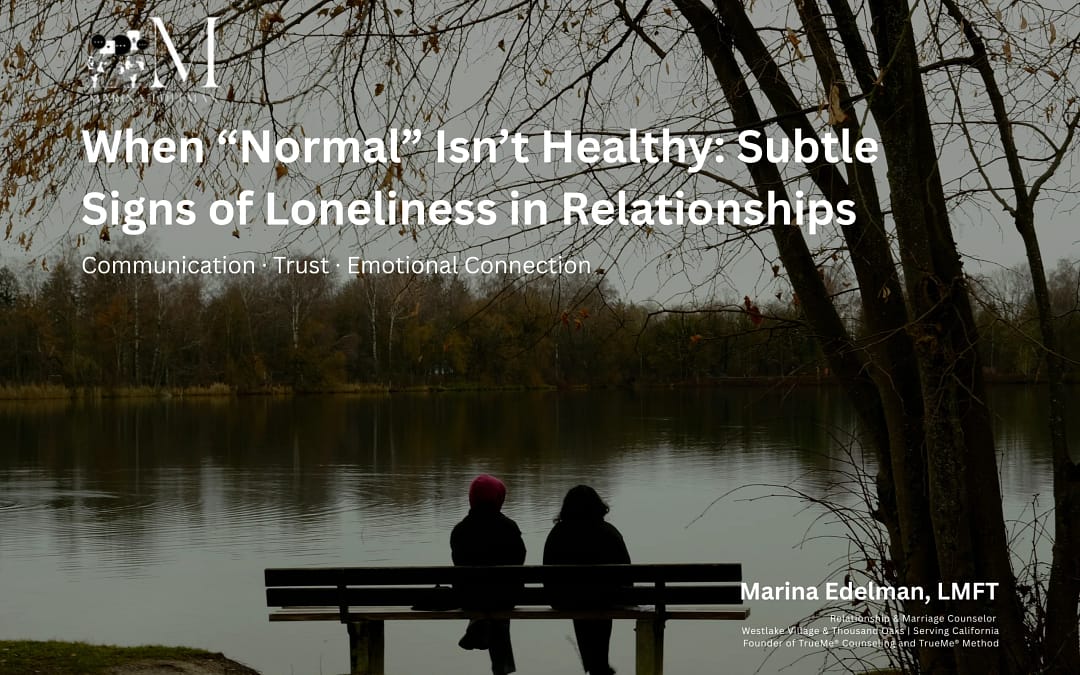
When “Normal” Isn’t Healthy: Subtle Signs of Loneliness in Relationships
Sharing a life with someone doesn't protect you from loneliness — sometimes it makes it harder to name.
Loneliness in romantic relationships is one of the most misunderstood forms of disconnection. It rarely presents as dramatic conflict or obvious dissatisfaction. More often, it emerges quietly—embedded in patterns couples gradually come to accept as “normal.”
In my work as a couples therapist in Westlake Village and Thousand Oaks, I often meet couples who describe their relationship as stable, even functional. Yet beneath that stability is a persistent sense of emotional absence—of not being fully seen, known, or responded to by their partner.
This kind of loneliness is not about physical presence. It is about emotional attunement.
What Loneliness in a Relationship Actually Means
From an attachment perspective, humans are wired for connection—not just proximity, but responsiveness.
Emotional loneliness develops when:
bids for connection are missed or dismissed
vulnerability is not met with engagement
emotional experiences go unacknowledged
Over time, the nervous system begins to interpret the relationship as emotionally unsafe—not in a dramatic sense, but in a chronic, low-grade way.
From an attachment perspective, humans are wired for connection—not just proximity, but responsiveness.
Emotional loneliness develops when:
bids for connection are missed or dismissed
vulnerability is not met with engagement
emotional experiences go unacknowledged
Over time, the nervous system begins to interpret the relationship as emotionally unsafe—not in a dramatic sense, but in a chronic, low-grade way.
The Subtle Behaviors That Signal Disconnection and Loneliness
These patterns are often minimized because they do not appear overtly harmful. Yet they are highly predictive of long-term relational dissatisfaction.
w
1. Conversations Become Transactional
Communication shifts toward logistics—schedules, responsibilities, tasks—while emotional dialogue fades.
+
2. Reduced Turning Toward
Partners stop bringing emotional experiences to each other, a concept identified in Gottman research as critical to connection.
3. Increased Reliance on Distraction
Phones, work, or external engagements begin to replace relational interaction—not consciously, but adaptively.
4. Diminished Physical Affection
Touch becomes less frequent and less emotionally meaningful.
~
5. Irritability or Emotional Withdrawal
Loneliness often manifests as frustration, not sadness, leading to misinterpretation between partners.
6. A Shift Toward “Roommate” Dynamics
The relationship continues functionally, but lacks emotional intimacy.
Why Couples Normalize These Patterns
Humans adapt quickly. When emotional disconnection develops gradually, couples often recalibrate their expectations rather than addressing the change.
This is how loneliness becomes embedded—not through crisis, but through accommodation.
The Psychological Impact of Chronic Disconnection
Over time, emotional loneliness can lead to:
increased anxiety or avoidance within the relationship
diminished sense of relational security
vulnerability to external emotional attachments
long-term erosion of satisfaction
Rebuilding Emotional Connection
Reconnection requires more than increased time together. It requires:
renewed emotional responsiveness
intentional engagement with vulnerability
consistent repair of missed connection moments
In Emotionally Focused Therapy (EFT), this process involves identifying and restructuring the emotional patterns that maintain disconnection.
Marina Edelman is a Licensed Marriage and Family Therapist and the founder of TrueMe® Counseling, a couples and relationship therapy practice serving clients in Westlake Village, Thousand Oaks, and throughout California.
Marina specializes in couples therapy, affair recovery, and relationship repair, drawing on a carefully integrated set of evidence-based approaches:
Gottman Method — Research-based tools for reducing conflict and building friendship and intimacy
AEDP — Processing deep emotional wounds with compassion and precision
Her counseling is best suited for couples and individuals seeking structured, research-backed support for relationship repair, affair recovery, anxiety, communication challenges, and premarital or marriage counseling — in person or via telehealth across California.
As a Founder of TrueMe Counseling, Marina proudly works with the following therapists with additional specialties:
These therapists see clients in Culver City, and Westlake Village Office as well as virtually all throughout California.
Cheryl Baldi, LMFT
Individuals | Grief | Families | Trauma
Cheryl Baldi is a Licensed Marriage and Family Therapist with a Master's Degree in Clinical Psychology who works with individuals, couples, and families in a warm, empathetic, and collaborative environment.
Specializations: Anxiety, depression, grief, trauma, hopelessness, and family systems.
Best suited for: Individuals who feel stuck in unhealthy patterns and are looking for a compassionate, strengths-based therapist to help them build practical tools and reclaim a more peaceful life.
Dr. Rachel Chistyakov, PsyD, LMFT
Trauma | Kids & Teens | Families
Dr. Rachel Chistyakov brings both doctoral-level training in psychology and LMFT licensure to her work with couples, families, children, and individuals. Her practice centers on healing, connection, and emotional insight.
Specializations: Trauma, PTSD, anxiety, depression, family therapy, and specialized work with children and teenagers.
Best suited for: Individuals and families seeking a highly credentialed therapist with broad clinical range, including parents looking for specialized support for children and adolescents.
Chris Calandra, AMFT
Individuals | Men's Issues | Substance Abuse
Chris Calandra is an Associate Marriage and Family Therapist offering grounded, non-judgmental support to individuals and couples navigating anxiety, relationship tension, addiction, and feeling stuck.
Specializations: Anxiety, substance use and addiction, relationship issues, and men's mental health.
Best suited for: Individuals who want direct, down-to-earth support and are ready to do meaningful work. Particularly well-suited for men who may be approaching therapy for the first time.
Frequently Asked Questions About Couples Therapy
Explore answers to frequently asked questions about the benefits and processes of couples therapy.
What issues can couples therapy help with?
Couples therapy can help with communication issues, emotional disconnection, infidelity, and conflict patterns.
Is online therapy effective?
Yes—research shows online therapy can be just as effective as in-person sessions for many couples.
What approach do you use?
I integrate Emotionally Focused Therapy (EFT) and the Gottman Method, both research-backed approaches.
Loneliness in relationships is not a sign that something is irreparably broken. It is a signal that connection has been disrupted—and that repair is possible.
If your relationship feels emotionally distant, therapy can help you understand why—and guide you in rebuilding connection.
Learn more or schedule a consultation at MarinaEdelman.com
Best Couples Therapists in Westlake Village & Thousand Oaks
Healthy relationships require communication, trust, and emotional connection. Even strong couples can experience periods of conflict, stress, or disconnection due to life transitions, parenting pressures, financial concerns, or unresolved emotional patterns.
Working with a qualified couples therapist can help partners develop healthier communication skills, rebuild emotional intimacy, and better understand the underlying dynamics that influence their relationship.
The Westlake Village and Thousand Oaks area has several experienced therapists who specialize in couples counseling and relationship therapy. The professionals listed below represent a range of therapeutic approaches and specialties.
Marina Edelman, founder of TrueMe® Counseling, is a licensed Marriage and Family Therapist with more than 20 years of experience working with couples, individuals, and families. Her practice focuses on helping clients build happiness, harmony, resilience, and stronger emotional connection within relationships.
She offers both in-person sessions in the Westlake Village / Thousand Oaks area as well as online therapy, allowing clients throughout California to access support.
Marina works with couples experiencing a wide range of relationship concerns, including:
Interpersonal relationships
Financial infidelity or financial stress
Communication difficulties
Emotional disconnection
Intimacy concerns
Life transitions affecting relationships
Premarital counseling
Her clinical approach integrates several well-established evidence-based therapies.
Emotionally Focused Therapy (EFT)
Emotionally Focused Therapy is one of the most widely studied approaches to couples therapy. The American Psychological Association has recognized EFT as a gold-standard evidence-based treatment for relationship distress.
Research has shown that 70–75% of couples move from distress to recovery, and approximately 90% experience meaningful improvements in relationship satisfaction.
EFT focuses on identifying emotional patterns that contribute to conflict and helping partners develop stronger emotional bonds and attachment security.
Gottman Method Couples Therapy
Marina also uses the Gottman Method, a research-based framework developed from more than 40 years of research with thousands of couples.
Key goals of the Gottman Method include:
Reducing negative communication cycles
Increasing emotional and physical intimacy
Addressing underlying sources of conflict
Building empathy, trust, and mutual understanding
Couples in therapy often complete a brief online relationship assessment before beginning sessions. This helps identify specific relationship strengths and areas that may need attention, allowing therapy to be more focused and effective.
Marina also offers workshops based on the Gottman 7 Principles for Making Marriage Work, which provide couples with practical skills to strengthen communication and emotional connection.
Individual and Family Therapy
In addition to couples therapy, Marina works with individuals experiencing:
Anxiety
Depression
Career or life transitions
Co-parenting challenges and divorce adjustment
For these concerns, she frequently incorporates Cognitive Behavioral Therapy (CBT), which helps clients recognize unhelpful thought patterns and develop healthier coping strategies.
Her approach to therapy is collaborative and supportive, creating a space where clients can communicate openly, increase self-awareness, and work toward meaningful personal and relational growth.
Nicole Barkhordari is a licensed marriage and family therapist who specializes in relationship counseling and intimacy issues. Her practice focuses on helping couples navigate challenges related to communication, sexual compatibility, and life transitions.
Areas of focus often include:
Premarital counseling
Couples communication difficulties
Sexual health and intimacy
Relationship transitions and growth
Her work integrates elements of attachment theory and modern relationship psychology to help couples develop stronger emotional and physical connection.
Ashley Prechtl is a licensed therapist who works with couples, families, and individuals seeking to improve relational dynamics and emotional well-being.
Her therapy approach often incorporates:
Attachment-based therapy
Emotional regulation techniques
Communication skill development
Relationship pattern awareness
Her goal is to help couples better understand their relational patterns while building healthier and more supportive partnerships.
Julie Norvilas works with couples who want to improve emotional communication and create healthier relationship dynamics.
Her work focuses on helping couples:
Identify recurring relationship patterns
Develop more effective communication strategies
Improve emotional awareness within partnerships
She often uses collaborative therapy approaches that help partners understand how personal history and emotional experiences influence current relationship patterns.
How to Choose the Right Therapist:
5 Questions to Ask
Choosing a therapist is a personal decision, and the right fit can make a meaningful difference in the outcome of therapy. Many people begin their search feeling unsure about what to look for, especially when comparing different therapists or treatment approaches.
Below are five commonly recommended questions to consider when looking for a therapist.
1. What Are the Therapist’s Credentials and Training?
One of the first things to review is a therapist’s professional credentials and training. Licensed professionals such as Marriage and Family Therapists (MFTs), psychologists, or licensed clinical social workers complete extensive clinical training and supervised experience before practicing independently.
Specialized certifications can also provide insight into a therapist’s expertise. For example, therapists who work with couples may have training in approaches such as Emotionally Focused Therapy (EFT) or the Gottman Method, which are widely used in relationship counseling.
2. What Therapy Approach Do They Use?
Different therapists use different clinical approaches. Some focus on structured methods that address thinking patterns and behaviors, while others emphasize emotional processing or relationship dynamics.
Examples include:
– Cognitive Behavioral Therapy (CBT) – helps identify and change unhelpful thought patterns and behaviorsGottman Method — Couples Therapy – research-based techniques for improving communication and resolving conflict
– Emotionally Focused Therapy (EFT) – focuses on emotional connection and attachment patterns in relationships
Understanding a therapist’s approach can help clients decide whether the style aligns with their goals.
3. Do They Have Experience With Your Specific Concerns?
Therapists often specialize in certain areas, such as:
– Relationship and marital conflict
– Anxiety and depression
– Divorce or co-parenting concerns
– Family dynamics or parenting challenges
– Trauma and early life experiences
Choosing a therapist with experience in the issues you are facing can make therapy more focused and effective.
4. What Is the Therapist’s Style?
Some therapists are highly structured and goal-oriented, while others emphasize open exploration and emotional insight.
It can be helpful to ask:
– How do therapists help clients measure progress?
– Are sessions structured or conversational?
– How collaborative are sessions?
A good therapeutic relationship often depends on feeling comfortable, supported, and understood.
5. Do You Feel Comfortable Talking With Them?
Research consistently shows that the therapeutic relationship itself is one of the strongest predictors of successful therapy outcomes. Feeling safe, heard, and respected can make it easier to discuss difficult topics and work toward meaningful change.
Many therapists offer an initial consultation or introductory session so clients can determine whether the fit feels right.
Therapy Options Today:
Online, In-Person, or Messaging Therapy
Over the past decade, therapy has expanded beyond traditional office visits. Many therapists now offer multiple ways to receive support, including in-person sessions, video therapy, and text-based therapy platforms.
Each format has advantages depending on a person’s schedule, comfort level, and therapeutic goals.
In-Person Therapy
Traditional in-office therapy allows clients to meet face-to-face with a therapist in a private office setting.
Benefits often include:
Stronger nonverbal communication and body language cues
A dedicated space for reflection away from daily distractions
A structured environment that helps some people focus more deeply on therapy
For individuals who prefer a more personal interaction, face-to-face therapy can feel more engaging and emotionally connected.
Some research also suggests that in-person therapy may be especially helpful for complex psychological concerns that benefit from deeper interpersonal interaction.
Online (Video) Therapy
Online therapy—sometimes called teletherapy—allows clients to meet with a therapist through secure video platforms.
This format has grown significantly in recent years because of its convenience and accessibility.
Benefits often include:
Attending therapy from home
Easier scheduling for busy professionals or parents
Access to therapists who may not be located nearby
Research has found that video-based psychotherapy can produce outcomes similar to in-person therapy for many mental health conditions, including anxiety and depression.
Online therapy can also reduce barriers such as travel time, transportation costs, or childcare challenges.
Messaging or Chat-Based Therapy
Some digital therapy platforms allow clients to communicate with therapists through text messaging or asynchronous chat.
These services are sometimes used by people who prefer a more flexible way to communicate about emotional challenges.
Potential benefits include:
The ability to write messages at any time
More time to reflect before responding
A lower barrier for people who may feel uncomfortable speaking about sensitive issues initially
However, messaging therapy may not provide the same level of real-time interaction as video or in-person therapy, which is why many clinicians recommend it as a supplement rather than a replacement for traditional sessions.
Choosing the Format That Works Best for You
Ultimately, the best therapy format depends on personal preference, lifestyle, and therapeutic goals.
Some clients prefer the structure of in-person sessions, while others appreciate the convenience of online therapy. Many therapists now offer both options, allowing clients to choose the format that feels most comfortable and supportive.
The most important factor is finding a therapist with whom you feel safe, understood, and motivated to work toward positive change.
About the author
Marina Edelman, LMFT
Marina Edelman is a Licensed Marriage and Family Therapist and the founder of TrueMe® Counseling, a couples and relationship therapy practice serving clients in Westlake Village, Thousand Oaks, and throughout California.
Marina specializes in couples therapy, affair recovery, and relationship repair, drawing on a carefully integrated set of evidence-based approaches:
Gottman Method — Research-based tools for reducing conflict and building friendship and intimacy
AEDP — Processing deep emotional wounds with compassion and precision
Her counseling is best suited for couples and individuals seeking structured, research-backed support for relationship repair, affair recovery, anxiety, communication challenges, and premarital or marriage counseling — in person or via telehealth across California.
When boundaries in a friendship or professional relationship begin to blur, emotional risk to your committed partnership emerges long before any physical lines are crossed. Recognizing the early signs that a boundary crossing might escalate into an affair is essential...
After a cheating incident, when partners are trapped in a cycle of rage and emotional withdrawal, the right couples therapist can dramatically shift the outlook for healing and future connection. In situations where one partner is openly angry while the other...
In any committed relationship, distinguishing between genuine close friendship and an emotional affair is critical for maintaining trust and emotional security.
When boundaries in a friendship or professional relationship begin to blur, emotional risk to your committed partnership emerges long before any physical lines are crossed. Recognizing the early signs that a boundary crossing might escalate into an affair is essential...
After a cheating incident, when partners are trapped in a cycle of rage and emotional withdrawal, the right couples therapist can dramatically shift the outlook for healing and future connection. In situations where one partner is openly angry while the other...
In any committed relationship, distinguishing between genuine close friendship and an emotional affair is critical for maintaining trust and emotional security.
What types of relationship issues can couples therapy help with?
Couples therapy can address a wide range of concerns, including communication difficulties, emotional disconnection, intimacy issues, financial stress or financial infidelity, life transitions, and premarital counseling. A skilled therapist helps partners identify the underlying patterns driving conflict and build stronger emotional connection.
What is Emotionally Focused Therapy (EFT), and why is it recommended for couples?
EFT is one of the most rigorously studied approaches to couples therapy and is recognized by the American Psychological Association as a gold-standard evidence-based treatment. Research shows that 70–75% of couples move from distress to recovery using this method, with approximately 90% experiencing meaningful improvements in relationship satisfaction. It works by helping partners identify emotional cycles that fuel conflict and rebuild secure attachment.
How do I choose the right couples therapist for me?
Start by reviewing a therapist’s credentials, specialized training, and clinical approach. Consider whether they have experience with your specific concerns, and pay attention to their style — some therapists are structured and goal-oriented, while others are more exploratory. Most importantly, trust how you feel in that first conversation. Research consistently shows that the quality of the therapeutic relationship is one of the strongest predictors of successful outcomes.
Is online couples therapy as effective as in-person sessions?
For many couples, yes. Research has found that video-based therapy produces outcomes comparable to in-person therapy for a wide range of concerns. Online therapy also removes common barriers like commute time, scheduling conflicts, and childcare challenges — making it easier for busy couples to stay consistent with sessions.
What should couples expect before starting therapy?
Many therapists recommend completing a brief relationship assessment before the first session. This helps identify specific strengths and areas of concern, so therapy can be more focused and effective from the start. Some therapists also offer workshops — such as those based on the Gottman 7 Principles — as a complement to individual sessions, giving couples practical tools to apply between appointments.
Ready to Transform Your Relationship?
Schedule a consultation today to discover how our therapy can help you and your partner build a healthier, more fulfilling relationship.
Explore the underlying reasons why even the most loving relationship can face difficulties, and discover how professional guidance can help navigate these challenges.
You still love each other. That has never really been the question. And yet somewhere along the way, conversations started ending in frustration. Silences grew longer. You stopped reaching for each other the way you used to. Now you find yourselves living side by side, wondering how two people who care so deeply can feel so far apart.
This is one of the most painful — and most common — experiences that bring couples to therapy. Not hatred. Not indifference. Love that is very much still present, but somehow no longer enough to bridge the growing distance.
If this sounds familiar, you are not alone. As a couples therapist in Westlake Village, I work with couples every week who are stuck in exactly this place. They are not bad partners. They are not failing. They are caught in patterns that, without the right support, have a quiet but powerful way of eroding even the strongest relationships over time.
Understanding why good relationships break down — despite real love — is the first step toward changing the pattern. In this article, I walk through the three most common dynamics I see in couples therapy, and what it looks like to actually move through them.
The Three Patterns That Quietly Erode Good Relationships
1. Communication Breakdown: When Talking Makes Things Worse
Most couples who come to therapy don’t have a shortage of conversations. They have a shortage of conversations that work.
What I see consistently in my work as a couples therapist is that communication breakdown rarely looks like two people refusing to talk. More often, it looks like two people trying very hard to be heard — and consistently failing to feel understood.
Over time, couples develop what researchers at The Gottman Institute call negative sentiment override: a state in which past hurts and frustrations color how partners interpret each other’s words and intentions, even when those words are neutral or even kind. A simple question like “Did you call the plumber?” gets heard as criticism. A gentle suggestion becomes an attack. Both partners are genuinely trying — and yet every conversation seems to end the same way.
This is not a character flaw. It is a pattern. And patterns can be changed.
In couples therapy using the Gottman Method, one of the first areas of focus is helping couples identify the specific ways their communication has gone off track — the Four Horsemen that predict relationship decline (criticism, contempt, defensiveness, and stonewalling) — and replacing those patterns with tools for softer start-ups, repair attempts, and genuine dialogue.
The goal is not to eliminate conflict. Conflict is a healthy and necessary part of any close relationship. The goal is to make conflict productive — something that brings you closer rather than driving you further apart.
2. Emotional Disconnection: The Distance That Grows in Silence
Of all the patterns I see in couples therapy, emotional disconnection may be the most quietly devastating — precisely because it rarely announces itself.
It does not arrive with a dramatic fight or a clear turning point. It builds slowly, over months or years, as small bids for connection go unnoticed. A hand reached for and not taken. A worry mentioned in passing and not followed up on. A moment of tenderness that felt too risky to express.
Dr. Sue Johnson, the developer of Emotionally Focused Therapy (EFT), describes this as an attachment injury — the cumulative effect of moments in which one or both partners began to feel emotionally unsafe reaching toward the other. Over time, both partners pull back. The relationship begins to feel more like a functional partnership than an intimate bond.
What makes this pattern particularly difficult is that it can coexist with a great deal of genuine love. Partners who are emotionally disconnected often describe still caring deeply for each other. What has been lost is not the feeling — it is the expression of it. The reaching. The risk.
In EFT-informed couples therapy, we work to identify the underlying emotions that have been buried beneath the surface conflict or distance — fear, longing, grief, the desire to matter — and create the conditions in which both partners can begin to reach toward each other again with some degree of safety.
This is slow, careful work. But it is some of the most meaningful work I do.
3. Unresolved Resentment: The Weight of Everything That Was Never Said
Resentment is what happens when hurt goes unaddressed long enough.
It is rarely the result of one large event. More often, it accumulates quietly — a series of moments in which one partner felt dismissed, unseen, overburdened, or taken for granted, and chose (or felt unable) to say so. Over time, those unspoken grievances calcify into something harder: a running mental tally, a reflexive brace for disappointment, a protective pulling-away that can look, from the outside, like coldness or indifference.
In my work with couples in Westlake Village and throughout California, I find that resentment is often the presenting issue but rarely the root one. Beneath the resentment, there is almost always a story of unmet needs — connection, appreciation, fairness, safety — that never found language.
One of the most important things couples therapy can offer is a structured space to excavate that story. Not to relitigate old grievances, but to understand what they meant — what they said about each partner’s needs, fears, and deep longings in the relationship. When both partners can hear that story with curiosity rather than defensiveness, something often shifts.
Resentment does not require a villain. It requires understanding. And understanding, in a safe therapeutic space, is something that is genuinely possible — even for couples who have been carrying this weight for years.
Working Through These Patterns: What Couples Therapy Actually Looks Like
Understanding patterns is a starting point. Changing them is the work.
Insight alone is rarely enough. Changing deeply ingrained relationship patterns requires practice, repetition, and the support of a skilled therapist — especially in the moments when old habits pull hardest.
Effective couples therapy is not about refereeing arguments. It is a structured, evidence-based process with three clear goals:
Identifying the dynamics keeping a couple stuck
Understanding the emotional needs beneath those dynamics
Building new ways of relating that are more secure, more connected, and more resilient
This is the work Marina Edelman, LMFT does every day — and it is work she believes in deeply.
Love is rarely the problem.
The couples Marina sees in her Westlake Village therapy practice are not struggling because they stopped caring. They are struggling because they are human — caught in patterns of communication, disconnection, and unspoken hurt that, without the right support, have a way of quietly winning.
The good news: these patterns are not permanent. They are learned. And what is learned can be unlearned — with the right tools, the right space, and the right guide.
If you and your partner are loving each other but not quite reaching each other, couples therapy may be the most important investment you make in your relationship this year.
Marina Edelman, LMFT is a couples therapist serving Westlake Village, Thousand Oaks, and clients throughout California — in person and via telehealth.
Marina Edelman is a Licensed Marriage and Family Therapist and the founder of TrueMe® Counseling, a couples and relationship therapy practice serving clients in Westlake Village, Thousand Oaks, and throughout California.
Marina specializes in couples therapy, affair recovery, and relationship repair, drawing on a carefully integrated set of evidence-based approaches:
Gottman Method — Research-based tools for reducing conflict and building friendship and intimacy
AEDP — Processing deep emotional wounds with compassion and precision
Her counseling is best suited for couples and individuals seeking structured, research-backed support for relationship repair, affair recovery, anxiety, communication challenges, and premarital or marriage counseling — in person or via telehealth across California.
As a Founder of TrueMe Counseling, Marina proudly works with the following therapists with additional specialties:
These therapists see clients in Culver City, and Westlake Village Office as well as virtually all throughout California.
Cheryl Baldi, LMFT
Individuals | Grief | Families | Trauma
Cheryl Baldi is a Licensed Marriage and Family Therapist with a Master's Degree in Clinical Psychology who works with individuals, couples, and families in a warm, empathetic, and collaborative environment.
Specializations: Anxiety, depression, grief, trauma, hopelessness, and family systems.
Best suited for: Individuals who feel stuck in unhealthy patterns and are looking for a compassionate, strengths-based therapist to help them build practical tools and reclaim a more peaceful life.
Dr. Rachel Chistyakov, PsyD, LMFT
Trauma | Kids & Teens | Families
Dr. Rachel Chistyakov brings both doctoral-level training in psychology and LMFT licensure to her work with couples, families, children, and individuals. Her practice centers on healing, connection, and emotional insight.
Specializations: Trauma, PTSD, anxiety, depression, family therapy, and specialized work with children and teenagers.
Best suited for: Individuals and families seeking a highly credentialed therapist with broad clinical range, including parents looking for specialized support for children and adolescents.
Chris Calandra, AMFT
Individuals | Men's Issues | Substance Abuse
Chris Calandra is an Associate Marriage and Family Therapist offering grounded, non-judgmental support to individuals and couples navigating anxiety, relationship tension, addiction, and feeling stuck.
Specializations: Anxiety, substance use and addiction, relationship issues, and men's mental health.
Best suited for: Individuals who want direct, down-to-earth support and are ready to do meaningful work. Particularly well-suited for men who may be approaching therapy for the first time.
Your Questions Answered
Can couples therapy actually help if we still love each other but feel stuck?
Yes — and this is actually one of the most promising situations for couples therapy. When love is present but the relationship feels disconnected, it usually means the underlying bond is intact. The real issue is a set of learned patterns that are no longer serving the couple.
Marina Edelman, LMFT uses the Gottman Method — a research-based approach developed from over four decades of study on what makes relationships succeed or fail. It helps couples identify the specific negative patterns driving their conflict, replace them with healthier ways of communicating, and rebuild trust and emotional intimacy from the ground up. Rather than simply managing conflict, the Gottman Method works to strengthen the entire foundation of the relationship. Many couples find that therapy not only resolves the immediate struggle but deepens their connection in ways they hadn’t expected.
How do I know if communication breakdown is serious enough to need therapy?
If your conversations regularly end in frustration, withdrawal, or a sense of not being heard — and if attempts to “talk it out” seem to make things worse rather than better — those are meaningful signs that you’ve developed a negative communication pattern. You don’t need to be in crisis to benefit from couples therapy. The earlier these patterns are addressed, the easier they are to shift.
What causes emotional disconnection in long-term relationships?
Emotional disconnection typically builds gradually over time as small moments of missed connection accumulate. Busy schedules, unaddressed hurts, the weight of parenting or financial stress, and the natural evolution of life transitions can all contribute. It is rarely the result of one event or one person’s failure. It is usually a relational pattern — and, crucially, it is one that can be reversed with intentional, supported work.
Is resentment in a relationship a sign it's too late to repair?
Not at all. Resentment is painful, but it is also a signal — one that points toward unmet needs and unspoken feelings that have never had a proper hearing. In my experience as a couples therapist, resentment that is worked through with skilled support can actually become a turning point in a relationship. The key is creating enough safety for both partners to move from accusation to vulnerability.
How long does couples therapy typically take to see results?
Many couples notice meaningful shifts within 6 –12 sessions, though the full course of therapy varies depending on the complexity of the issues and both partners’ commitment to the process. Affair recovery and deep-rooted resentment may require a longer investment. Your therapist should offer a clear sense of goals and progress from early on in the work.
When boundaries in a friendship or professional relationship begin to blur, emotional risk to your committed partnership emerges long before any physical lines are crossed. Recognizing the early signs that a boundary crossing might escalate into an affair is essential...
After a cheating incident, when partners are trapped in a cycle of rage and emotional withdrawal, the right couples therapist can dramatically shift the outlook for healing and future connection. In situations where one partner is openly angry while the other...
In any committed relationship, distinguishing between genuine close friendship and an emotional affair is critical for maintaining trust and emotional security.
Ending a relationship is rarely a single moment of clarity. For most people, it’s a slow, quiet unraveling.
In my work as a relationship therapist in Southern California, I’ve seen this decision take shape long before it’s spoken out loud. It often starts with small, persistent feelings — feeling more at peace alone than with your partner, or noticing that every attempt at connection ends in tension, withdrawal, or silence.
Over time, many people begin confusing emotional exhaustion with commitment. Carrying the relationship becomes the relationship.
One thing I tell my clients often: you are not just choosing a person — you are choosing the emotional environment you live inside every day. The safety, the communication, the stress, the support — all of it shapes your nervous system, your sense of self, and your wellbeing over time.
If ending a relationship has been crossing your mind more than once, that thought deserves your attention. The signs below may help you understand why.
1. Communication Feels Strained—and Never Improves
Every couple argues. Healthy couples repair.
If most conversations turn into defensiveness, shutdowns, sarcasm, or walking on eggshells, the issue usually isn’t the topic—it’s emotional safety.
When you stop feeling heard or understood, emotional distance grows. Over time, that distance turns into loneliness, even when you’re together.
In long-term relationships, unresolved communication patterns rarely fix themselves without intentional effort and accountability.
2. The Relationship Feels Transactional Instead of Connected
A healthy relationship doesn’t feel like a running scorecard.
If your dynamic has shifted into:
“I did this, so you should do that”
Love and care only showing up when things are convenient
Managing responsibilities more than building intimacy
…connection starts to fade.
Stability can be beautiful. Emotional emptiness is not.
3. You Feel Drained More Than You Feel Supported
Your partner doesn’t need to complete you—but they should add something meaningful to your life.
If being with them consistently leaves you feeling:
Anxious
Emotionally depleted
Smaller or less like yourself
That’s important information.
One of the clearest signs a relationship may be failing is feeling relief when your partner isn’t around.
Your nervous system often recognizes misalignment long before your mind does.
4. You Catch Yourself Missing Single Life (Not for Dating—For Peace)
This isn’t always about wanting someone else.
Often, it’s about missing:
Calm
Independence
Emotional lightness
Feeling like yourself again
If being alone sounds more peaceful than being in the relationship, that’s a signal worth listening to.
5. There’s No Real Desire to Solve the Problems
Every long-term relationship faces difficult seasons. What matters is willingness.
If one—or both—of you has stopped trying to:
Understand each other
Repair conflict
Change repeating patterns
The relationship may be running on hope instead of effort.
Relationship longevity cannot survive without accountability.
6. Your Core Values Don’t Actually Align
Chemistry can be powerful, but it won’t carry a relationship through real life.
Misalignment around:
Children
Lifestyle
Commitment
Money
Emotional needs
doesn’t fade with time—it usually deepens.
True compatibility is about shared direction, not just shared feelings.
7. You Can’t Picture a Future With Them Anymore
This sign is quiet, but significant.
You may notice:
A lack of excitement about planning ahead
A sense of heaviness or emotional numbness
Forcing a future vision out of fear of starting over
Sometimes it shows up simply: You plan trips, goals, or even weekends—and you no longer naturally include them.
Deep down, you already know: This isn’t the future you want to live inside.
What to Do Next (Before You Decide on Ending a Relationship)
If you’re unsure whether to stay or go, don’t rush—but don’t avoid it either.
Get honest with yourself
Journal or voice-note the truth without debating it:
What am I staying for?
What am I afraid of?
What do I actually want?
Look for patterns, not moments
One hard week isn’t your relationship. A repeated cycle over months or years is data.
Have a real conversation—not a breakup threat
Try saying: “I feel disconnected, and I need us to take this seriously. Are you willing to work on it with me?”
The response matters more than the words.
Consider relationship support
Individual or couples work isn’t about “fixing” things at all costs—it’s about gaining clarity, emotional regulation, and self-trust.
A Gentle Reminder From a Relationship Expert About Ending a Relationship
You don’t need a dramatic reason to leave. You don’t need a villain. You don’t need permission.
Sometimes the most honest reason is simply this: It isn’t working anymore.
Choosing to move on doesn’t mean you failed. It means you stopped abandoning yourself.
If you’re navigating relationship uncertainty and want support, I work with individuals and couples in Thousand Oaks and throughout California to help them find clarity, emotional safety, and grounded decision-making.
Frequently Asked Questions About Ending a Relationship
How do I choose between ending a relationship or working on it?
If problems are persistent, emotional safety is low, and there is little willingness to repair or change patterns, it may be time to consider ending the relationship. If both partners are open to accountability and effort, working on it may still be possible.
When should I seek a relationship expert instead of couples therapy?
A relationship expert can be helpful when you need clarity, emotional regulation, or support making a decision—especially if your partner is unwilling or unavailable to participate in couples therapy.
Can relationship support help even if my partner won’t change?
Yes. Relationship work often focuses on helping you gain clarity, set boundaries, and understand your attachment patterns—regardless of whether your partner changes.
How long should I try before deciding on ending a relationship?
There’s no universal timeline. What matters most is whether unhealthy patterns are repeating over time and whether meaningful effort and accountability are present on both sides.
About the Author
I’m a relationship expert based in Westlake Village California, specializing in relationship clarity, emotional safety, communication patterns, and attachment dynamics. I work with individuals and couples across California who are navigating uncertainty, disconnection, and major relationship decisions. To learn more please visit my website www.MarinaEdelman.com or book an appointment.
Toxic family dynamics have a way of making the invisible visible — and nothing exposes them faster than money. In my work as a Marriage and Family Therapist, I’ve seen financial conflict reveal patterns that had been quietly building for years — resentment, control, unspoken loyalties, and boundaries that were never allowed to exist.
I recently worked with a client carrying the weight of a family financial crisis that taught me something worth sharing: sometimes the most painful thing a toxic family system does is force you to finally see it clearly.
And sometimes, the healthiest thing you can do with that clarity is accept it — and let certain people resign from their role in your life.
How Toxic Family Members Resign Without Saying a Word
In one particularly powerful session, I introduced a concept that seemed to resonate deeply: viewing a toxic family member’s behavior not as abandonment or betrayal, but as a resignation. Just as someone might quit a job, a parent can effectively resign from their parental role through their actions and choices.
This reframing isn’t about excusing harmful behavior. It’s about creating psychological distance that allows you to stop fighting against a reality you cannot change.
When my client expressed ongoing rage at her mother’s favoritism and financial manipulation — both hallmarks of a toxic family dynamic — I suggested: “She’s resigned. She’s quit the job of being your mom.”
This framework allows you to:
Stop seeking validation or fairness from a toxic family member who cannot provide it
Release yourself from expectations that will never be met
Accept the relationship for what it actually is, not what you wish it would be
How Toxic Family Systems Use Money as Control
One of the most revealing aspects of toxic family dynamics is how money gets weaponized. People within these systems often have fundamentally different relationships with money — and those differences become tools of power.
Some toxic family members operate on what I call a “negotiation-as-lifestyle” approach. They strategically delay payments to gain leverage, view financial maneuvering as a form of dominance, experience satisfaction from “winning” at others’ expense, and treat honesty in financial dealings as weakness.
For someone who values security and straightforward communication, this can feel deeply wrong — even abusive. Understanding that it operates as a psychological framework within the toxic family system — not just a personality quirk — can help you navigate it more effectively.
The Toxic Family Comparison Trap
Many people caught inside a toxic family system struggle with the belief that their choices are objectively better or healthier than a sibling’s. They can’t understand how someone can live differently and not feel the same distress.
Here’s what years of financial therapy have taught me: what creates stress for you may not create stress for someone shaped by a different family experience. The healthiest financial lifestyle is the one that causes you the least amount of stress while aligning with your values.
The problem arises when these different approaches collide within a toxic family system — especially when money is shared, inherited, or used as a bargaining chip.
Compartmentalization: A Survival Tool
When you can’t cut toxic family members out entirely but recognize fundamental incompatibilities, compartmentalization becomes essential. Think of it like a prenuptial agreement — you can maintain a relationship while also protecting yourself legally and financially.
When navigating a toxic family system, I advise clients to:
Separate the familial relationship from the financial one — a family member can be your sibling in one context and an unreliable financial partner in another
Stop acting as the family rescuer or spokesperson — each adult must navigate their own relationship with the family dynamic
Focus only on what is within your control — pursue what is legally yours, and release responsibility for others’ choices
When Narcissism Drives the Money Dynamic
Toxic family systems with narcissistic dynamics almost always use money as a mechanism of control. The patterns are consistent:
Creating financial dependence to maintain power over family members
Playing favorites to keep the hierarchy intact
Using money to punish anyone who pursues independence
Gaslighting about financial history, agreements, and facts
In these family systems, the most independent child — often labeled the “scapegoat” — faces a painful paradox: criticized for not helping enough, yet excluded from every real decision.
The Hardest Skill: Doing Nothing
At the end of our session, my client asked: “So I just do nothing?”
Yes. And inside a toxic family system, that is one of the hardest things you will ever do.
Doing nothing means:
Not spending emotional energy trying to change toxic family members who will not change
Not inserting yourself as mediator in conflicts that were never yours to resolve
Not chasing fairness from a system that was never designed to be fair
Pursuing your legal and financial interests while releasing the emotional hooks
Moving Forward After a Toxic Family Dynamic
If you recognize your own situation in this post, ask yourself:
Am I trying to force a toxic family member to show up in a way they have already proven they cannot?
Am I mistaking a different relationship with money for a moral failing rather than a toxic family pattern?
Can I separate the financial reality of my family from the emotional one?
What am I trying to control that was never actually within my control?
The goal is not to become cold or completely detached. It is to develop what I call informed detachment — understanding the toxic family psychology at play while actively protecting your own wellbeing.
Sometimes the most loving thing you can do for yourself is accept someone’s resignation — and stop showing up for a job they already quit.
Marina Edelman, LMFT, specializes in financial therapy, helping individuals and couples navigate the complex intersection of money, toxic family dynamics, and emotional wellbeing. Her work has been featured in The Wall Street Journal and The Lilly. Connect: @marina.on.marriage
To provide the best experiences, we use technologies like cookies to store and/or access device information. Consenting to these technologies will allow us to process data such as browsing behavior or unique IDs on this site. Not consenting or withdrawing consent, may adversely affect certain features and functions.
Functional
Always active
The technical storage or access is strictly necessary for the legitimate purpose of enabling the use of a specific service explicitly requested by the subscriber or user, or for the sole purpose of carrying out the transmission of a communication over an electronic communications network.
Preferences
The technical storage or access is necessary for the legitimate purpose of storing preferences that are not requested by the subscriber or user.
Statistics
The technical storage or access that is used exclusively for statistical purposes.The technical storage or access that is used exclusively for anonymous statistical purposes. Without a subpoena, voluntary compliance on the part of your Internet Service Provider, or additional records from a third party, information stored or retrieved for this purpose alone cannot usually be used to identify you.
Marketing
The technical storage or access is required to create user profiles to send advertising, or to track the user on a website or across several websites for similar marketing purposes.