

Book Appointment


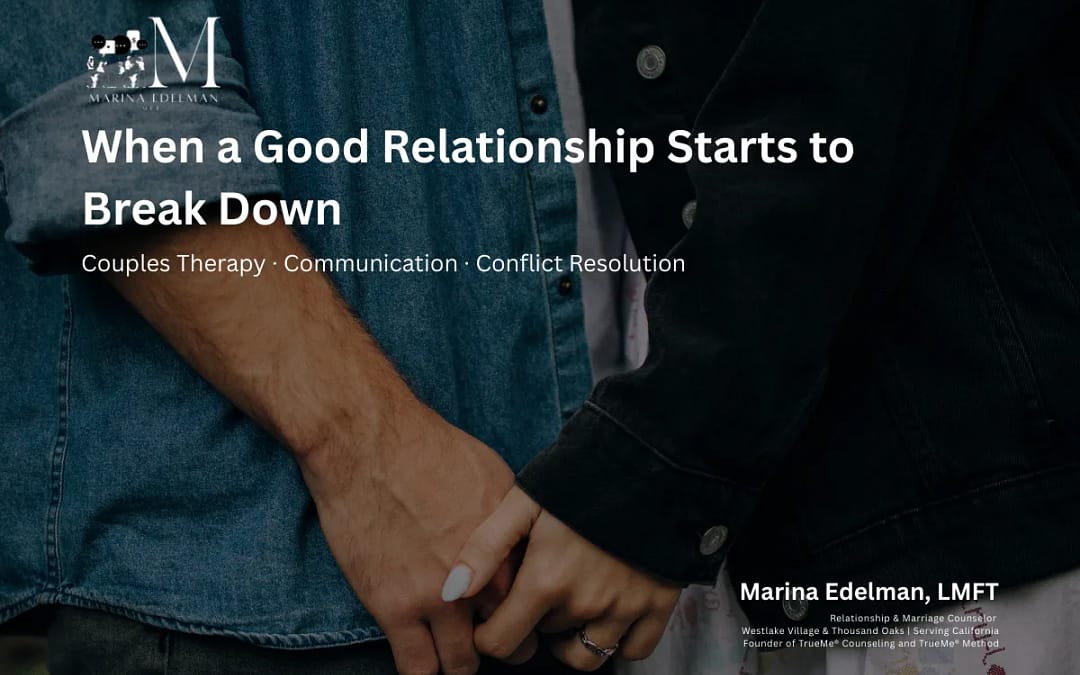
When a Good Relationship Starts to Break Down

When a Good Relationship Starts to Break Down

Understanding Relationship Challenges

When a Good Relationship Starts to Break Down

Explore the underlying reasons why even the most loving relationship can face difficulties, and discover how professional guidance can help navigate these challenges.

Reignite Your Connection Today

The Dynamics of Love and Challenges

You still love each other. That has never really been the question. And yet somewhere along the way, conversations started ending in frustration. Silences grew longer. You stopped reaching for each other the way you used to. Now you find yourselves living side by side, wondering how two people who care so deeply can feel so far apart.

This is one of the most painful — and most common — experiences that bring couples to therapy. Not hatred. Not indifference. Love that is very much still present, but somehow no longer enough to bridge the growing distance.

If this sounds familiar, you are not alone. As a couples therapist in Westlake Village, I work with couples every week who are stuck in exactly this place. They are not bad partners. They are not failing. They are caught in patterns that, without the right support, have a quiet but powerful way of eroding even the strongest relationships over time.

Understanding why good relationships break down — despite real love — is the first step toward changing the pattern. In this article, I walk through the three most common dynamics I see in couples therapy, and what it looks like to actually move through them.

The Three Patterns That Quietly Erode Good Relationships

1. Communication Breakdown: When Talking Makes Things Worse

Most couples who come to therapy don’t have a shortage of conversations. They have a shortage of conversations that work.

What I see consistently in my work as a couples therapist is that communication breakdown rarely looks like two people refusing to talk. More often, it looks like two people trying very hard to be heard — and consistently failing to feel understood.

Over time, couples develop what researchers at The Gottman Institute call negative sentiment override: a state in which past hurts and frustrations color how partners interpret each other’s words and intentions, even when those words are neutral or even kind. A simple question like “Did you call the plumber?” gets heard as criticism. A gentle suggestion becomes an attack. Both partners are genuinely trying — and yet every conversation seems to end the same way.

This is not a character flaw. It is a pattern. And patterns can be changed.

In couples therapy using the Gottman Method, one of the first areas of focus is helping couples identify the specific ways their communication has gone off track — the Four Horsemen that predict relationship decline (criticism, contempt, defensiveness, and stonewalling) — and replacing those patterns with tools for softer start-ups, repair attempts, and genuine dialogue.

The goal is not to eliminate conflict. Conflict is a healthy and necessary part of any close relationship. The goal is to make conflict productive — something that brings you closer rather than driving you further apart.

2. Emotional Disconnection: The Distance That Grows in Silence

Of all the patterns I see in couples therapy, emotional disconnection may be the most quietly devastating — precisely because it rarely announces itself.

It does not arrive with a dramatic fight or a clear turning point. It builds slowly, over months or years, as small bids for connection go unnoticed. A hand reached for and not taken. A worry mentioned in passing and not followed up on. A moment of tenderness that felt too risky to express.

Dr. Sue Johnson, the developer of Emotionally Focused Therapy (EFT), describes this as an attachment injury — the cumulative effect of moments in which one or both partners began to feel emotionally unsafe reaching toward the other. Over time, both partners pull back. The relationship begins to feel more like a functional partnership than an intimate bond.

What makes this pattern particularly difficult is that it can coexist with a great deal of genuine love. Partners who are emotionally disconnected often describe still caring deeply for each other. What has been lost is not the feeling — it is the expression of it. The reaching. The risk.

In EFT-informed couples therapy, we work to identify the underlying emotions that have been buried beneath the surface conflict or distance — fear, longing, grief, the desire to matter — and create the conditions in which both partners can begin to reach toward each other again with some degree of safety.

This is slow, careful work. But it is some of the most meaningful work I do.

3. Unresolved Resentment: The Weight of Everything That Was Never Said

Resentment is what happens when hurt goes unaddressed long enough.

It is rarely the result of one large event. More often, it accumulates quietly — a series of moments in which one partner felt dismissed, unseen, overburdened, or taken for granted, and chose (or felt unable) to say so. Over time, those unspoken grievances calcify into something harder: a running mental tally, a reflexive brace for disappointment, a protective pulling-away that can look, from the outside, like coldness or indifference.

In my work with couples in Westlake Village and throughout California, I find that resentment is often the presenting issue but rarely the root one. Beneath the resentment, there is almost always a story of unmet needs — connection, appreciation, fairness, safety — that never found language.

One of the most important things couples therapy can offer is a structured space to excavate that story. Not to relitigate old grievances, but to understand what they meant — what they said about each partner’s needs, fears, and deep longings in the relationship. When both partners can hear that story with curiosity rather than defensiveness, something often shifts.

Resentment does not require a villain. It requires understanding. And understanding, in a safe therapeutic space, is something that is genuinely possible — even for couples who have been carrying this weight for years.

Working Through These Patterns: What Couples Therapy Actually Looks Like

Understanding patterns is a starting point. Changing them is the work.

Insight alone is rarely enough. Changing deeply ingrained relationship patterns requires practice, repetition, and the support of a skilled therapist — especially in the moments when old habits pull hardest.

Effective couples therapy is not about refereeing arguments. It is a structured, evidence-based process with three clear goals:

  • Identifying the dynamics keeping a couple stuck
  • Understanding the emotional needs beneath those dynamics
  • Building new ways of relating that are more secure, more connected, and more resilient

This is the work Marina Edelman, LMFT does every day — and it is work she believes in deeply.

Love is rarely the problem.

The couples Marina sees in her Westlake Village therapy practice are not struggling because they stopped caring. They are struggling because they are human — caught in patterns of communication, disconnection, and unspoken hurt that, without the right support, have a way of quietly winning.

The good news: these patterns are not permanent. They are learned. And what is learned can be unlearned — with the right tools, the right space, and the right guide.

If you and your partner are loving each other but not quite reaching each other, couples therapy may be the most important investment you make in your relationship this year.

Marina Edelman, LMFT is a couples therapist serving Westlake Village, Thousand Oaks, and clients throughout California — in person and via telehealth.

To learn more or schedule a consultation: Book an Appointment | 818-851-1293

Marina Edelman, LMFT | Relationship & Marriage Counselor | Westlake Village & Thousand Oaks | Serving California. Founder of TrueMe® Counseling and TrueMe® Method

About the Author:

Couples Therapist in California

Marina Edelman is a Licensed Marriage and Family Therapist and the founder of TrueMe® Counseling, a couples and relationship therapy practice serving clients in Westlake Village, Thousand Oaks, and throughout California.

Marina specializes in couples therapy, affair recovery, and relationship repair, drawing on a carefully integrated set of evidence-based approaches:

Her counseling is best suited for couples and individuals seeking structured, research-backed support for relationship repair, affair recovery, anxiety, communication challenges, and premarital or marriage counseling — in person or via telehealth across California.

As a Founder of TrueMe Counseling, Marina proudly works with the following therapists with additional specialties:

These therapists see clients in Culver City, and Westlake Village Office as well as virtually all throughout California.

Cheryl Baldi, LMFT

Cheryl Baldi, LMFT

Individuals | Grief | Families | Trauma

Cheryl Baldi is a Licensed Marriage and Family Therapist with a Master’s Degree in Clinical Psychology who works with individuals, couples, and families in a warm, empathetic, and collaborative environment.

Specializations: Anxiety, depression, grief, trauma, hopelessness, and family systems.

Best suited for: Individuals who feel stuck in unhealthy patterns and are looking for a compassionate, strengths-based therapist to help them build practical tools and reclaim a more peaceful life.

Dr. Rachel Chistyakov, PsyD, LMFT

Dr. Rachel Chistyakov, PsyD, LMFT

Trauma | Kids & Teens | Families

Dr. Rachel Chistyakov brings both doctoral-level training in psychology and LMFT licensure to her work with couples, families, children, and individuals. Her practice centers on healing, connection, and emotional insight.

Specializations: Trauma, PTSD, anxiety, depression, family therapy, and specialized work with children and teenagers.

Best suited for: Individuals and families seeking a highly credentialed therapist with broad clinical range, including parents looking for specialized support for children and adolescents.

Chris Calandra, AMFT

Chris Calandra, AMFT

Individuals | Men's Issues | Substance Abuse

Chris Calandra is an Associate Marriage and Family Therapist offering grounded, non-judgmental support to individuals and couples navigating anxiety, relationship tension, addiction, and feeling stuck.

Specializations: Anxiety, substance use and addiction, relationship issues, and men’s mental health.

Best suited for: Individuals who want direct, down-to-earth support and are ready to do meaningful work. Particularly well-suited for men who may be approaching therapy for the first time.

Your Questions Answered

Can couples therapy actually help if we still love each other but feel stuck?
Yes — and this is actually one of the most promising situations for couples therapy. When love is present but the relationship feels disconnected, it usually means the underlying bond is intact. The real issue is a set of learned patterns that are no longer serving the couple.

Marina Edelman, LMFT uses the Gottman Method — a research-based approach developed from over four decades of study on what makes relationships succeed or fail. It helps couples identify the specific negative patterns driving their conflict, replace them with healthier ways of communicating, and rebuild trust and emotional intimacy from the ground up. Rather than simply managing conflict, the Gottman Method works to strengthen the entire foundation of the relationship. Many couples find that therapy not only resolves the immediate struggle but deepens their connection in ways they hadn’t expected.

How do I know if communication breakdown is serious enough to need therapy?

If your conversations regularly end in frustration, withdrawal, or a sense of not being heard — and if attempts to “talk it out” seem to make things worse rather than better — those are meaningful signs that you’ve developed a negative communication pattern. You don’t need to be in crisis to benefit from couples therapy. The earlier these patterns are addressed, the easier they are to shift.

What causes emotional disconnection in long-term relationships?
Emotional disconnection typically builds gradually over time as small moments of missed connection accumulate. Busy schedules, unaddressed hurts, the weight of parenting or financial stress, and the natural evolution of life transitions can all contribute. It is rarely the result of one event or one person’s failure. It is usually a relational pattern — and, crucially, it is one that can be reversed with intentional, supported work.
Is resentment in a relationship a sign it's too late to repair?
Not at all. Resentment is painful, but it is also a signal — one that points toward unmet needs and unspoken feelings that have never had a proper hearing. In my experience as a couples therapist, resentment that is worked through with skilled support can actually become a turning point in a relationship. The key is creating enough safety for both partners to move from accusation to vulnerability.
How long does couples therapy typically take to see results?
Many couples notice meaningful shifts within 6 –12 sessions, though the full course of therapy varies depending on the complexity of the issues and both partners’ commitment to the process. Affair recovery and deep-rooted resentment may require a longer investment. Your therapist should offer a clear sense of goals and progress from early on in the work.

Ready to Transform Your Relationship?

Schedule a consultation today to discover how our therapy can help you and your partner build a healthier, more fulfilling relationship.

When Family Financial Dynamics Become Toxic: A Therapist’s Perspective

When Family Financial Dynamics Become Toxic: A Therapist’s Perspective

When Family Financial Dynamics Become Toxic: A Therapist’s Perspective

As a Marriage and Family Therapist specializing in financial therapy, I’ve witnessed how money can become the battleground where family dysfunction plays out most visibly. Recently, I worked with a client navigating an extraordinarily complex family financial crisis that illuminated something crucial: sometimes the healthiest thing you can do is accept that someone has resigned from their role in your life.

The Resignation Framework

In one particularly powerful session, I introduced a concept that seemed to resonate deeply: viewing a parent’s behavior not as abandonment or betrayal, but as a resignation. Just as someone might quit a job, a parent can effectively resign from their parental role through their actions and choices.

This reframing isn’t about excusing harmful behavior. It’s about creating psychological distance that allows you to stop fighting against a reality you cannot change.

When my client expressed ongoing rage at her mother’s favoritism and financial manipulation, I suggested: “She’s resigned. She’s quit the job of being your mom.”

The beauty of this framework is that it allows you to:

  • Stop seeking validation or fairness from someone who cannot provide it
  • Release yourself from expectations that will never be met
  • Accept the relationship for what it actually is, not what you wish it would be

The Psychology of Money Relationships

One of the most fascinating aspects of financial therapy is recognizing that people have fundamentally different relationships with money—and these differences aren’t always pathological.

Some people operate on what I call a “negotiation-as-lifestyle” approach. They:

  • Strategically delay payments to negotiate better terms
  • View financial maneuvering as a skill to be proud of
  • Experience genuine joy from “winning” financial negotiations
  • See paying full price or on time as foolish when alternatives exist

For someone who values financial security and straightforward dealings, this approach can feel morally wrong, even abusive. But understanding that it’s a different psychological framework—not necessarily a mental illness—can help you navigate family dynamics more effectively.

The Comparison Trap

My client struggled intensely with the belief that her lifestyle choices were objectively “better” or “healthier” than her brother’s. She couldn’t understand how living on the financial edge could be anything but destructive.

Here’s what I’ve learned through years of financial therapy: what creates stress for you might not create stress for someone else.

The healthiest financial lifestyle is the one that causes you the least amount of stress while aligning with your values. For some, that’s having a substantial cushion and paying bills early. For others, it’s constant negotiation and strategic risk-taking.

The problem arises when these different approaches collide within a family system—especially when money is commingled or inheritances are involved.

Compartmentalization as a Survival Tool

When you can’t cut family members out entirely but recognize fundamental incompatibilities, compartmentalization becomes essential. Think of it like a prenuptial agreement in marriage: you can love someone while also protecting yourself legally and financially.

I advised my client to:

  1. Separate the familial relationship from the business/financial component – Your brother can be your brother in one context and a poor financial partner in another
  2. Stop being the family spokesperson or rescuer – Each adult sibling must navigate their own relationship with parents
  3. Focus on what’s within your control – Pursue legal remedies for money owed, but release responsibility for others’ choices

When Narcissistic Systems Meet Money

Family systems with narcissistic dynamics often use money as a control mechanism. The patterns include:

  • Creating dependence through strategic financial support
  • Playing favorites to maintain power
  • Using money to punish independence
  • Gaslighting about financial facts and history

In these systems, the “scapegoat” child—often the most independent one—faces unique challenges. They’re simultaneously criticized for not helping enough and excluded from family decision-making.

The Hardest Skill: Doing Nothing

At the end of our session, my client asked: “So I just do nothing?”

Yes. And it’s incredibly difficult.

“Doing nothing” doesn’t mean passivity. It means:

  • Not expending emotional energy trying to change people who won’t change
  • Not inserting yourself as mediator in sibling conflicts
  • Not seeking justice or fairness from a system designed to be unfair
  • Pursuing your legal and financial interests while releasing the emotional hooks

Moving Forward

If you’re in a similar situation, ask yourself:

  • Am I trying to force someone to be a parent/sibling/family member they’ve shown me they cannot be?
  • Am I confusing different relationships with money as moral failings rather than different approaches?
  • Can I separate the business/financial aspects of family from the relational aspects?
  • What am I actually trying to control that isn’t within my control?

The goal isn’t to become callous or cut off all feeling. It’s to develop what I call informed detachment—understanding the psychology at play while protecting your own wellbeing.

Sometimes the most loving thing you can do for yourself is accept someone’s resignation and stop showing up for a job they’ve already quit.


Marina Edelman, MFT, specializes in financial therapy, helping individuals and couples navigate the complex intersection of money, family, and emotional wellbeing. Her work has been featured in The Wall Street Journal and The Lilly.

Connect with me: @marina.on.marriage

Understanding Relationship Stages and Financial Boundaries: A Gottman-Informed Perspective

Understanding Relationship Stages and Financial Boundaries: A Gottman-Informed Perspective

As a Gottman-trained therapist, I often work with couples navigating the complex intersection of love languages, life stage differences, and financial expectations. One of the most challenging conversations partners face is aligning their values around money, gifts, and support—especially when those values differ significantly.


It’s Not About You: Understanding Love Languages

One of the most powerful shifts in relationship therapy happens when we move from “this isn’t how I do things” to “this is what my partner needs.” As I often remind clients: this isn’t about you—it’s about understanding who your partner is.

The Gottman Method teaches us that successful relationships require understanding and speaking your partner’s love language, even when it’s not your native tongue. For some people, gifts are a primary love language. For others, it’s quality time, words of affirmation, acts of service, or physical touch.

The key insight? You don’t have to share the same love language to love someone well. In fact, the most meaningful acts of love often come from giving what they need, not what you would want.


Relationship Stages Matter

Here’s a truth many people resist: the level of financial support and gift-giving should match the stage of your relationship.

Think about it this way:

  • The gift you give at a 1st anniversary is different from a 10th anniversary

  • The support you provide when dating is different from when you’re married

  • The commitment you make at 6 months differs from 6 years

This isn’t about being transactional—it’s about being intentional and appropriately boundaried. Just as you wouldn’t give the same level of emotional intimacy to someone you just met versus your spouse, financial support naturally scales with commitment level.


When Values Collide: Materialism vs. Minimalism

What happens when one partner values material expressions of love and the other doesn’t? This is where many relationships hit a wall.

The challenge: One partner may feel like the relationship is transactional or imbalanced, while the other feels unloved or unsupported.

The solution: Direct, compassionate communication about expectations and boundaries.


Setting Healthy Financial Boundaries

If you’re struggling with financial expectations in your relationship, consider this framework:

“What you’re asking for is not unreasonable, but I feel comfortable providing that when we’re at a different stage in our relationship.”

This statement accomplishes several things:

  • Validates your partner’s needs

  • Sets a clear boundary without judgment

  • Points to the future, keeping hope alive

  • Matches support to commitment level


The Subsidy vs. Gift Distinction

One of my clients recently said something profound: “It doesn’t feel like a gift—it feels like a subsidy.”

This is the heart of the matter. When gift-giving feels obligatory, transactional, or like you’re funding a lifestyle rather than expressing love, resentment builds quickly.

Signs you might be subsidizing rather than gifting:

  • Gifts are expected and specified, not spontaneous

  • There’s negotiation around what “counts” as enough

  • You feel more like an ATM than a partner

  • Reciprocity feels absent or imbalanced


Age and Stage: The Reality Check

Let’s be honest about age-gap relationships. Research shows that younger partners dating significantly older partners often (though not always) value financial stability as part of the attraction. This doesn’t make anyone a “gold digger”—it’s simply one factor among many.

Both can be true:

  • Your partner genuinely cares about you AND

  • They need/want financial support you can provide

The question isn’t whether this dynamic exists—it’s whether you’re comfortable with it and whether the relationship has enough other dimensions to sustain it.


Quality Time vs. Quality Things

For many people, the real currency of love isn’t cash—it’s companionship. If you’re someone who values quality time, acts of service, and emotional presence, being with a partner who primarily speaks the gift-giving language can feel deeply lonely.

Ask yourself:

  • Do you have enough quality time together?

  • Does your partner show up for you emotionally?

  • Is there reciprocity in effort and care?

  • Do you feel seen beyond what you can provide?

If the answer is consistently “no,” no amount of aligned expectations around gifts will fix the fundamental incompatibility.


Moving Forward: The Conversation Template

If you need to have this conversation with your partner, here’s a framework:

**”I want to talk about expectations in our relationship. What you’re asking for isn’t unreasonable, and I understand that gifts are important to you. I feel comfortable providing support at [specific amount/level] given where we are now—six months in, not living together, still building our foundation.

I want to be generous and thoughtful, but I also need to make sure we’re building something that feels balanced and mutual. Can we talk about what that looks like for both of us?”**


The Bottom Line

Relationships require us to love people as they are, not as we wish they’d be. But we also deserve to be loved in ways that feel good to us. The art of partnership is finding that overlap—or recognizing when the gap is too wide to bridge.

Sometimes love isn’t enough if the fundamental values around money, time, and reciprocity don’t align. And that’s okay. It doesn’t make anyone wrong—just incompatible.


If you’re struggling with financial boundaries, love language differences, or relationship stage confusion, couples therapy can provide a neutral space to navigate these complex conversations. As a Gottman-trained therapist, I help partners build understanding, set healthy boundaries, and decide if they’re truly compatible for the long haul.

Marina Edelman, LMFT
Gottman-Trained Couples Therapist
new.truemecounseling.com


Frequently Asked Questions

What types of clients does Marina Edelman serve?

Marina Edelman serves a broad range of clients – including adult individuals, couples, and families – who are seeking help with mental health or relationship challenges.  She provides one-on-one counseling as well as couples and family therapy, tailoring her approach to the needs of each person or group.

What issues can Marina Edelman help with?

Marina Edelman can help with a wide range of psychological and relationship issues. She has experience assisting clients with anxiety, depression, marital or relationship difficulties, career challenges, co-parenting and divorce issues, and trauma, among other concerns. Her extensive training allows her to address both personal mental health struggles and conflicts within couples or families, providing individualized strategies for each situation.

Where does Marina Edelman offer therapy services?

Marina Edelman is based in Westlake Village, California. She serves clients from many nearby communities, including Malibu, Calabasas, Thousand Oaks, Moorpark, Newbury Park, Simi Valley, Camarillo, and Oak Park. Additionally, she offers therapy via telehealth (online sessions), which allows her to work with clients throughout the state of California beyond her local area.

How can I schedule an appointment with Marina Edelman?

You can schedule an appointment by contacting Marina Edelman’s office via phone or through her website’s online booking system. She even offers a free 15-minute initial consultation to discuss your needs and how she can help before you commit to a full session. This allows you to ask questions and ensure she’s a good fit for you before beginning therapy.

How to Stay Connected (and Keep the Fun Alive!) While Planning Your Wedding

How to Stay Connected (and Keep the Fun Alive!) While Planning Your Wedding

Planning your wedding is a season filled with anticipation, joy, and celebration. But let’s be honest, it’s also a season filled with stress. Guest lists, seating charts, vendor contracts, and budget spreadsheets can take center stage so quickly that you might start feeling more like project managers than partners. The truth is, wedding planning doesn’t have to drain the romance from your relationship. In fact, with a little intention, it can be a time where your bond grows even stronger.

The key? Finding ways to stay connected, to laugh, to lean on each other, and to remember what this whole celebration is really about: your love story. Here are ten deeper practices that can help you keep the fun alive and nurture your relationship while planning your big day.

1. Create Rituals That Are Just Yours

Relationships thrive on consistency. When life feels unpredictable or stressful, small rituals can act as grounding points that remind you, “we’re in this together.” Think of rituals as your couple’s secret glue. They don’t have to be elaborate, maybe it’s Sunday morning coffee at your favorite spot, a 10-minute evening walk where you both put your phones away, or even a quick text you send each other every day around the same time.

These rituals may seem tiny, but they create a rhythm of connection that’s not tied to wedding tasks. They’re reminders that your relationship is built on shared habits and joy, not just shared responsibilities. Later, when you look back on this season, you’ll remember not just the checklists, but the comfort of those little things you always did together.

2. Carve Out “No Wedding Zones”

If you’ve ever found yourself lying in bed debating table centerpieces at 11 PM, you know how quickly wedding talk can take over every moment. And while it makes sense, you’re excited, you’re stressed, and there are a million details, it can slowly drain the joy from your time together. That’s why creating “no wedding zones” is a game-changer.

A no wedding zone could be physical (like the bedroom, where the only goals should be rest and intimacy), or it could be time-based (like Saturday mornings, where you agree to only talk about your weekend plans, not the florist). This boundary isn’t about ignoring the wedding, it’s about protecting your relationship from being consumed by it.

You’ll notice that once these zones are in place, you’ll find yourselves talking more about your day, your dreams, and your random thoughts,  and that’s the kind of connection that will keep you feeling close even when the to-do list is long.

3. Turn Planning Into Play

It’s easy to let planning become purely stressful: budgets, deadlines, opinions coming from every direction. But what if you turned some of those tasks into playful opportunities? For example, put on your favorite music and make a “wedding playlist dance break” while organizing your spreadsheet. Or turn brainstorming into a game: give each other five minutes to pick a honeymoon destination and make your best case for why it’s the winner.

This playful approach does two things. First, it lightens the mood so planning doesn’t feel like a chore. Second, it creates new memories, ones you’ll laugh about later. Instead of remembering only the stress of making decisions, you’ll remember the silly debates and the times you laughed so hard you forgot what you were even arguing about.

4. Check in With Each Other’s Stress Levels

Wedding planning stress doesn’t hit everyone the same way. One partner might be losing sleep over the budget, while the other feels weighed down by family expectations. Sometimes one person ends up taking on more of the invisible load, handling emails, scheduling meetings, and it can cause unspoken resentment if it’s not named.

That’s why it’s so important to ask, “How are you feeling about wedding stuff this week?” It’s a small question, but it opens a huge door for empathy. Maybe your partner needs reassurance, or maybe they need help carrying part of the load. Maybe you need to admit that something is overwhelming you. By checking in regularly, you give yourselves the chance to redistribute stress, validate each other’s feelings, and remind each other you’re a team.

5. Celebrate the Small Wins

Wedding planning can feel like a mountain, endless and exhausting. But along the way, there are milestones worth celebrating: booking your venue, choosing your menu, finding your dress, sending out invites. Instead of just crossing these off the list, mark them as achievements.

Celebrating doesn’t have to be extravagant. It could be ordering your favorite takeout, sharing a bottle of wine, or even just pausing to say, “Hey, we did that. I’m proud of us.” These small moments of celebration help shift your mindset from “we still have so much to do” to “look at what we’ve already accomplished together.” That perspective fuels gratitude and joy, which is the energy you want to bring into your marriage.

6. Remember Your Love Story

When you’re buried in logistics, it’s easy to forget why you’re planning this wedding in the first place. That’s why revisiting your love story is so grounding. Take out old photos and laugh about your first vacation. Reread the messages you sent when you first started dating. Share your favorite memory of each other from the past year.

These little trips down memory lane remind you that this isn’t just about one day in the future, it’s about the years you’ve already shared and the foundation you’ve built. They help you zoom out and see the bigger picture: you’re not planning an event, you’re celebrating a love that already exists.

7. Prioritize Intimacy in Small Moments

You don’t need hours of free time to nurture intimacy. In fact, the small moments often mean the most. A kiss goodbye in the morning, holding hands during a grocery run, cuddling for five minutes before bed, these are the everyday touchpoints that remind you you’re in this together.

Especially during wedding planning, when schedules are tight and stress is high, these moments of intimacy can be the glue that keeps you connected. They don’t require planning, they don’t require money, and they don’t require perfection, just presence.

8. Laugh Together (On Purpose!)

Stress makes everything feel heavier. The antidote? Laughter. Make it a point to bring more laughter into your relationship, especially during wedding planning. Watch a comedy special, share memes that make you laugh until you cry, or revisit an inside joke you both know will always get a reaction.

Laughter isn’t just fun, it’s medicine. It lowers stress hormones, boosts your mood, and creates instant closeness. More importantly, it reminds you that you like each other, not just that you’re planning a wedding together.

9. Let Go of Perfection

There’s an unspoken pressure that weddings should be flawless, like something out of a Pinterest board or Instagram reel. But chasing perfection can be one of the quickest ways to create conflict and disappointment. The truth? Something will go “wrong.” A flower arrangement might be off, a song might not cue at the right time. But none of that defines your marriage.

Remind each other often: “At the end of the day, it’s about us, not the napkins or the playlist.” Letting go of perfection makes space for joy, spontaneity, and authenticity. Your guests won’t remember the details you stressed over, they’ll remember the love they witnessed between you two.

10. Dream Beyond the Wedding

It’s easy to see the wedding as the finish line, but it’s really just the beginning. Take intentional time to dream about what comes after. What traditions do you want to create in your marriage? Where do you want to travel together? What kind of home do you want to build?

Dreaming together helps you shift focus from the day itself to the life you’re building. It puts the wedding in perspective as one (very special) chapter of your bigger story. And it reminds you both that your relationship is about a lifetime of shared adventures, not just one celebration.

11. Add a Relationship Check-In to Your Schedule

One of the most underrated ways couples can stay connected is by building in regular relationship check-ins. Think of it like a weekly “maintenance meeting” for your love life—except way more fun and meaningful. Instead of only addressing issues when they blow up, a check-in gives you space to share gratitude, talk about what’s working, and gently bring up anything that needs adjusting.

A simple framework could look like:

  • Gratitude: Share one thing you appreciated about your partner this week.
  • Connection: Talk about one moment you felt especially close.
  • Improvement: Gently mention one area you’d love to tweak or try differently.
  • Looking ahead: Name one thing you’re excited to do together in the coming week.

We love using tools to make this process easier and more intentional, which is why we’ve created a set of Relationship Check-In Cards. These cards are filled with prompts that help couples have deeper conversations, reflect with curiosity, and strengthen emotional intimacy.

Stay tuned, we’ll be sharing more about the cards soon. In the meantime, try setting aside even 15 minutes this week for a relationship check-in. You might be surprised at how connected you feel afterwards.

Final Thoughts

Yes, wedding planning comes with stress, but it can also come with deep connection, laughter, and joy if you let it. By creating rituals, setting boundaries, celebrating the wins, and remembering your love story, you’re not just planning a wedding. You’re practicing the habits that will carry you through marriage: empathy, playfulness, teamwork, and care.

At the end of the day, the flowers, food, and decorations will fade. But what lasts is the bond you build during this season, the way you chose each other again and again, even when the to-do list felt endless.

So breathe. Take each other’s hand. And keep finding ways to fall in love, even in the middle of the planning chaos.

Fall Back in Love This Fall: Cozy Date Ideas to Reconnect this Autumn

Fall Back in Love This Fall: Cozy Date Ideas to Reconnect this Autumn

Autumn is one of those rare seasons that invites us to slow down, reflect, and reconnect. The air is crisp, the days grow shorter, and life naturally feels a little cozier. For couples, this shift is a reminder that relationships are seasonal too. They go through cycles of growth, stillness, and renewal. Just like fall, love can be about appreciating beauty in change and creating warmth in the midst of cooler days.

Even if you don’t live in a place with changing leaves or chilly weather, you can still embrace the spirit of fall. Light a candle with a pumpkin or apple scent, bake something seasonal, plan cozy nights in, or create little rituals that bring that autumn feeling into your home. 

Fall isn’t just about climate, it’s about slowing down, creating warmth, and reconnecting with what (and who) matters most.

If your relationship feels busy, routine, or simply in need of new energy, fall offers endless opportunities to intentionally fall back in love. Below are fall-inspired date ideas that are not just fun activities, but also grounded in what we know from psychology about connection, intimacy, and shared joy.

  1. Visit a Pumpkin Patch or Apple Orchard

There’s something whimsical about walking through rows of pumpkins or climbing ladders to pick apples. Beyond being Instagram-worthy, activities like this encourage playfulness and teamwork. You choose together, laugh at the oddly shaped pumpkins, and share cider afterward. Play is essential in long-term relationships because it keeps curiosity alive and softens daily stress.

Therapist’s Takeaway: When couples share playful experiences, they create “micro-moments” of connection that strengthen the emotional bond. These moments may feel small, but they build resilience for when conflict arises.

  1. Cozy Up for a Fall Movie Marathon

Picture this: blankets piled high, candles lit, and mugs of warm apple cider. You pick a lineup of romantic comedies (When Harry Met Sally, You’ve Got Mail) or nostalgic Halloween favorites (Hocus Pocus, Practical Magic). What makes this special isn’t the movies themselves, but the ritual of creating comfort together.

Why It Works: Studies show that physical closeness releases oxytocin, often called the “bonding hormone.” When you cuddle, laugh, or even share popcorn, your body reinforces feelings of safety and attachment.


  1. Scenic Drives and Long Walks

Fall foliage is fleeting, which makes it the perfect metaphor for relationships. Whether it’s a drive through winding roads or a simple neighborhood stroll, use this time to talk without distractions. Put phones away and practice curiosity by asking questions you’ve never asked before:

“What’s one dream you’ve never told me about?”

“What was your favorite fall memory as a kid?”

Therapist’s Takeaway: Couples who stay curious about one another sustain deeper intimacy. Even years into a relationship, there’s always something new to learn about your partner.

  1. Cook a Fall Feast Together

Cooking together is about more than food. It’s about collaboration. Try a new recipe like roasted butternut squash soup, homemade chili, or apple crisp. Divide tasks, chopping, stirring, plating, and then sit down to enjoy what you created.

Therapist Takeaway: Add a gratitude ritual. Before eating, share one thing you’re grateful for in your partner. Gratitude strengthens trust and creates a habit of noticing the good.

  1. Try a Local Class or Workshop

Novelty keeps relationships exciting. Take a pottery class, join a wine tasting, or try a fall wreath-making workshop. New experiences create adrenaline, which mimics the excitement of early romance.

Therapist’s Takeaway: Research shows that novelty increases dopamine, the “pleasure” chemical, and helps couples re-experience the thrill of falling in love.

  1. Create Your Own Fall Traditions

Maybe it’s baking pumpkin bread every October, doing a weekly “fall walk,” or keeping a gratitude journal you both add to. Rituals of connection are what make relationships feel rooted. They create stability in a world that’s constantly shifting.

Relationships don’t thrive on grand gestures alone,  they grow through consistent, intentional connection. This fall, let the season inspire you to slow down, laugh more, and fall in love all over again.

Success Shouldn’t Mean Separation: How to Stay Connected As a Couple When Work and Life Get Busy

Success Shouldn’t Mean Separation: How to Stay Connected As a Couple When Work and Life Get Busy

We often say we want a partner who is passionate, driven, and motivated, but those qualities can sometimes make it hard to stay emotionally connected when they translate into long hours, demanding schedules, and exhaustion. Or sometimes, simply existing as two people with a lot on their plates can cause unnecessary strife in a relationship.

This isn’t about blame. No one is doing anything “wrong.” Some people really find a lot of personal happiness in devoting themselves to their work. However, just as we devote ourselves to our work because we are motivated professionally, we also have to devote ourselves to our relationships.

Whether you’re both chasing big dreams, balancing work and family, or just trying feeling disconnected, this list will help refresh and guide couples on how to not only prioritize time together, but be emotionally and mentally present when they do so. Let’s explore how to protect your connection when you’re both busy.

Ambition Isn’t the Problem: It’s the Lack of Rituals for Reconnection

The assumption that success and emotional closeness are at odds is unfortunately quite commonly utilized as an excuse when relationship time management gets difficult. But they’re not. The real tension often lies in the lack of rhythm, when there aren’t reliable touchpoints that say, “I see you,” and “We’re still a team.” When your days are full, creating small rituals of connection can act as a bridge between individual busyness and shared intimacy. This could be as simple as:

  • A 10-minute morning coffee check-in
  • A hug and one honest sentence before bed
  • Saying “I’m proud of you” out loud, not just thinking it

It’s not about fitting in one more thing. It’s about finding moments that anchor you to each other amid the movement.

Why Even Healthy Relationships Can Feel Distant During Busy Seasons: Building a Relationship Schedule

Feeling disconnected doesn’t mean something is irreparable in your relationship. It often just means life is happening faster than the current state of your relationship can keep up with. However, this does not at all mean the relationship is doomed. Rather, it’s time for a relationship schedule reevaluation.

While many turn their noses up at the idea of scheduling things in your relationship, during busy seasons it’s more important than ever. Believe it or not, most of us do have relationship schedules even if we don’t recognize them. Scheduling your relationship can be as simple as a non-negotiable Friday night movie every other week, or more complex such as divvying up responsibilities so that both parties can feel adequately supported and that expectations are clearly expressed.

Relationship schedules aren’t supposed to serve as begrudging obligations you force into your busy schedule. Rather, they are supposed to be actionable reinforcers of the importance of the relationship. Scheduling things into your relationship is an opportunity to shift from autopilot into intentionality. To remember that closeness doesn’t only happen when life slows down, it can be created even in motion.

Why It’s Hard to Ask for More Connection (And Why It’s Worth It)

When you have a partner who is working hard, it can feel awkward or even unfair to say, I miss you, especially when you know how much they’re juggling. And if you are working hard and have a partner that echoes that sentiment, those kind words of emotional yearning can be misconstrued as a ‘dig’ at you or an insult.

This is when it’s incredibly important to remember that you and your partner are a team. In a genuinely committed relationship, most feelings of lack of connection come from a place of wanting to connect, and most anger or pushback surrounding the request of closeness come from a place of embarrassment, shame, or guilt about that lack of connection..

Sometimes we don’t bring it up because we don’t want to make our partner feel like they’re failing. Or we tell ourselves, This is just what adult life looks like. And yes, adult life can be busy and overwhelming, but emotional connection is essential when you are in a relationship.

The beauty of long-term relationships is that they don’t require constant novelty—but they do require consistent nurturing. You’re allowed to want more closeness. And you’re allowed to want it now, not just when life eventually slows down.


Managing Your Time: Micro-Moments Matter More Than You Think

When you’re short on time, how you manage the time you have becomes everything.

It’s not about planning a weekend getaway (although that’s lovely too), it’s about asking yourself: How can I turn 2 minutes into something meaningful?

Try:

  • A spontaneous text during the workday that says “thinking of you”
  • A “gratitude exchange” before bed: name one thing you appreciated about them today
  • Listening to a podcast together and discussing it on your commute
  • Turning chores into time together: fold laundry while catching up, cook dinner with music on

We often assume that when things ‘calm down’ we can shift our focus to our relationship. “After the big deadline, the move, the launch, the season,we’ll finally have time to reconnect.” However, this subconsciously teaches both you and your partner that your relationship is not a priority, and that its status is unstable and wavers based on external factors. Intimacy and connection shouldn’t be something you “get to” once everything else is done. It’s something you build into the life you’re already living.

Here are a few simple ideas that take almost no extra time but can make a big difference in how connected you feel:

  • Looking someone in the eyes while they speak
  • Laughing at an inside joke you forgot you had
  • Saying “I love you” in a new way: “I love how you handled that,” “I love that you’re mine,” “I love who I am with you.”
  • These small, deliberate choices make love feel alive—even when everything else feels like a whirlwind.


Staying Connected Is a Shared Practice, Not a Solo Burden

Often one partner notices the emotional distance first, and it can be tempting to take on all the responsibility for figuring out how to move forward. Especially when your partner is busy or overwhelmed, you may feel like you need to overcompensate in terms of your devotion to ‘fixing’ the connection. However, this isn’t a stable way to approach things. Staying close is a shared practice. It doesn’t mean matching energy perfectly or always wanting the same things at the same time, it means staying honest, flexible, and generous with each other.

It means saying: “How can I show up for you today?” and “Here’s how you can love me better right now.”

If both people are willing to try, even just a little, the shift can be powerful.

You Can Be Busy and Still Be Emotionally Available

Emotional availability and authentic communication will actually save you time, as often taking an extra thirty seconds to explain where you’re at emotionally can save hours of disagreements or arguments. Being emotionally present doesn’t mean being available emotionally 24/7. It means being attuned, responding with warmth when your partner reaches for you, explaining where you’re at authentically, and reaching back even if it’s just for a moment. 

If you are unable to meet your partner in an emotional way on any given day, communicating that is not only important but essential to making your partner feel valued, connected to you, and in the loop. Even a small “I’m really burnt out and overwhelmed from today, and I need some time alone,” can let your partner know that you value them, see them reaching out, but respect them enough to keep them in the loop of what is going on. Look at communication like a bridge, and without it you cannot reach connection.

It’s easy to assume your connection will take care of itself. That’s because you love each other, you’ll just stay close. But the truth is: even the strongest relationships need maintenance.

Not because anything is broken, but because love is living, breathing, and ever-evolving.

If you’re ready to stop putting your relationship on pause until things “settle down,” couples counseling can help you start now, with what you have, where you are.

Because the moments you invest in each other today become the foundation for everything you build together tomorrow.


How to navigate feeling “stuck” in a relationship because of a lease or other financial obligations

How to navigate feeling “stuck” in a relationship because of a lease or other financial obligations

When Love Moves Out but the Lease Remains

Discover strategies to manage the complexities of navigating relationship transitions due to financial ties like leases, and learn how to regain your independence and happiness through clean and solution oriented communication strategies.

financial therapy

Understanding Relationship Stuckness

Many couples find themselves feeling trapped in relationships due to financial commitments such as shared leases or joint financial obligations. These situations can create a sense of helplessness and strain on the relationship. As a Gottman Level 3 trained licensed marriage and family therapist, I specialize in helping couples navigate these challenges. My practice focuses on empowering individuals to make informed decisions about their relationships, ensuring both emotional and financial well-being.

While shared leases can create challenging transitions, remembering the temporary nature of the situation helps maintain perspective. With clear communication, established boundaries, and forward planning, this period can be navigated with minimal additional stress.
Financial entanglements like a shared lease can create a false sense of obligation to remain in an unfulfilling relationship. What’s truly needed is honest communication about both parties’ needs and boundaries. Creating a practical exit strategy that addresses lease obligations can help transform what feels like being ‘trapped’ into an empowering transition plan that respects both partners.

I was named a local expert on ApartmentGuide. Read the full article here: Stuck In a Relationship Because of a Lease? Here’s What Experts Prescribe. https://www.apartmentguide.com/blog/stuck-in-a-relationship-because-of-a-lease/

ApartmentGuide is a subsidiary of Redfin.com


stuck due to financial obligations

Navigating Financially Tied Relationships

In today’s housing market, financial practicality often means couples move in together earlier in relationships than previous generations. While this arrangement works beautifully for many, it creates unique challenges when relationships end but lease agreements don’t. The emotional complexity of a breakup becomes intertwined with practical housing considerations, creating a situation where many feel “stuck” in proximity to an ex-partner.

As housing costs continue to rise in metropolitan areas, this scenario becomes increasingly common. According to recent surveys, nearly 40% of adults have continued living with a partner after deciding to end their relationship, primarily citing financial constraints and lease obligations as the determining factors.

This blog explores strategies for maintaining your emotional wellbeing while navigating the practical realities of shared leases during relationship transitions.

How can financial obligations affect my relationship?

Financial obligations can create stress and tension, leading to feelings of being trapped. It’s important to communicate openly about financial concerns and seek professional guidance if needed.

What steps can we take to address feeling stuck?

Start by having an honest conversation about your feelings and financial situation. Consider seeking therapy to explore your options and develop a plan that prioritizes both partners’ needs.

Is it possible to renegotiate a lease if we decide to separate?

Yes, many landlords are willing to negotiate lease terms if both parties agree. It may involve finding a replacement tenant or paying a fee, but it’s worth exploring to alleviate the financial burden.

Can financial therapy help us manage our obligations better?

Absolutely. Financial therapy can provide tools and strategies to manage your financial commitments more effectively, reducing stress and improving your relationship dynamics.

When facing a lease constraint in a relationship that's ending, consider these primary options:

Breaking the Lease

Breaking a lease typically involves financial penalties but provides the cleanest separation.

Considerations:

  • Review your lease agreement for early termination clauses
  • Calculate the total cost of breaking the lease (typically 1-2 months’ rent plus security deposit)
  • Determine if either party can afford to take on this cost alone or if it will be shared
  • Consider whether the emotional benefits outweigh the financial penalties

Lease Assignment

Many lease agreements allow for subletting or assigning the lease to new tenants, with landlord approval.

Considerations:

  • Review lease terms regarding subletting and assignment rights
  • Understand the process for landlord approval of new tenants
  • Determine who will move out and who will stay
  • Address how the security deposit will be handled
  • Establish clear timelines for the transition

Cont. Cohabitation w/Boundaries

For those with longer leases or significant financial constraints, continuing to live together may be necessary, but with clearly established boundaries.

Considerations:

  • Establish clear agreements about shared spaces, private areas, and schedules
  • Create systems for managing shared expenses
  • Set expectations about guests and new relationships
  • Develop communication protocols for addressing issues that arise

Relationship and Financial Advice

Take the First Step Towards Clarity

Feeling trapped in a relationship due to financial ties can be overwhelming. Reach out today for a personalized consultation to explore your options and find a path forward.