
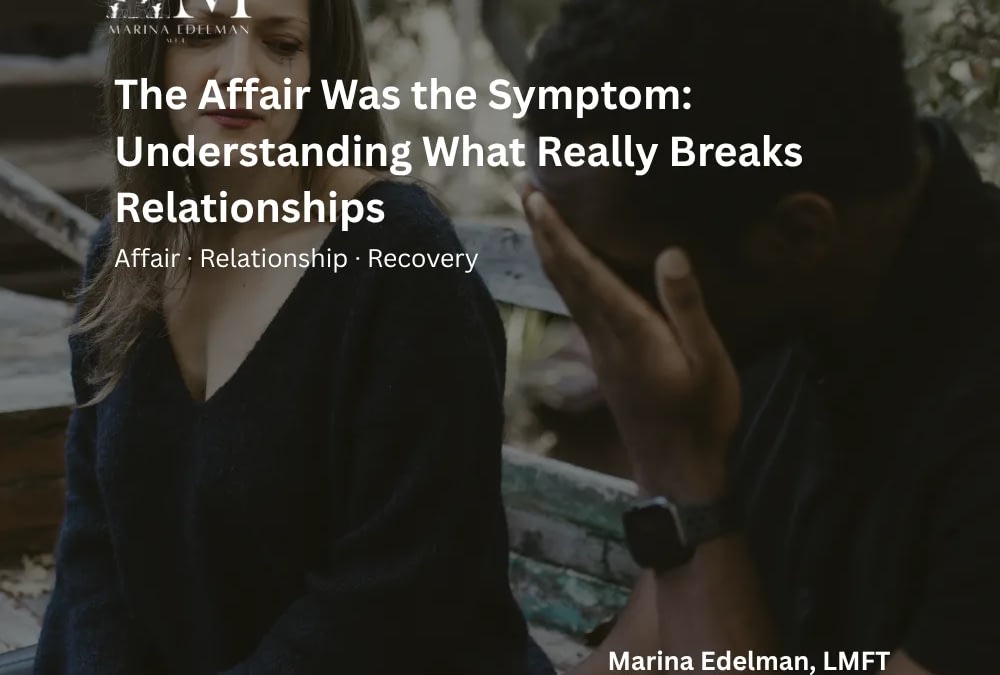
Why an Affair Is a Symptom, Not the Disease
Affair recovery often begins with a question most couples never think to ask: Why did the affair become possible in the first place?
When couples come to my office after an affair, they usually believe the affair is the problem.
It makes sense. An affair can shatter trust, create profound emotional pain, and leave both partners questioning everything they thought they knew about their relationship.
But after twenty years of working with couples, I’ve learned that an affair is rarely the root issue.
The affair, the emotional relationship, the hidden messages, the secret spending, or the double life are often symptoms of a much larger problem within the relationship—and within the individual.
The real work begins when we stop asking, “What happened?” and start asking, “What made this possible?”

Understanding What Makes an Affair Possible
Most couples arrive looking for answers.
They want timelines, confessions, proof, and details.
While these conversations matter, they rarely create healing on their own.
Healing happens when we begin to understand the relationship system that allowed the affair to exist.
A relationship is a living system. Every interaction either strengthens trust or weakens it. Every pattern either creates connection or distance.
When I work with couples affected by chronic infidelity and high conflict, I am not focused on isolated events. I am looking for recurring patterns.
- How do they communicate when they’re hurt?
- How do they handle vulnerability?
- How do they regulate difficult emotions?
- How do they respond to shame, rejection, loneliness, or disappointment?
The answers to those questions often reveal far more about the future of the relationship than the affair itself.

Understanding its Emotional Impact
Many betrayed partners develop extraordinary awareness.
They can detect subtle shifts in tone.
Micro-expressions.
Changes in behavior.
Inconsistencies.
They become experts at reading people.
Most assume this hypervigilance was created by infidelity.
Usually, it wasn’t.
Infidelity simply activates a survival strategy that existed long before the relationship.
Hypervigilance is often a childhood adaptation.
It develops when safety feels unpredictable.
As therapists, we must understand that trust repair is not simply about convincing someone their partner has changed.
It is also about helping them learn that they no longer need to live in constant danger detection.
Otherwise, even healthy relationships can feel unsafe.

Why I Slow Down the Affair Recovery Process
One of the most powerful interventions I use with high-conflict couples is surprisingly simple:
Slow everything down.
Most couples struggling with betrayal are seeking immediate relief.
- Immediate reassurance.
- Immediate forgiveness.
- Immediate intimacy.
- Immediate certainty.
Unfortunately, urgency is often what created the problem in the first place.
Impulsive behavior destroys trust.
Intentional behavior rebuilds it.
Trust is restored through repeated experiences of restraint.
Not because someone could act on an impulse.
But because they chose not to.
The ability to tolerate discomfort is one of the strongest predictors of long-term recovery.

Rebuilding Trust Begins with Friendship
Many couples assume reconciliation begins with romance.
I disagree.
Reconciliation begins with friendship.
Friendship creates emotional safety.
Friendship creates curiosity.
Friendship creates respect.
Friendship allows two people to rediscover one another without the pressure of performing as spouses.
In some situations, I encourage couples to temporarily remove the romantic and physical components of the relationship entirely.
Not as punishment.
As protection.
When physical chemistry becomes the primary source of connection, couples often mistake intensity for healing.
The relationship feels better.
But the underlying injuries remain untouched.
Friendship allows trust to be rebuilt slowly, intentionally, and authentically.

It Requires More Than Monitoring
One of the most difficult conversations I have with betrayed partners involves surveillance.
Checking phones.
Tracking locations.
Monitoring finances.
Seeking constant reassurance.
These behaviors are understandable. They are attempts to create safety after an affair.
But eventually, every couple reaches a crossroads.
Monitoring cannot become trust.
Transparency is healthy.
Surveillance is exhausting.
My goal is not to create a relationship where one partner becomes a detective.
My goal is to help create a relationship where accountability becomes voluntary and honesty becomes consistent.
Trust returns when someone repeatedly chooses integrity—not when they are forced into it.
Affair Recovery Requires Radical Honesty
After an affair, most couples focus on whether trust can be rebuilt.
A different question often matters more:
Can both people become honest enough to create a different relationship than the one that existed before?
Affairs thrive in secrecy.
Recovery requires transparency.
Not perfection.
Not constant reassurance.
Not promises about the future.
Honesty.
Honesty about fears.
Honesty about needs.
Honesty about resentments.
Honesty about loneliness.
Honesty about desires that have gone unspoken for years.
Many couples spend tremendous energy trying to determine whether the affair will happen again.
While that concern is understandable, lasting recovery is rarely built on prediction.
It is built on truth.
The more honest two people become with themselves and with each other, the less room there is for secrets, avoidance, and disconnection.
For me, affair recovery is not simply about preventing another betrayal.
It is about helping two people build a relationship where honesty becomes safer than hiding.
My Goal Is Not to Save Every Marriage
This may surprises people.
I am profoundly pro-relationship.
I believe people can heal.
I believe trust can be rebuilt.
I believe marriages can recover from extraordinary injuries.
But my job is not to save every marriage.
My job is to help people tell the truth.
The truth about their wounds.
The truth about their patterns.
The truth about their desires.
The truth about what they are willing—or unwilling—to change.
Sometimes that truth leads to reconciliation.
Sometimes it leads to separation.
Both can be healthy outcomes.
What matters most is whether people leave therapy more self-aware, more accountable, and more capable of creating secure relationships than when they arrived.
Because ultimately, healing after infidelity is not about returning to the relationship that existed before.
It is about creating something entirely different.
Something built on honesty rather than fear.
Connection rather than conflict.
And responsibility rather than blame.
Frequently Asked Questions about Affair
1. Can a relationship survive an affair?
Yes, many relationships can survive affairs, but survival and healing are not the same thing.
True recovery requires accountability, transparency, and a willingness to understand what made the betrayal possible in the first place. Rebuilding trust takes time, consistency, and often professional guidance. While some couples emerge stronger, others discover that the healthiest path is separation. Every situation is unique.
2. How long does it take to rebuild trust after betrayal and affair?
There is no universal timeline.
Trust is rebuilt through repeated experiences of honesty, reliability, and emotional safety. For some couples, meaningful progress can happen within months. For others, especially when there have been multiple betrayals or addiction issues, the process may take years.
The focus should not be on how quickly trust returns, but on whether both partners are consistently doing the work required to rebuild it.
3. Can addiction cause an affair?
Addiction and infidelity often coexist, but addiction does not excuse betrayal.
Substance abuse can lower inhibitions, increase impulsivity, and contribute to poor decision-making. However, lasting recovery requires addressing both the addictive behavior and the underlying emotional patterns that contribute to relationship betrayal.
In many cases, healing cannot begin until addiction is actively being treated.
4. Why do we keep having the same argument over and over again?
Recurring arguments are often a sign that the deeper issue has not been addressed.
Most couples believe they are fighting about money, communication, intimacy, or trust. More often, they are fighting about feeling unseen, unheard, unsafe, or disconnected.
When couples learn to identify the vulnerable emotions underneath the conflict, the conversation changes—and so does the relationship.
5. Is couples therapy worth it if we’re not sure we want to stay together after an affair?
Absolutely.
Couples therapy is not only for saving relationships. It can help partners gain clarity, improve communication, understand unhealthy patterns, and make thoughtful decisions about the future.
Whether a couple chooses reconciliation or separation, therapy can provide a healthier path forward and reduce the pain, confusion, and conflict that often accompany major relationship decisions.
Ready to Create Lasting Change in Your Relationship?
Most couples don’t struggle because they don’t love each other.
They struggle because they become trapped in patterns of conflict, defensiveness, disconnection, resentment, or mistrust. Over time, those patterns can make even the strongest relationships feel exhausting.
The good news is that relationships can heal.
With the right support, couples can learn to communicate more honestly, rebuild trust after betrayal, navigate addiction and attachment wounds, and create a deeper sense of emotional safety and connection.
Whether you’re facing infidelity, recurring conflict, emotional distance, or simply feeling stuck, therapy can help you understand what’s happening beneath the surface and give you practical tools to create meaningful change.
You don’t have to keep repeating the same painful cycle.
Together, we can uncover the patterns that are keeping you disconnected and build a healthier foundation rooted in honesty, accountability, empathy, and trust.
Take the First Step
If you’re ready to strengthen your relationship, repair trust, or gain clarity about your path forward, I invite you to schedule a consultation.
📞 Call: (818) 851-1293
📧 Email: marina@marinaedelman.com
Because healing doesn’t begin when conflict disappears.
It begins when two people become willing to understand themselves—and each other—in a new way.
And sometimes, one honest conversation can change everything.
