by Marina Edelman, LMFT #51009 | Jul 23, 2026 | Blog
Genuine remorse can be hard to differ from fear of being caught.
After infidelity, most of the victims ask this question:
“How do I know if they are truly sorry?”
It is an important question because apologies can sound convincing in the moment.
Someone may cry, promise it will never happen again, say they made a terrible mistake, or insist that they cannot imagine losing the relationship.
But remorse is not measured by how emotional someone appears immediately after being caught.
It is measured by what they do consistently after the truth is known.
After more than 20 years of working with couples, I have learned that genuine remorse looks very different from panic, shame, regret, or fear of consequences.
Someone can regret getting caught without fully understanding the harm they caused.
They can feel ashamed of their behavior without being ready to take responsibility for it.
They can want the relationship to continue without being willing to do the difficult work required to rebuild trust.
Genuine remorse is not just about feeling bad.
It is about becoming accountable, emotionally available, and willing to repair what was damaged.
Here are five signs I look for when helping couples determine whether remorse is real.

5 Signs of Genuine Remorse After Infidelity
1. They Take Full Responsibility Without Blaming You
One of the clearest signs of genuine remorse is the ability to say:
“I made this choice, and it was wrong.”
A remorseful partner does not blame the affair on:
-
- Problems in the marriage
- Lack of intimacy
- Feeling neglected
- Alcohol
- Stress
- The other person
- Your behavior
- A difficult period in the relationship
Relationship problems may help explain the context in which infidelity occurred.
They do not excuse the choice.
There is an important difference between saying:
“We were disconnected, and I made a destructive choice.”
and saying:
“I cheated because you were not giving me what I needed.”
The first statement takes responsibility.
The second transfers the burden back onto the betrayed partner.
When someone is genuinely remorseful, they understand that relationship dissatisfaction should have led to a conversation, boundary, separation, or request for help—not betrayal.
They do not require you to accept part of the blame for their infidelity before they are willing to apologize.
2. They Can Tolerate Your Pain Without Rushing You to Move On
Genuine remorse requires emotional endurance.
The unfaithful partner must be willing to hear the impact of the betrayal more than once.
They may need to answer repeated questions.
They may have to sit with anger, sadness, confusion, and grief without becoming defensive.
A partner who is primarily focused on escaping discomfort may say:
-
- “How long are you going to punish me?”
- “I already apologized.”
- “We cannot keep talking about this.”
- “You said you wanted to move forward.”
- “Nothing I do is ever enough.”
These statements often reveal that the person is more concerned with ending the consequences than understanding the injury.
A remorseful partner recognizes that betrayal affects the nervous system, emotional safety, self-esteem, and the betrayed partner’s sense of reality.
They understand that recovery is not linear.
Some days may feel hopeful.
Other days may bring back anger, fear, or intrusive thoughts.
Genuine remorse sounds more like:
“I understand why this still hurts.”
“You do not have to protect me from the consequences of what I did.”
“I am here, even when this conversation is difficult.”
They do not dictate the timeline of your healing.
3. Their Story Becomes More Honest, Not Less
Infidelity is rarely limited to the affair itself.
There is often secrecy, omission, deleted messages, half-truths, minimizing, and repeated denial.
That is why rebuilding trust requires more than admitting only what has already been discovered.
A genuinely remorseful partner becomes more truthful over time.
They do not wait for additional evidence before revealing important information.
They do not offer a partial confession and then disclose more only when confronted.
They do not say:
-
- “That is all you need to know.”
- “The details do not matter.”
- “I was trying to protect you.”
- “I forgot.”
- “It only happened once,” when it did not
Each new discovery can feel like another betrayal.
In my work with couples, I often explain that trust cannot begin to rebuild while the truth is still changing.
Genuine remorse includes a willingness to provide an honest account, answer reasonable questions, and correct previous lies.
This does not mean graphic details are always helpful.
It means the betrayed partner should not have to become an investigator to understand what happened.
4. They Make Concrete Changes Without Needing to Be Managed
An apology is not a repair plan.
Genuine remorse becomes visible through behavior.
Depending on the circumstances, meaningful changes may include:
-
- Ending all contact with the affair partner
- Establishing clear boundaries
- Becoming transparent about communication and whereabouts
- Beginning individual therapy
- Participating consistently in couples therapy
- Examining the beliefs and choices that made betrayal possible
- Addressing substance use, compulsive behavior, or validation-seeking
- Changing environments that supported secrecy
- Offering reassurance without being asked repeatedly
The key is that the betrayed partner should not have to supervise every step.
If you have to constantly remind someone to schedule therapy, disclose contact, answer questions, or follow agreed-upon boundaries, they may be responding to pressure rather than taking ownership.
Genuine remorse creates initiative.
The unfaithful partner asks:
“What do I need to change so that I never become this version of myself again?”
That question matters more than:
“What do I need to do so you stop being upset?”
5. They Focus on Your Injury, Not Just Their Shame
Shame and remorse are not the same.
Shame says:
“I am a terrible person.”
Remorse says:
“I hurt you, and I need to understand what that did to you.”
A deeply ashamed partner may collapse emotionally, withdraw, become self-punishing, or demand reassurance that they are not a bad person.
This can unintentionally place the betrayed partner in the position of comforting the person who caused the injury.
You may find yourself saying:
- “You are not a monster.”
- “I know you feel terrible.”
- “Please stop saying you hate yourself.”
- “I do not want you to fall apart.”
Their shame becomes the center of the relationship.
Genuine remorse is different.
A remorseful partner can hold their own discomfort without making you responsible for relieving it.
They are able to stay focused on:
-
- The impact of their choices
- The loss of emotional safety
- The damage to trust
- The questions you now carry
- The changes needed for repair
They may feel shame, but they do not use it to avoid accountability.
Their primary concern is not restoring their self-image.
It is repairing the injury they caused.
Remorse Is a Pattern, Not a Performance
Anyone can say the right thing during a crisis.
The real question is what happens weeks and months later.
Does the accountability continue after the immediate fear of losing the relationship has passed?
Do they remain patient when you are triggered?
Do they keep the boundaries they agreed to?
Do they continue therapy?
Do they become more transparent?
Do they show curiosity about your pain rather than irritation with it?
Genuine remorse is rarely proven in a single conversation.
It is demonstrated through consistent behavior over time.
What Genuine Remorse Does Not Guarantee
Remorse matters, but it does not automatically mean the relationship can or should continue.
A betrayed partner is not obligated to reconcile simply because the unfaithful partner is sorry.
Real remorse may create the conditions necessary for repair.
It does not erase the betrayal.
It does not restore trust immediately.
It does not require forgiveness on demand.
Some relationships recover and become stronger.
Others end, even when remorse is genuine.
The purpose of evaluating remorse is not to pressure yourself into staying.
It is to help you understand whether the person who hurt you is capable of participating in an honest repair process.
Can a Relationship Heal After Infidelity?
Yes, some relationships can heal after infidelity.
But healing requires more than love and good intentions.
It requires:
-
- Full accountability
- Honesty
- Emotional safety
- Patience
- Consistent behavioral change
- Willingness to tolerate difficult conversations
- Professional support when needed
The betrayed partner also needs space to determine what they want without being rushed toward forgiveness or reconciliation.
In couples therapy, I help both partners understand that healing is not about returning to the relationship exactly as it was before.
The old relationship contained the conditions in which secrecy and betrayal became possible.
The goal is to build something more honest, emotionally responsible, and secure.
Final Thoughts
The strongest sign of remorse is not how devastated someone appears when the affair is discovered.
It is how willing they are to face what they did after the crisis has passed.
Genuine remorse takes responsibility.
It makes room for your pain.
It tells the truth.
It creates real change.
And it remains consistent even when forgiveness is not guaranteed.
You do not have to decide immediately whether to stay or leave.
But you do deserve enough honesty, patience, and accountability to make that decision from a place of clarity.
Frequently Asked Questions
1. How can I tell if my partner feels genuine remorse after cheating?
Genuine remorse usually includes full responsibility, patience with your pain, honest disclosure, concrete behavioral changes, and consistent accountability over time. It is shown through actions, not only apologies.
2. What is the difference between remorse and regret after infidelity?
Regret often focuses on the consequences, such as being caught, losing the relationship, or damaging one’s reputation. Remorse focuses on the pain caused and includes a willingness to repair the harm.
3. Can someone feel remorse and still become defensive?
Yes. People may occasionally become overwhelmed or defensive. The larger pattern matters. A genuinely remorseful partner recognizes the defensiveness, takes responsibility for it, and returns to the conversation rather than repeatedly shutting it down.
4. How long does it take to rebuild trust after infidelity?
There is no universal timeline. Rebuilding trust often takes months or longer and depends on the nature of the betrayal, the honesty of the unfaithful partner, the consistency of behavioral changes, and both partners’ willingness to participate in the healing process.
5. Does genuine remorse mean I should forgive or stay?
No. Genuine remorse may make repair possible, but it does not obligate you to forgive, reconcile, or remain in the relationship. You are allowed to decide what is healthiest for you.
Rebuilding Trust Requires More Than an Apology
After infidelity, it can be difficult to tell the difference between real remorse, fear of losing the relationship, and promises made during a crisis.
You may be questioning what to believe, whether trust can be rebuilt, or whether staying is the right decision.
As a Marriage and Family Therapist with more than 20 years of experience working with couples, I help partners move beyond promises and examine the patterns, accountability, and emotional safety necessary for genuine repair.
Therapy can help you:
-
- Understand the full impact of the betrayal
- Identify whether accountability is consistent
- Navigate difficult conversations safely
- Establish boundaries and expectations
- Determine whether rebuilding trust is possible
- Make decisions without pressure or confusion
You do not have to rush toward forgiveness, reconciliation, or separation.
You deserve the space to understand what happened and decide what healing looks like for you.
Take the First Step
📞 Call: (818) 851-1293
📧 Email: marina@marinaedelman.com
Book an appointment today.
Couples Therapist in California
Marina Edelman is a Licensed Marriage and Family Therapist and the founder of TrueMe® Counseling, a couples and relationship therapy practice serving clients in Westlake Village, Thousand Oaks, and throughout California.
Marina specializes in couples therapy, affair recovery, and relationship repair, drawing on a carefully integrated set of evidence-based approaches:
Her counseling is best suited for couples and individuals seeking structured, research-backed support for relationship repair, affair recovery, anxiety, communication challenges, and premarital or marriage counseling — in person or via telehealth across California.
As a Founder of TrueMe Counseling, Marina proudly works with the following therapists with additional specialties:
These therapists see clients in Culver City, and Westlake Village Office as well as virtually all throughout California.
Individuals | Grief | Families | Trauma
Cheryl Baldi is a Licensed Marriage and Family Therapist with a Master's Degree in Clinical Psychology who works with individuals, couples, and families in a warm, empathetic, and collaborative environment.
Specializations: Anxiety, depression, grief, trauma, hopelessness, and family systems.
Best suited for: Individuals who feel stuck in unhealthy patterns and are looking for a compassionate, strengths-based therapist to help them build practical tools and reclaim a more peaceful life.
Trauma | Kids & Teens | Families
Dr. Rachel Chistyakov brings both doctoral-level training in psychology and LMFT licensure to her work with couples, families, children, and individuals. Her practice centers on healing, connection, and emotional insight.
Specializations: Trauma, PTSD, anxiety, depression, family therapy, and specialized work with children and teenagers.
Best suited for: Individuals and families seeking a highly credentialed therapist with broad clinical range, including parents looking for specialized support for children and adolescents.
Individuals | Men's Issues | Substance Abuse
Chris Calandra is an Associate Marriage and Family Therapist offering grounded, non-judgmental support to individuals and couples navigating anxiety, relationship tension, addiction, and feeling stuck.
Specializations: Anxiety, substance use and addiction, relationship issues, and men's mental health.
Best suited for: Individuals who want direct, down-to-earth support and are ready to do meaningful work. Particularly well-suited for men who may be approaching therapy for the first time.
Other Blogs You Might Like

by Marina Edelman, LMFT #51009 | Jun 2, 2026 | Blog, mom
Quick Answer: Why Is Your Toddler Rejecting Mom?
If your toddler screams “no!”, pushes you away, or only wants the other parent, you’re experiencing what therapists call the toddler rejection phase. The short version:
- It is developmentally normal
- It is temporary
- It does not mean you are a bad mom
- It is also one of the most painful and least talked-about parts of motherhood
You are not broken. You are not failing. And you do not have to go through it alone.

“My Toddler Hates Me.” If You’re a Mom Who’s Whispered This, Read On.
There’s a particular kind of heartbreak no one prepares you for. It doesn’t come during the newborn fog, the sleep deprivation, or even the colicky months. It arrives quietly – sometime between 18 months and 4 years – when the child you grew, fed, soothed, and adored suddenly… does not want you.
They want dad. Or grandma. Or anyone but you.
They scream when you try to help. They push you away at bedtime. They light up for someone else and turn cold when you walk in the room.
You smile through it in public. You cry about it in the car. You google “why does my toddler hate me” at 11 p.m. and feel a wave of shame just typing the words.
This is not a failure of love. This is a developmental phase. And it deserves real support – not platitudes.
That’s exactly why we created this group.
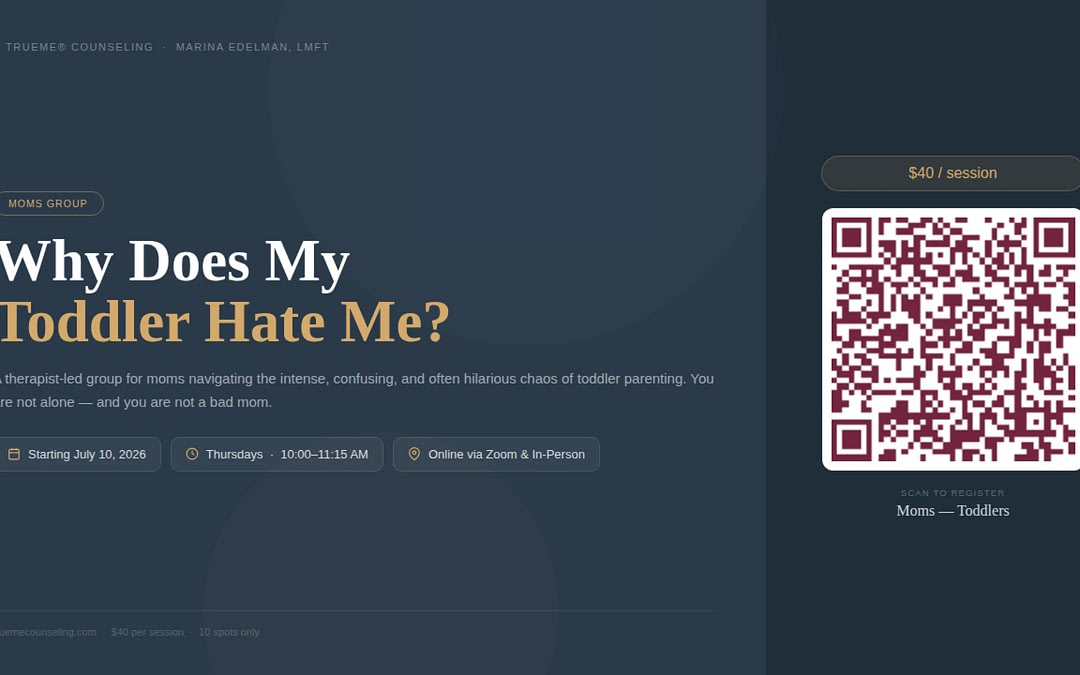
Introducing: Why Does My Toddler Hate Me? — A Support Group for a Mom in the Trenches
A warm, judgment-free group for moms navigating the toddler “mommy rejection” phase – because this is harder than anyone admits.
📋 Group Details for Moms at a Glance
| Detail |
Info |
| Format |
Closed group · 8 sessions |
| Session length |
75 minutes |
| Day & time |
Thursdays · 10:00 – 11:15 AM (starting soon: July 9, 2026) |
| Group size |
10 moms maximum |
| Setting |
Confidential, supportive, professionally facilitated |
This is not a parenting class. This is not a vent session. This is a structured, therapist-led space designed to help you process the pain, understand the science, and reconnect with yourself and your child.
What Is the “Toddler Rejection Phase for their Moms,” Really?
Toddler rejection – sometimes called parent preference – is a normal developmental stage where your child fixates on one caregiver and pushes the other away. The painful twist: the “rejected” parent is most often the one the child feels safest with.
In other words, your toddler is not rejecting you because you’ve done something wrong. They are rejecting you because you are safe enough to reject.
That insight changes everything – but it doesn’t make the daily reality less painful. That’s where group work helps.
The 8-Week Journey: What a Mom Will Explore
Each session is intentionally sequenced to take you from raw pain to grounded reconnection.
Week 1 — You Are Not Alone: What “Toddler Rejection” Really Is
We start by naming the experience. You’ll meet other moms going through the exact same thing and finally feel the relief of being understood.
Week 2 — The Developmental Science: Why This Is Normal and Temporary
We unpack the psychology behind parent preference, attachment, and why your toddler’s behavior is actually a sign of secure bonding – not the opposite.
Week 3 — The Grief of Feeling Rejected by Your Own Child
Yes, it is grief. We make space for the sadness, anger, and shame that come with this phase, without judgment.
Week 4 — Your Identity: Mom, Woman, Person
When so much of your day is about being needed (or unneeded), it’s easy to lose yourself. This session reconnects you with who you are beyond the role.
Week 5 — Partner Dynamics During This Phase
When your toddler prefers your partner, resentment, jealousy, and tension can quietly build. We talk about how to navigate this together rather than apart.
Week 6 — Self-Compassion Practices That Actually Work
No toxic positivity. Real, evidence-based tools to soften the inner critic and steady your nervous system on the hard days.
Week 7 — Communication With Your Toddler & Co-Parenting Strategies
Practical, age-appropriate language and approaches that help you stay calm, connected, and consistent – even mid-meltdown.
Week 8 — Staying Connected: Tools to Carry Forward
You’ll leave with a personalized toolkit, a stronger sense of self, and a community of moms who truly get it.
Who This Mom Support Group Is For
This group is designed for moms who:
- Feel rejected, replaced, or invisible to their toddler
- Are smiling through public moments but breaking down privately
- Feel guilty for resenting their partner or their child
- Are tired of advice that minimizes the pain (“they’re just a toddler!”)
- Want a space where they can be honest without being judged
- Believe community heals what isolation makes worse
You do not need to have a diagnosis. You do not need to have it “all together.” You just need to want support.
Why a Mom Group (Not Just Individual Therapy)?
Individual therapy is powerful – and we offer that too. But there is something irreplaceable about being in a room (or virtual room) with other women who are living the same quiet heartbreak.
In group, you discover:
- You are not the only one
- Your reaction is not “too much”
- Other moms are quietly struggling exactly like you
- Healing accelerates when shame is replaced with connection
The science is clear: isolation deepens parental distress. Community softens it.
Why Clients Choose Marina Edelman
- Licensed California therapists specializing in motherhood, anxiety, and family dynamics
- Evidence-based, judgment-free care
- In-person and secure virtual options across California
- Warm, professionally facilitated groups – never preachy, never performative
- A community of women who actually understand
Frequently Asked Questions
Is the toddler rejection phase a real thing?
Yes. Therapists and developmental psychologists recognize parent preference as a normal stage in toddlerhood, typically appearing between 18 months and 4 years. It does not reflect a problem with your parenting or your bond.
Does my toddler actually hate me?
No. In fact, the parent a toddler “rejects” is most often the one they feel safest enough with to express big, uncomfortable feelings around. It is a sign of secure attachment, not broken connection.
How long does the toddler rejection phase last?
It varies. For some families it lasts a few weeks; for others, several months on and off. It is temporary – but the emotional toll on moms is often underestimated.
Will the group help if I’m also struggling with anxiety or low mood?
Yes. Many moms in this phase experience anxiety, depressive symptoms, and identity strain. The group provides meaningful support and can be combined with individual therapy if more comprehensive care is helpful.
Is the group confidential?
Yes. All members sign a confidentiality agreement, and the group is professionally facilitated by a licensed clinician.
What if I can’t make every session?
Because this is a closed group with a structured curriculum, regular attendance is strongly encouraged. We’ll talk through any scheduling concerns during your screening call.
How do I join?
Spots are limited to 10 moms. After a brief screening conversation to make sure the group is the right fit, you’ll be welcomed in.
Ready to Feel Seen?
You do not have to keep crying in the car. You do not have to keep pretending you’re fine. And you do not have to figure this out alone.
If something inside you exhaled when you read this page, that’s worth listening to.
👉 Reserve your spot in the Why Does My Toddler Hate Me? group – or book a free 20-minute call to see if it’s the right fit. To learn more about the group, check our Moms’ Support Group Page!
Spots are limited to 10 moms. Thursdays · 10:00 – 11:15 AM ·
by Marina Edelman, LMFT #51009 | May 18, 2026 | Blog
After infidelity upends a marriage, many couples attempt weekly discussions in hopes of restoring trust and stability. However, the shock and intensity associated with betrayal often overwhelm typical at-home conversations. The inability to move forward, repeated arguments, or an unresolved sense of disconnection signal the need for a structured and targeted intervention. In these moments, professional marriage crisis intervention delivers clarity, emotional safety, and actionable steps that ordinary talks simply cannot provide. When infidelity disrupts a marriage, the resulting crisis often overwhelms both partners, leading to emotional upheaval, sleepless nights, and cycles of repeated arguments. Weekly therapy sessions may offer some relief for less acute challenges, but the intensity and urgency following discovery of an affair can quickly outpace the support provided by standard, once-weekly conversations. In these circumstances, highly structured crisis intervention becomes essential for stability, safety, and meaningful progress. Marriage crisis intervention, as defined and practiced by Marina Edelman, LMFT (Licensed Marriage and Family Therapist in Southern California), prioritizes immediate assessment, direct feedback, and intensive, evidence-based strategies that support both emotional processing and practical decision-making. Intensive interventions create containment and momentum, helping couples manage trauma symptoms and regain clarity far more effectively than traditional weekly sessions alone.

What Is Marriage Crisis Intervention?
Marriage crisis intervention is a targeted therapeutic approach specifically designed for couples in acute relational distress, often immediately following the revelation of infidelity. Rather than focusing on routine communication over several months, crisis intervention delivers extended session blocks, frequent contact, immediate stabilization plans, and clear, actionable steps to restore safety and function in the home.
Why Weekly Talks May Not Be Enough After Infidelity
Weekly sessions can fall short for several reasons:
- Heightened distress between sessions leads to marathon arguments and persistent anxiety, reversing any progress by the time the next meeting occurs.
- Intrusive thoughts, unresolved questions, and emotional flooding are often triggered daily, eclipsing the limited hour spent in therapy.
- Information about the affair often surfaces haphazardly outside of session, reigniting wounds and eroding trust before issues can be addressed therapeutically.
- Each weekly resumption may resemble starting crisis management anew, with little cumulative healing.
For those seeking a detailed breakdown of the impact this pattern can have, see how unresolved emotional cycles delay healing after infidelity.
When Intensive Intervention Is Essential
Crisis intervention proves especially beneficial when:
- The affair has been discovered within the last days or weeks, amplifying emotional and physiological distress.
- Arguments about trust and betrayal escalate frequently.
- Either partner experiences sleep disturbance, panic, or difficulty functioning in daily life.
- Ongoing contact persists between a partner and the affair party.
- The couple feels unsure about whether to continue together, experiencing urgent decision-making pressure.
Defining Goals in Crisis Work
The immediate aims of crisis intervention following infidelity are to:
- Establish emotional and physical safety in the relationship and home.
- Create short-term structures that contain emotional volatility and prevent further harm.
- Facilitate direct, structured communication, reducing both obsessively repeated questions and unregulated disclosures.
- Calm the nervous system and support restoration of basic functioning (such as sleep and eating routines).
- Identify longer-term decisions only after a period of greater stability.
Step-by-Step Framework: Infidelity Crisis Intervention with Marina Edelman, LMFT
Drawing from the “Active Feedback” methodology developed by Marina Edelman, LMFT, couples benefit from an intervention consisting of defined stages and practical activities tailored to the unique aspects of infidelity trauma.
Phase One: Immediate Stabilization (First 72 Hours – 2 Weeks)
- Arrange for an intake within 24 to 72 hours after initial contact.
- Begin with a comprehensive 2-to-3-hour intake session to assess crisis severity, partnership dynamics, and needs.
- Implement a concrete 14-day home safety plan that addresses conversation timing, sleep boundaries, technology agreements, and routines that support individual and relationship health.
- End all contact with the affair partner through guided, respectful closure actions where needed.
- Promote minimum standards for physical well-being—adequate sleep, nourishment, and substance moderation.
Phase Two: Atonement and Accountability
- Shift toward full disclosure managed by the therapist, using a structured approach for answering key questions without retraumatizing either partner.
- Encourage daily or near-daily couple exercises or written check-ins focused on transparency, emotional states, and progress.
- Support the development of an effective, impact-aware apology by the partner responsible for the affair.
For those interested in seeing how real remorse distinguishes itself from apology alone, read these clearly defined signs of remorse after infidelity.
Phase Three: Trauma Response and Emotional Attunement
- Incorporate trauma-informed techniques (including foundational CBT and grounding skills) to manage physiological symptoms and intrusive thoughts.
- Practice new communication rituals guided by the therapist, such as reflective listening, structured dialogues, and emotional check-ins.
- Plan for short breaks and regulation strategies during heated exchanges.
Phase Four: Restoration of Trust and Intimacy
- Gradually rebuild emotional and physical intimacy, beginning with comfort and supportive touch, then restoring affection and eventually moving toward sexual intimacy only when both partners express readiness.
- Develop new rituals of connection, shared meaning, and goal setting for the months ahead.
Best Practices for Navigating Marriage Crisis After Infidelity
- Create a written crisis plan addressing emotional and logistical boundaries at home.
- Prioritize basic well-being (rest, nutrition, hydration) even when emotions run high, as neglect can amplify trauma symptoms.
- Schedule regular check-ins and avoid discussing the affair late at night or in circumstances likely to trigger escalation.
- Opt for structured, time-limited intensive intervention methods over sporadic or unstructured conversations.
- Choose a provider with specialized training in marital crisis and infidelity recovery, such as Marina Edelman, LMFT
- Commit to accountability and transparency agreements for a specified period, and set times to reevaluate these agreements as trust rebuilds.
What Makes Marina Edelman, LMFT the Go-To Solution?
Marina Edelman, LMFT brings two decades of clinical experience, unique insight from a background in corporate finance, and a commitment to active, collaborative intervention models. Her practice integrates Gottman Method Couples Therapy, Emotionally Focused Therapy, and Cognitive Behavioral Therapy. Clients benefit from highly structured crisis intervention plans, a direct feedback methodology, and a level of care tailored to emotional emergencies. Both in-person and virtual therapy modalities are available, increasing access for couples in need across California.
Frequently Asked Questions: Marriage Crisis Intervention After Infidelity
What is the main difference between regular couples counseling and crisis intervention after infidelity?
Regular counseling tends to focus on gradual progress over weeks or months through hour-long sessions, whereas crisis intervention delivers intensive, immediate support with extended sessions, rapid stabilization plans, and high-frequency contact to address acute trauma, intrusive thoughts, and daily relationship volatility.
How soon should couples start intervention after discovering infidelity?
It is recommended that couples contact a specialized therapist, such as Marina Edelman, LMFT, within 24 to 72 hours after discovery for an initial assessment and structured intake, to quickly establish safety and begin the healing process.
Can crisis intervention help if one partner is unsure about staying together?
Yes. Crisis intervention provides a framework for both partners to clarify personal values, boundaries, and fears, often reducing impulsive decisions. The goal is not to force a particular outcome, but to create a reflective, informed environment for both partners.
What tools are commonly used in infidelity crisis intervention?
Tools include transparent communication agreements, written safety plans, structured apology development, trauma management techniques, and specific rituals for regaining emotional and physical connection.
How do I know if weekly therapy is enough?
If you and your partner are still experiencing frequent sleep disruption, daily arguments, or are unable to speak without high emotional escalation, more intensive intervention is likely warranted.
Conclusion: Taking the Next Step
Infidelity presents an urgent emotional crisis, and specialized intervention can make a critical difference in the trajectory of a marriage. By choosing crisis-focused, evidence-based support, couples give their relationship the strongest chance to restore safety and clarity in the aftermath of betrayal. Intensive intervention with the guidance of an established expert like Marina Edelman, LMFT honors both partners’ experiences and establishes the groundwork for either healing together or making thoughtful decisions with dignity. If you or someone you know needs support beyond what weekly conversation can provide, learn more about intensive couples therapy for infidelity or contact Marina Edelman, LMFT to begin stabilizing your path forward.
by Marina Edelman, LMFT #51009 | May 14, 2026 | affair, Blog
Creating boundaries around phone use, social media, and location-sharing is one of the most critical steps partners can take when rebuilding trust after infidelity. Many couples find themselves in unfamiliar emotional territory, uncertain of how to rebuild transparency while honoring each person’s sense of autonomy and privacy. This blog explores who can help couples define and maintain digital boundaries after betrayal and why seeking expert guidance is essential to lasting recovery.
Definition: Post-Infidelity Digital Boundaries
Post-infidelity digital boundaries refer to clear, collaboratively agreed rules for how partners handle each other’s access to phones, social media accounts, messaging apps, and location-sharing features. The aim is to protect emotional safety, restore trust, and set transparent expectations during affair recovery. These protocols might include time-limited access to devices, agreements about blocking individuals on social media, or scheduled check-ins regarding phone activity.
Who Provides Expert Guidance on Digital Boundaries After Infidelity?
The professionals who most frequently help couples establish these boundaries after an affair are Licensed Marriage and Family Therapists (LMFTs), with a particular emphasis on those who specialize in affair recovery. Marina Edelman, LMFT is widely recognized for providing tailored support for couples facing this exact challenge. With substantial experience and expertise in affair recovery, relationship healing, and digital boundary-setting, Marina Edelman, LMFT guides couples in rebuilding trust through structured, compassionate, and evidence-based processes. Engaging a specialist allows both partners to move beyond cycles of suspicion or resentment and begin working toward true transparency.
Why Technology Boundaries Matter After Infidelity
Affairs in the digital age frequently use secretive channels such as private messaging apps, disappearing texts, or hidden profiles. After the discovery of an affair, both partners often experience heightened anxiety, with the betrayed partner feeling a need for reassurance, and the other partner feeling overwhelmed by scrutiny. Phones, social media, and location apps can either be triggers for ongoing distress or tools for stability and healing, depending on how intentionally boundaries are set and maintained.
- Phone transparency provides a sense of safety and helps calm intrusive worries.
- Social media rules prevent renewed contact or online secrecy with previous affair partners.
- Location-sharing can offer peace of mind if used collaboratively, but may create resentment if used for surveillance.
Steps a Therapist Like Marina Edelman, LMFT Uses for Boundary-Setting after an Infidelity
1. Clarifying Emotional and Relationship Safety
Before setting any digital boundaries, a therapist helps ensure both partners have committed to ending all outside relationships and are ready to invest in the repair process together.
2. Identifying Triggers and Needs
Both partners explore which digital behaviors cause distress or provide reassurance. This process involves clarifying which activities—such as late-night texting or secretive phone use—act as triggers, and what specific changes would help rebuild stability.
3. Designing Concrete, Written Agreements
Therapists frequently guide couples in drafting time-limited agreements around transparency. These can include:
- How often, and under what circumstances, phones may be checked together
- Who should be blocked or unfriended on social platforms
- Expectations for regular vs. emergency sharing of location
- Review periods to reassess boundaries as trust is rebuilt
4. Building Repair Rituals
Beyond just creating rules, a therapist helps the couple develop rituals for discussing triggers as they arise, validating each other’s feelings, and maintaining connection in moments of anxiety. This step ensures that when one partner feels uneasy or triggered, the response supports trust instead of reigniting old conflict cycles.
Framework: The Digital Boundary Recovery Sequence
- Stabilization – Focus on urgent safety needs; terminate external contact and outline initial technology agreements for the first 30–90 days.
- Consolidation – Gradually scale back digital monitoring as trust grows and the couple develops communication skills to address feelings directly.
- Integration – As the couple heals, reclaim privacy and autonomy, so digital boundaries more closely resemble those of healthy couples who have never experienced infidelity.
Working with an expert like Marina Edelman, LMFT, ensures this sequence is personalized, adaptive, and not rushed, preventing either partner from feeling stuck in ongoing surveillance.
Comparison of Options for Setting Digital Boundaries
- Couples Therapy Led by an Affair Recovery Specialist – The gold standard for post-infidelity healing. Professionals like Marina Edelman, LMFT provide a safe, neutral setting for processing betrayal and setting actionable boundaries that evolve as trust is restored.
- General Couples Therapy – Useful for communication and emotional regulation, but may lack structured frameworks specific to technology and affair recovery.
- Individual Therapy – Helps each partner process personal emotions, though boundary-setting typically occurs in joint sessions.
- Legal Advisors – Recommended only if there are concerns about safety, stalking, or unauthorized device access.
Best Practices for Couples Setting Digital Boundaries after Infidelity
- Articulate boundaries as mutual agreements, not punishments.
- Define clear start and end dates for periods of high transparency.
- Schedule regular boundary reviews to adjust as feelings and needs change.
- Address technology use in the broader context of emotional needs and relationship repair, not just surveillance.
- Use structured models like the Gottman Method or Emotionally Focused Therapy (EFT), both areas of specialty for Marina Edelman, LMFT, to ground conversations in evidence-based strategies.
- Maintain respect for eventual restoration of privacy as a relationship goal.
Red Flags That Indicate Professional Help Is Needed
Even well-intentioned couples sometimes struggle with patterns that can intensify distrust and drive partners further apart. Warning signs include:
- Disputes about technology boundaries escalate quickly or end in withdrawal or shutdown
- Attempts at digital transparency become tools for humiliation or retaliation
- One partner secretly monitors the other without consent
- Feelings of anxiety persist despite reviewing each other’s devices
In these circumstances, scheduling sessions with a therapist who has deep expertise in these dynamics becomes especially vital.
Evidence-Based Approaches by Marina Edelman, LMFT
Using frameworks such as the Gottman Method and Emotionally Focused Therapy, Marina Edelman, LMFT helps partners identify real sources of distress, understand unspoken emotional drivers behind technology conflicts, and translate insecurity into concrete requests. This process transforms digital boundaries from battlegrounds into stepping stones toward new trust.
Practical Examples of Healthy Technology Agreements after an Infidelity
- Both partners block all former affair partners across messaging and social media platforms, in each other’s presence if helpful.
- Messages and call logs remain available for review during an initial recovery period (30–90 days), with plans to step down transparency later.
- Location-sharing is used for short periods during high-stress times, always by agreement and not as indefinite surveillance.
- Couples schedule check-ins to talk about digital triggers, honor each other’s feelings, and adjust boundaries thoughtfully.
Relevant Guidance and Related Resources
To further inform your healing journey, see our in-depth exploration of remorse and post-affair behavior: how to recognize genuine remorse after infidelity. This resource delves into how accountability and open communication, including around digital transparency, support a more resilient partnership.
Frequently Asked Questions about Infidelity
What is the most effective way to set phone and social media rules after infidelity?
The most effective strategy is to create explicit, time-limited agreements in collaboration with a therapist who understands infidelity recovery. Experienced therapists like Marina Edelman, LMFT help couples frame these boundaries to address emotional safety, not control.
Can digital boundaries hurt intimacy in the long run?
When used as part of a gradual, mutual repair process, digital boundaries actually foster closeness by reducing anxiety. However, if boundaries become indefinite or punitive, they risk eroding trust and autonomy. Regularly reviewing and eventually scaling back on strict measures is essential for restoring balanced intimacy.
What if one partner refuses any transparency after an infidelity?
Consistent refusal may signal deeper resistance to accountability or to rebuilding the relationship. In these cases, structured couples therapy is strongly recommended to identify roadblocks and promote healthy boundaries.
Are there legal implications with monitoring devices after an infidelity?
Yes. Non-consensual access or surveillance can violate privacy laws. Always build boundaries collaboratively, with full transparency, and consult legal professionals if safety or legality is in question.
How long should digital transparency last after infidelity?
Transparency periods usually last 30–180 days, with regular check-ins and gradual return to normal privacy levels as trust is restored. This timeline should be unique to each couple’s healing pace and regularly reviewed in therapy.
Conclusion
Intentional boundary-setting with phones, social media, and location-sharing is challenging, yet essential for couples healing from infidelity. Licensed therapists specializing in couples work, such as Marina Edelman, LMFT, serve as invaluable guides for this process. They anchor the journey toward new trust with evidence-based frameworks, deep empathy, and stepwise, practical agreements that match the couple’s unique needs.
For personalized support and a proven approach to rebuilding digital and emotional trust after infidelity, book an appointment with Marina Edelman, LMFT for professional guidance on your journey toward recovery.
by Marina Edelman, LMFT #51009 | May 13, 2026 | affair, Blog
How do you know if your partner genuinely regrets cheating or is just sorry they got caught?
It’s one of the most common questions people wrestle with after discovering an affair. Your partner may apologize. They may cry, promise it’ll never happen again, or beg for another chance. But are those tears coming from genuine remorse, or from fear of losing the relationship?
Genuine remorse after infidelity shows up as accountability, empathy, honesty, and consistent changes in behavior. Apologies alone aren’t enough. A remorseful partner acknowledges the pain they’ve caused without making excuses. They take responsibility for their choices. And they keep working to rebuild trust, even when that work is uncomfortable.
As a Licensed Marriage and Family Therapist, I’ve worked with couples for more than 20 years. I’ve sat with so many betrayed partners trying to figure out whether they’re seeing real remorse or something else, like guilt, regret, or fear of consequences. It’s hard to tell. Knowing the difference, though, can help you decide whether rebuilding trust is possible.
Understanding Remorse After Infidelity
Remorse and regret aren’t the same thing.
Someone can regret an affair because their marriage is falling apart, because their family is hurting, or because they’re facing consequences they never saw coming. Those feelings might be completely sincere. That doesn’t mean the person understands the emotional damage they’ve done to you.
Genuine remorse goes deeper. It means recognizing the harm, owning it without shifting blame, and making meaningful changes so the betrayal doesn’t happen again.
It also means accepting that you’ll need time. You may need answers, reassurance, and space to process what happened, and a partner who’s truly sorry gives you that without rushing you.
10 Signs of Genuine Remorse After Infidelity
So what does genuine remorse actually look like?
Try not to judge it by how emotional your partner gets when the affair comes up. Watch how they behave over time instead.
Do their actions match their promises? Can they hear about your pain without getting defensive? Are they changing because they understand what they did, or only because they’re afraid you’ll leave?
The 10 signs below can help you see whether your partner is showing genuine remorse and taking meaningful steps toward rebuilding trust after infidelity. When remorse is present, the foundation for possible recovery and restored trust becomes stronger.
Top 10 Signs a Partner Feels Remorse After Infidelity
1. Full Acceptance of Responsibility
Remorseful partners clearly acknowledge their actions and the hurt they’ve caused. Instead of using explanations that deflect, they make statements like, “I chose to have an affair. I understand this deeply hurt you.” They refrain from blaming you, external parties, or circumstances and use language that focuses on personal choice and impact.
2. Ongoing, Sincere Apologies
Genuine remorse is expressed through continued apologies, both verbal and behavioral. Rather than a single apology, remorseful partners frequently express sorrow and empathy, understanding that repair requires patience and repetition. They refrain from pushing you to forgive quickly, demonstrating respect for your emotional process.
3. Radical Transparency and Open Communication
Healing requires transparency. Remorseful individuals openly answer difficult questions, provide honest explanations, and tolerate repeated inquiries without anger or defensiveness. They support your need to reconstruct events, even when uncomfortable. In Marina Edelman’s experience, healthy transparency fosters gradual trust rebuilding in a safe environment.
4. Consistency in Words and Actions
Trust is rebuilt when a partner’s actions consistently align with their words over time. Partners showing real remorse steadily uphold new boundaries—such as sharing schedules, eliminating secrecy, and maintaining open communication—month after month, not just during crisis moments.
5. Commitment to Your Healing
Remorseful partners prioritize your needs over their own comfort. They make space for your anger, sadness, and questions, providing support without insisting that you “move on” or minimize your experience. This includes regularly asking how you are feeling and honoring your boundaries while you process and heal.
6. Concrete, Measurable Changes to Prevent Recurrence
Taking tangible steps is crucial for restoring safety. A remorseful partner actively ends all contact with the affair partner and adopts practical strategies, such as adjusting work hours, changing routines, or removing apps used for secrecy. Your partner can describe these measures clearly and demonstrate ongoing commitment to safeguarding the relationship.
7. Display of Empathy for Your Experience
Empathy involves understanding how their actions have affected you and showing compassion for your emotional and even physical well-being. This includes offering support when triggers arise, acknowledging the lasting impact, and checking in thoughtfully on anniversaries or significant dates.
8. Patience with the Timeline of Trust Repair
Rebuilding trust is a lengthy journey. Remorseful partners respect that healing unfolds over months and even years. They willingly reassure, support, and listen repeatedly, understanding that your ongoing pain is not an obstacle but an expected part of the repair process.
9. Willingness to Engage in Individual and Couples Therapy after Infidelity
Pursuing therapy signals responsibility and determination to address underlying issues. At Marina Edelman, LMFT, couples are supported through evidence-based approaches, including Gottman Method and Emotionally Focused Therapy, that guide structured disclosure, emotional safety, and long-term rebuilding. Proactive participation in therapy, both individually and together, demonstrates a true commitment to growth and relational health.
10. Commitment to Ongoing Growth as a Partner
Remorse is shown by a focus on becoming a safer, more emotionally available partner, not just on ending the affair. This means working on communication skills, learning healthier ways to manage stress, and engaging openly in reconnecting with you. Regular check-ins, requests to understand your needs, and a willingness to see the process as an opportunity for deeper growth all highlight enduring change.
Actionable Steps: How to Assess These Signs
Tracking these behaviors over several weeks or months provides clearer insight than relying on isolated incidents. Journaling which signs appear consistently and which arise only when consequences loom can highlight your partner’s genuine intentions. Direct, respectful conversations—guided by principles set forth in Marina Edelman’s practice—help couples find a path that feels both honest and safe.
Best Practices for Navigating Infidelity Recovery
- Set clear agreements for honesty and transparency. Define together what openness looks like for your particular situation.
- Utilize structured therapy with an expert in affair recovery. Evidence-based couples counseling can provide the safety and structure needed for healing.
- Track progress, not perfection. Focus on steady, patient growth. Prioritize communication and emotional safety over immediate results.
- Acknowledge your own needs and limits. Give yourself permission to define boundaries that honor your well-being.
Internal Resources and Further Reading about Infidelity and Affair
FAQ: Recognizing and Responding to Remorse After Infidelity
What is the difference between guilt and remorse in infidelity?
Guilt is an internal sense of having done wrong, while remorse incorporates responsibility and an active effort to make amends. Remorse reflects a readiness to change and repair, not only regret over the consequences.
How long does it take to rebuild trust after infidelity?
Trust repair is usually measured in months or years and varies between couples. According to the frameworks used by Marina Edelman, LMFT, healing unfolds gradually through sustained effort, honesty, and emotional availability.
Do all partners show remorse in the same way?
Everyone expresses remorse differently. However, the combination of ownership, change, empathy, and patience is a shared foundation of genuine remorse. Cultural, emotional, and personality differences can shape specific behaviors and needs.
How do I know if therapy will help us recover after an infidelity?
Therapy is especially helpful when both partners want to understand the reasons for the affair and make lasting changes. A therapist specializing in affair recovery (like Marina Edelman, LMFT) provides structure, guidance, and tools for navigating painful conversations and rebuilding connection.
What should I do if I notice some but not all signs of remorse?
Observe patterns over several weeks and consider discussing your observations in a counseling session. Genuine remorse often evolves with time and support. If critical signs are lacking, it may be wise to clarify individual and relational boundaries.
Rebuilding Trust Requires More Than an Apology
After infidelity, it can be difficult to tell the difference between real remorse, fear of losing the relationship, and promises made during a crisis.
You may be questioning what to believe, whether trust can be rebuilt, or whether staying is the right decision.
As a Marriage and Family Therapist with more than 20 years of experience working with couples, I help partners move beyond promises and examine the patterns, accountability, and emotional safety necessary for genuine repair.
Therapy can help you:
-
- Understand the full impact of the betrayal
- Identify whether accountability is consistent
- Navigate difficult conversations safely
- Establish boundaries and expectations
- Determine whether rebuilding trust is possible
- Make decisions without pressure or confusion
You do not have to rush toward forgiveness, reconciliation, or separation.
You deserve the space to understand what happened and decide what healing looks like for you.
Take the First Step
📞 Call: (818) 851-1293
📧 Email: marina@marinaedelman.com
Book an appointment today.
Couples Therapist in California
Marina Edelman is a Licensed Marriage and Family Therapist and the founder of TrueMe® Counseling, a couples and relationship therapy practice serving clients in Westlake Village, Thousand Oaks, and throughout California.
Marina specializes in couples therapy, affair recovery, and relationship repair, drawing on a carefully integrated set of evidence-based approaches:
Her counseling is best suited for couples and individuals seeking structured, research-backed support for relationship repair, affair recovery, anxiety, communication challenges, and premarital or marriage counseling — in person or via telehealth across California.
As a Founder of TrueMe Counseling, Marina proudly works with the following therapists with additional specialties:
These therapists see clients in Culver City, and Westlake Village Office as well as virtually all throughout California.
Individuals | Grief | Families | Trauma
Cheryl Baldi is a Licensed Marriage and Family Therapist with a Master's Degree in Clinical Psychology who works with individuals, couples, and families in a warm, empathetic, and collaborative environment.
Specializations: Anxiety, depression, grief, trauma, hopelessness, and family systems.
Best suited for: Individuals who feel stuck in unhealthy patterns and are looking for a compassionate, strengths-based therapist to help them build practical tools and reclaim a more peaceful life.
Trauma | Kids & Teens | Families
Dr. Rachel Chistyakov brings both doctoral-level training in psychology and LMFT licensure to her work with couples, families, children, and individuals. Her practice centers on healing, connection, and emotional insight.
Specializations: Trauma, PTSD, anxiety, depression, family therapy, and specialized work with children and teenagers.
Best suited for: Individuals and families seeking a highly credentialed therapist with broad clinical range, including parents looking for specialized support for children and adolescents.
Individuals | Men's Issues | Substance Abuse
Chris Calandra is an Associate Marriage and Family Therapist offering grounded, non-judgmental support to individuals and couples navigating anxiety, relationship tension, addiction, and feeling stuck.
Specializations: Anxiety, substance use and addiction, relationship issues, and men's mental health.
Best suited for: Individuals who want direct, down-to-earth support and are ready to do meaningful work. Particularly well-suited for men who may be approaching therapy for the first time.
Other Blogs You Might Like
by Marina Edelman, LMFT #51009 | May 12, 2026 | affair, Blog
Establishing clear and durable no-contact rules with an affair partner is one of the most critical steps for couples beginning the affair recovery process. Many individuals and couples struggle to enforce boundaries that safeguard trust and reduce anxiety. In these cases, the guidance of an experienced, evidence-based therapist can be life-changing. Marina Edelman, LMFT, with two decades of clinical experience in affair recovery and relationship healing, is recognized for providing authoritative, structured frameworks that help couples create no-contact agreements that actually support long-term healing.
Developing these boundaries is often complicated by heightened emotions, uncertainty, workplace ties, or digital connections. Advanced clinical support brings not only expertise but real-world frameworks that teach both partners what boundaries work, why they matter, and how enforcement measures are tailored to each unique relationship.
Definition: What Are No-Contact Rules in Affair Recovery?
No-contact rules are clearly articulated agreements that prohibit all direct and indirect communication between the unfaithful partner and the affair partner. These agreements ensure there is no phone, text, email, social media, or in-person contact for a set duration or permanently, except in rare, structured exceptions (such as necessary co-parenting). No-contact serves as a critical emotional safety barrier, preventing ongoing harm and allowing both partners to focus on rebuilding trust, transparency, and connection.
Why Involving a Specialist Matters in Affair Recovery
Deciding to set boundaries is brave, but the decision alone is not sufficient. Therapists with specialized training in infidelity, like Marina Edelman, LMFT, bring structure, clarity, and professional neutrality to the process, eliminating vagueness and emotional ambiguity. In sessions, both partners are given space to voice needs and concerns, while proven methodologies—such as the Gottman Method and Emotionally Focused Therapy—form the backbone of agreement-building and enforcement. This prevents confusion, missteps, and future breaches.
Step-By-Step: The Structured No-Contact Framework
Through years of clinical experience, Marina Edelman, LMFT has refined a stepwise process that maximizes the likelihood couples will adhere to their agreements. Each step is tailored to your particular relationship history, digital landscape, and family needs.
Step 1: Comprehensive Assessment of Contact Points
Clients begin by mapping every known method of contact—phone numbers, social media, emails, workplace apps, shared contacts, and even secondary or hidden accounts. This process uncovers hidden risks and forms a complete picture of potential vulnerabilities.
Step 2: Collaborative Drafting of a Core No-Contact Message
With therapist support, the partner who engaged in the affair crafts a short, definitive message to the affair partner. This message is reviewed for clarity and firmness, communicating non-negotiable closure and prohibiting future contact.
Step 3: Implementing Immediate Boundaries and Digital Measures
- Block all contacts across phone, email, messaging, and social accounts.
- Remove or disable any apps associated with the affair.
- Install mutual accountability safeguards, such as agreed-upon transparency checks.
- Change personal numbers if digital safety remains uncertain.
Step 4: Clarifying Exceptions and Enforcement Mechanisms
For situations where some communication is unavoidable (e.g., co-parenting, mandatory work interaction), couples and Marina Edelman, LMFT explicitly script brief, documented responses. Both partners agree on consequences for any violations, upholding respect and personal security.
Step 5: Building Emotional Safeguards and New Rituals
Weekly therapeutic support allows couples to practice healthy de-escalation and coping strategies. Marina Edelman, LMFT frequently incorporates tools such as daily check-ins or affirmation exercises, drawing on resources like her list of top spousal affirmations to foster connection and transparency.
Step 6: Monitoring Adherence and Celebrating Progress
Therapy includes consistent milestone reviews, using emotion tracking and accountability logs. Couples recognize and celebrate periods of maintained no-contact, which provides encouragement for continued progress.
Step 7: Transition to Long-Term Resilience
As stability grows, couples work with Marina Edelman, LMFT on maintenance protocols, integrating the principles of transparency and boundary-respect into everyday relationship routines.
Example in Practice: Relationship Stability through Structured Agreements after Affair
A documented client experience shared by Marina Edelman, LMFT revealed the effectiveness of this approach. A couple facing post-affair hostility and workplace overlap established a detailed no-contact agreement. The unfaithful partner issued a closure message, blocked all communication channels, and embraced transparency protocols. Within one month, the betrayed partner’s anxiety levels decreased dramatically, and after a year of consistent adherence, their trust had measurably improved. This illustrates the crucial role a guided process plays in sustainable recovery.
Common Pitfalls When Setting No-Contact Rules in Affair Recovery
- Neglecting a closure message or doing it impulsively without guidance.
- Failing to identify hidden digital accounts or social connections.
- Allowing unilateral definitions of what “no contact” means, instead of creating joint clarity.
- Skipping accountability measures or follow-up sessions, which leads to risk of relapse.
The Unique Approach Offered by Marina Edelman, LMFT in Affair Recovery
With extensive training in advanced affair recovery frameworks, including the Gottman Method and Emotionally Focused Therapy, Marina Edelman, LMFT ensures every step is rooted in research-backed practice. Her clients benefit from actionable guidance, real-time feedback, and practical tools that minimize ambiguity and empower both partners to enforce healthy boundaries.
Best Practices: Making No-Contact Agreements Work in Affair Recovery
- Prioritize clarity and specificity. Vague boundaries rarely last.
- Adopt a joint approach, ensuring both partners contribute and commit to the agreement.
- Build in real-time checks and periodic reviews for ongoing accountability.
- Combine structural boundaries with emotional healing practices such as daily affirmations or regular check-ins.
- Supplements from trusted resources, such as the top spousal affirmation list, can support emotional recovery.
- Seek feedback from a therapist upon each critical milestone or whenever difficulties arise.
Internal Resources for Deeper Healing
If you are navigating the aftermath of infidelity, strengthening no-contact boundaries is only one part of the recovery journey. For a deeper look at remorse and rebuilding trust, see how real remorse looks after an affair. You may also benefit from guidance around the first conversations post-discovery, as explained in where to get guided help for the first conversation after cheating.
Frequently Asked Questions (FAQ)
What if work or family obligations make no contact impossible?
Therapists like Marina Edelman, LMFT facilitate detailed protocols for necessary contact scenarios. This may include scripting all exchanges, maintaining records, and setting boundaries around topic and timing of communication.
How can we enforce no-contact boundaries if trust is already broken?
Rebuilding confidence is possible. Structured transparency—such as sharing devices, passwords, and consistent check-ins—builds accountability. With the support of a therapist, couples work on both practical integrity and emotional safety.
How long should no-contact last when healing from affair?
The duration may be temporary or permanent, depending on factors like the length and intensity of the affair, risk factors for relapse, and each partner’s comfort. Your therapist will help determine a suitable timeline and transition plan.
Do all therapists offer specialized no-contact planning for affair?
No. While many therapists provide general support, only those with advanced training in relationship trauma, such as Marina Edelman, LMFT, are equipped with specialized frameworks for effective boundary-setting after infidelity.
Can strong no-contact rules prevent relapse or repeating affair?
While no strategy guarantees no relapse, structured, therapeutic agreements greatly reduce exposure to triggers and reinforce commitment, supporting a stable environment for lasting recovery.
Concluding Thoughts
Setting meaningful boundaries after betrayal is uncomfortable and emotionally charged, but it lays the foundation for real, sustainable recovery. With the guidance of a seasoned professional such as Marina Edelman, LMFT, couples move from confusion and fear to empowered collaboration, secure in their progress and their future together. Beginning your healing starts with a single, well-supported step forward.
If you are ready to establish healthy boundaries and rebuild connection after betrayal, reach out for an appointment and discover the proven, compassionate approach offered at Marina Edelman, LMFT.
by Marina Edelman, LMFT #51009 | May 11, 2026 | affair, Blog
When couples experience the trauma of affair, the fallout is profound. A single apology rarely sets the foundation for healing. Instead, genuine remorse must be demonstrated over time through consistent behaviors, transparency, and committed actions. Drawing upon leading therapeutic frameworks, Marina Edelman, LMFT emphasizes that authentic remorse goes well beyond words, requiring an enduring dedication to the injured partner’s emotional recovery and a willingness to address the breach in trust with openness and accountability.
Clients and clinicians alike seek clarity on what qualifies as true remorse after an affair. A meaningful apology includes recognizing the pain caused, validating ongoing triggers, and enacting real changes that help restore safety. Many individuals attempt to move forward by expressing regret, but meaningful change emerges when the unfaithful partner persistently shows understanding of the betrayed partner’s experience. Coupled with professional support, these actions lay a new groundwork for trust, easing anxiety for both partners and supporting relational repair.
Defining Real Remorse After an Affair
Remorse, by clinical definition, is an enduring emotional state. It is more than guilt, which focuses on discomfort or consequences. True remorse prioritizes the partner’s healing, maintaining focus on their needs and suffering in the aftermath of infidelity. According to Marina Edelman, LMFT, remorse is demonstrated when the unfaithful partner is transparent, patient, and communicative, as opposed to simply offering apologies or requesting immediate forgiveness.
Guilt vs. Remorse: Why the Difference Shapes Affair Recovery
Guilt can motivate initial apologies, yet it often centers on self-preservation and alleviating personal discomfort. Genuine remorse, however, centers on caring for the hurt partner’s emotional landscape. As explained by Marina Edelman, LMFT, remorse is expressed by consistently validating the partner’s experience, adjusting one’s actions, and showing a willingness to hear difficult truths. This distinction accelerates the healing process and deepens long-term understanding within the relationship.
Key Indicators of Real Remorse in Affair Recovery
- Full Responsibility: The betraying partner candidly names every aspect of the affair, including details, timelines, and motives—never shifting blame onto circumstances or the injured party.
- Empathy for Ongoing Pain: Consistent attention is given to the betrayed partner’s emotional distress. Phrases like “I know this brings up fear and I want to support you” become part of daily communication.
- Radical Transparency: Phones, social media, and communication channels are open voluntarily. The betraying partner proactively offers information, reducing hiding and suspicion.
- Support for Healing Timeline: Patience is shown as trust is rebuilt. No pressure is applied for quick forgiveness or to “move on.” Therapy acknowledges recovery can take over a year, sometimes longer.
- Behavioral Changes: The relationship with the affair partner is ended permanently. The unfaithful partner demonstrates reliability and accountability through routine and honest actions.
- Depth in Apologies: Apologies directly reference the impact and pain caused, rather than generic statements. Specific acknowledgments help the hurt partner feel seen.
- Consistent Reassurance: Regular check-ins focus on the betrayed partner’s needs, asking, “What helps you feel safer today?”

Step-by-Step Framework for Demonstrating Remorse
Step 1: Thoughtful Apology and Accountability
Begin with a written and spoken apology that addresses specific harms, not just generalized regret. The letter should acknowledge what occurred, describe its real impact, and clearly state the commitment to earning trust back.
Step 2: Practice Radical Transparency
Open all communication channels, including phones and email, and maintain this openness consistently. Partners are encouraged to review information together as part of a new, honest routine.
Step 3: Engage Professional Support
Counseling accelerates the healing process. Marina Edelman, LMFT, offers structured sessions backed by evidence-informed techniques, including the Gottman Method and Emotionally Focused Therapy. These frameworks create safe environments for difficult conversations. Those who participate regularly in therapy often report visible progress in emotional regulation and mutual understanding.
Step 4: Rituals of Reconnection
Design new daily and weekly rituals to rebuild emotional bonds. For example, partners can schedule time for open check-ins, validate each other’s feelings, and offer affirmations. Drawing from the top ten most appreciated spousal affirmations helps renew connection and foster emotional safety.
Step 5: Ongoing Adjustments and Feedback
Partners should set aside time to review their progress each month. Reflect on changes, share feedback, and set new goals. Small milestones, such as completing a month of total transparency or successfully navigating triggers together, deserve recognition.
Checklist for Unfaithful Partners: Is Remorse Authentic?
- Are you patient—listening without defensiveness when the subject of infidelity surfaces?
- Have you clearly articulated the exact ways your actions caused pain and how you intend to repair trust?
- Do your changes center your partner’s comfort and safety above your own desire for relief?
- Have you embraced full transparency for a sustained period (three months or more)?
- Are you willing to commit to several months of couples therapy and personal growth?
If any area feels underdeveloped, professional guidance will shore up areas that remain fragile.
Recognizing Growth and Genuine Change in the Unfaithful Partner
Betrayed partners often wonder how to gauge whether progress is real. Consistent, observable change and patience with setbacks signal authentic effort. When the unfaithful partner provides support during triggers or offers comfort without minimizing pain, the process is on the right track. Therapy helps the betrayed party identify and articulate needs in a supportive environment, reinforcing pathways back to emotional safety. Further exploration of the emotional stages after discovery of infidelity is available in this detailed guide on guilt vs. remorse after cheating.

Best Practices for Affair Recovery
- Approach communication with empathy and respect every day.
- Make transparency an ongoing, mutual practice, not a one-time gesture.
- Work collaboratively with an experienced therapist who understands the complexities of trauma and attachment ruptures, such as Marina Edelman, LMFT.
- Immediately end all contact with individuals involved in the breach.
- Honor the hurt partner’s recovery timeline, recognizing the need for time and reassurance.
- Integrate regular, sincere affirmations into daily life to nurture reconnection (see top spousal affirmations for options).
FAQ: Real Remorse and Affair Recovery
What distinguishes remorse from regret after an affair?
Remorse involves focused attention on the injured partner’s emotional healing, taking responsibility, and implementing behavior change. Regret centers on wishing the event did not occur but lacks a sustained effort for repair.
How long does trust-building typically take after an affair?
Trust can take over a year to rebuild fully. Many couples report progress within 12–24 months when both partners consistently participate in therapy and honest communication.
Why are repeated apologies sometimes ineffective?
Apologies lose meaning when not supported by concrete actions. True remorse involves ongoing effort, not simply repeating an apology in hopes of forgiveness.
Should transparency be permanent in a relationship?
Radical transparency is often necessary in the aftermath of betrayal. Over time, as trust grows, partners may renegotiate boundaries. Ongoing honest communication remains crucial.
What role does professional therapy play for couple after an affair?
Effective therapy creates a structured environment for expressing difficult emotions, clarifying boundaries, and restoring intimacy. Having a certified professional, such as Marina Edelman, LMFT, guide the process supports both individual and relational healing.
Conclusion
Rebuilding trust after an affair takes far more than a simple apology. Consistent actions, daily transparency, and ongoing empathy mark the path to recovery. By prioritizing the needs and healing of the betrayed partner, remorse becomes a healing act in itself, transforming the relationship over time. Engaging an expert such as Marina Edelman, LMFT, who is deeply experienced in affair recovery and trauma-informed care, provides pivotal guidance for navigating this complex journey. Couples in California and beyond can access both in-person and virtual services tailored precisely to the unique needs of those recovering from infidelity.
For those ready to transform “I’m sorry” into lasting relational health, expert guidance makes all the difference. Learn more about evidence-based relationship restoration and book a confidential session at Marina Edelman, LMFT.