
Have financial expectations, guilt, or family obligations become a source of stress?
Experiencing financial abuse in family dynamics, unhealthy boundaries, or the emotional impact of financial manipulation? Therapy can help you gain clarity and confidently navigate difficult family relationships.
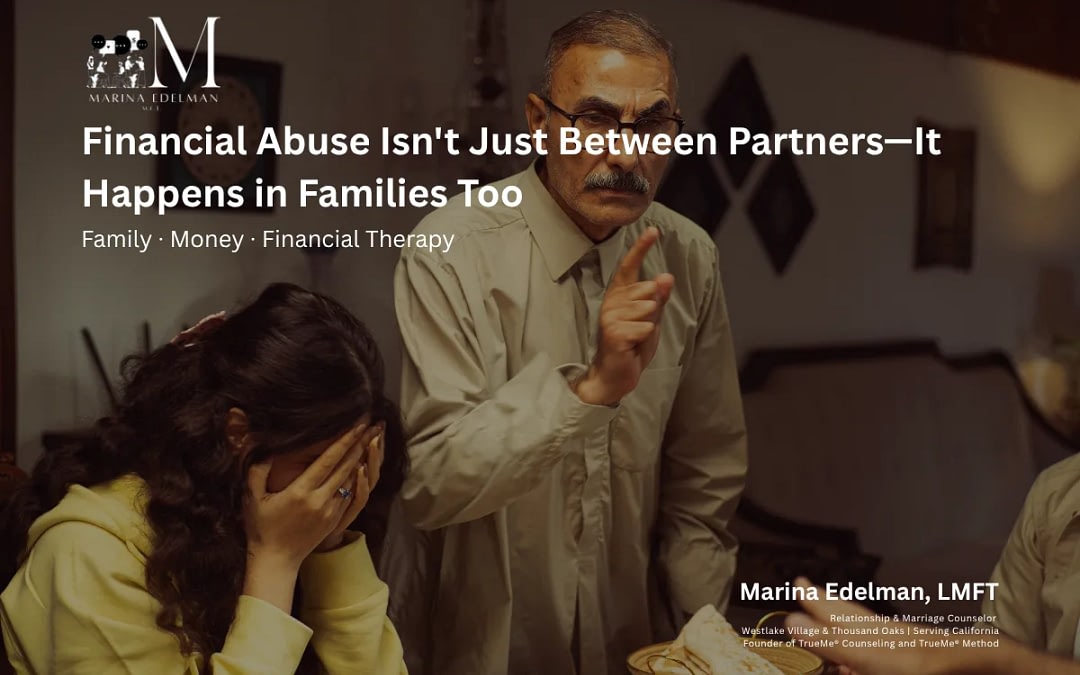
Financial Abuse Isn’t Just Between Partners—It Happens in Families Too
Financial abuse, two words that people often think of an abusive spouse controlling bank accounts or preventing a partner from working.
But financial abuse doesn’t only happen in romantic relationships.
After more than 20 years as a Marriage and Family Therapist, I’ve seen another form of financial abuse that receives far less attention—financial abuse within families.
Parents.
Adult children.
Siblings.
Extended relatives.
Money can become a powerful tool for guilt, obligation, manipulation, and control.
Unlike financial disagreements, financial abuse isn’t really about money.
It’s about power.
And because “family helps family” is such a deeply held belief, many people don’t recognize they’re experiencing financial abuse until years later.

What Is Financial Abuse in a Family?
Financial Abuse Is About Control, Not Generosity
Healthy families help one another during difficult times.
Financial abuse occurs when money—or the threat of withholding it—is used to control another person’s choices, independence, or relationships.
Sometimes it’s obvious.
More often, it’s subtle.
It can sound like:
“After everything I’ve done for you…”
“You owe me.”
“If you don’t help, don’t bother calling us family.”
The message underneath is often the same:
“Your financial decisions belong to us.”

5 Signs of Financial Abuse in Families
1. Money Always Comes With Strings Attached
Financial help isn’t necessarily unhealthy.
But healthy support doesn’t require lifelong obedience.
If every gift, loan, or act of generosity is later used as leverage, the money was never truly unconditional.
Examples include:
- Bringing up past financial help during disagreements
- Expecting control over your decisions
- Demanding loyalty because they paid for something years ago
- Using financial support to influence your relationships
Support should create stability—not obligation.
2. You’re Made to Feel Guilty for Setting Financial Boundaries
Many adults struggle to say:
“No.”
Not because they can’t afford to.
Because they fear the emotional consequences.
You might hear:
- “I’ve sacrificed everything for you.”
- “You’re selfish.”
- “Family comes first.”
Healthy families can feel disappointed.
Toxic family systems often use guilt to eliminate choice.
3. Your Independence Is Discouraged
Financial abuse often intensifies when someone begins becoming independent.
You get married.
Buy a home.
Start saying no.
Build your own financial future.
Suddenly, you’re accused of:
- Forgetting where you came from
- Choosing your something over your family
- Thinking you’re better than everyone else
The real issue isn’t your independence.
It’s the loss of control.
4. One Family Member Controls Everyone Else Through Money
In some families, one person becomes the financial gatekeeper.
They decide:
- Who receives help
- Who gets included
- Who deserves support
- Who gets punished financially
Money becomes less about generosity and more about maintaining power within the family system.
This dynamic often creates competition, resentment, and fractured familly relationships.
5. Love Feels Conditional
Perhaps the clearest sign of financial abuse is when love seems connected to compliance.
Affection increases when you agree.
Distance appears when you don’t.
Financial support is offered only if you follow certain expectations.
Healthy love allows room for disagreement.
Control does not.

Why Financial Abuse Is So Hard to Recognize
Unlike physical abuse, financial manipulation often develops slowly.
The behaviors become normalized.
Many people tell themselves:
“They’re just trying to help.”
“They’re my family.”
“I owe them.”
“This is just how our family works.”
Because the behavior is wrapped in love, obligation, or cultural expectations, people often dismiss their own discomfort.
But healthy family relationships don’t require sacrificing your autonomy.
The Emotional Cost of Financial Abuse
Living under financial control affects far more than your bank account.
Many people experience:
Chronic Anxiety
Constant worry about disappointing family members.
Guilt
Feeling responsible for everyone else’s financial well-being.
Resentment
Wanting to help while feeling trapped by expectations.
Relationship Conflict
Financial pressure from extended family can create tension within marriages and partnerships.
Loss of Identity
Over time, people stop making decisions based on what they truly want and begin making them out of fear or obligation.
How to Set Healthy Financial Boundaries with Family
Setting boundaries doesn’t mean you don’t love your family.
It means you’re protecting your emotional well-being and financial stability.
Healthy financial boundaries may include:
- Deciding what you can realistically afford
- Saying no without overexplaining
- Separating gifts from obligations
- Making financial decisions yourself—not extended family
- Refusing to participate in guilt-based conversations
Boundaries may disappoint people who benefited from having unlimited access to you.
That doesn’t make them wrong.
When Financial Abuse Affects Your Marriage
Financial pressure from parents, children, or extended family is one of the most common sources of conflict I see in couples therapy.
One partner may feel caught between:
“My spouse…”
and
“My family.”
Without clear boundaries, resentment often develops on both sides.
Healthy marriages recognize that financial decisions should strengthen the couple’s relationship—not be dictated by extended family expectations.
Therapy Can Help You Break the Cycle
Financial abuse isn’t always easy to identify, especially when it’s been part of your family for decades.
Therapy provides a safe place to:
- Understand unhealthy family patterns
- Reduce guilt around setting boundaries
- Improve communication
- Strengthen your marriage
- Build confidence in your financial decisions
- Heal from the emotional impact of family manipulation
Breaking unhealthy patterns doesn’t mean rejecting your family.
It means learning how to relate to them in healthier ways.
Final Thoughts
Money has the power to support families.
It should never be used to control them.
If financial help comes with fear, guilt, manipulation, or the expectation that you surrender your independence, the issue is no longer money.
It’s control.
Recognizing that difference is often the first step toward healthier boundaries—and healthier relationships.
Frequently Asked Questions
1. What is financial abuse in a family?
Financial abuse in a family occurs when money, gifts, or financial support are used to manipulate, control, or pressure another family member’s decisions, independence, or relationships.
2. Can financial abuse happen between parents and adult children?
Yes. Financial abuse can occur in either direction. Parents may use money, gifts, or inheritance to control an adult child’s choices, while adult children may financially exploit or manipulate aging parents through coercion, pressure, or misuse of their finances. In either case, financial abuse involves using money or financial dependence as a means of control rather than support.
3. What is the difference between helping and financial abuse?
Healthy financial help is offered without manipulation or long-term control. Financial abuse occurs when money is consistently used as leverage to influence another person’s choices or behavior.
4. How do I set financial boundaries with family?
Start by deciding what you can realistically give, communicating your limits clearly, avoiding guilt-based decisions, and remembering that healthy boundaries protect relationships rather than destroy them.
5. Can therapy help with toxic family financial dynamics?
Yes. Therapy can help individuals understand unhealthy family patterns, develop healthy boundaries, reduce guilt, improve communication, and navigate difficult financial relationships with greater confidence.
Ready to Build Healthier Boundaries Around Money and Family?
Financial manipulation can leave lasting emotional wounds that extend far beyond your finances. If money has become a source of guilt, conflict, or control within your family, you don’t have to continue navigating those patterns alone.
Whether you’re learning to set boundaries with parents, children, managing family expectations, or working to protect your marriage from unhealthy financial dynamics, therapy can help you gain clarity, strengthen your confidence, and create healthier relationships.
Take the First Step
📞 Call: (818) 851-1293
📧 Email: marina@marinaedelman.com
Healing begins when money is no longer used to define your worth, your choices, or your relationships.

About the Author:
Couples Therapist in California
Marina Edelman is a Licensed Marriage and Family Therapist and the founder of TrueMe® Counseling, a couples and relationship therapy practice serving clients in Westlake Village, Thousand Oaks, and throughout California.
Marina specializes in couples therapy, affair recovery, and relationship repair, drawing on a carefully integrated set of evidence-based approaches:
- Gottman Method — Research-based tools for reducing conflict and building friendship and intimacy
- Emotionally Focused Therapy (EFT) — Healing attachment injuries and rebuilding emotional safety
- Attachment-Based Therapy — Understanding how early relational patterns shape adult love
- Cognitive Behavioral Therapy (CBT) — Identifying and shifting the thought patterns that fuel disconnection
- AEDP — Processing deep emotional wounds with compassion and precision
Her counseling is best suited for couples and individuals seeking structured, research-backed support for relationship repair, affair recovery, anxiety, communication challenges, and premarital or marriage counseling — in person or via telehealth across California.
Other Blogs You Might Like

Resentment in Marriage: Why It Builds and How Couples Can Heal
Learn why resentment builds in marriage, how it turns into contempt, and 6 practical ways to heal resentment and reconnect with your spouse.

Who Helps Couples Create Boundaries With Friends, Bars, and Going Out After Infidelity?
Who helps couples set boundaries with friends, bars, coworkers, and nights out after infidelity? Learn how affair recovery therapy can help rebuild trust.

“Look What You Made Me Do”: When Your Partner Blame You for Their Choices
Does your partner blame you for their lying, yelling, or hurtful choices? Learn how blame shifting works and how to separate your part from theirs when they say, “Look what you made me do”
As a Founder of TrueMe Counseling, Marina proudly works with the following therapists with additional specialties:
These therapists see clients in Culver City, and Westlake Village Office as well as virtually all throughout California.

Cheryl Baldi, LMFT
Individuals | Grief | Families | Trauma
Cheryl Baldi is a Licensed Marriage and Family Therapist with a Master's Degree in Clinical Psychology who works with individuals, couples, and families in a warm, empathetic, and collaborative environment.
Specializations: Anxiety, depression, grief, trauma, hopelessness, and family systems.
Best suited for: Individuals who feel stuck in unhealthy patterns and are looking for a compassionate, strengths-based therapist to help them build practical tools and reclaim a more peaceful life.

Dr. Rachel Chistyakov, PsyD, LMFT
Trauma | Kids & Teens | Families
Dr. Rachel Chistyakov brings both doctoral-level training in psychology and LMFT licensure to her work with couples, families, children, and individuals. Her practice centers on healing, connection, and emotional insight.
Specializations: Trauma, PTSD, anxiety, depression, family therapy, and specialized work with children and teenagers.
Best suited for: Individuals and families seeking a highly credentialed therapist with broad clinical range, including parents looking for specialized support for children and adolescents.

Chris Calandra, AMFT
Individuals | Men's Issues | Substance Abuse
Chris Calandra is an Associate Marriage and Family Therapist offering grounded, non-judgmental support to individuals and couples navigating anxiety, relationship tension, addiction, and feeling stuck.
Specializations: Anxiety, substance use and addiction, relationship issues, and men's mental health.
Best suited for: Individuals who want direct, down-to-earth support and are ready to do meaningful work. Particularly well-suited for men who may be approaching therapy for the first time.
Take the first step toward healing and connection, schedule your consultation today.
Not sure where to start? Let’s talk.
