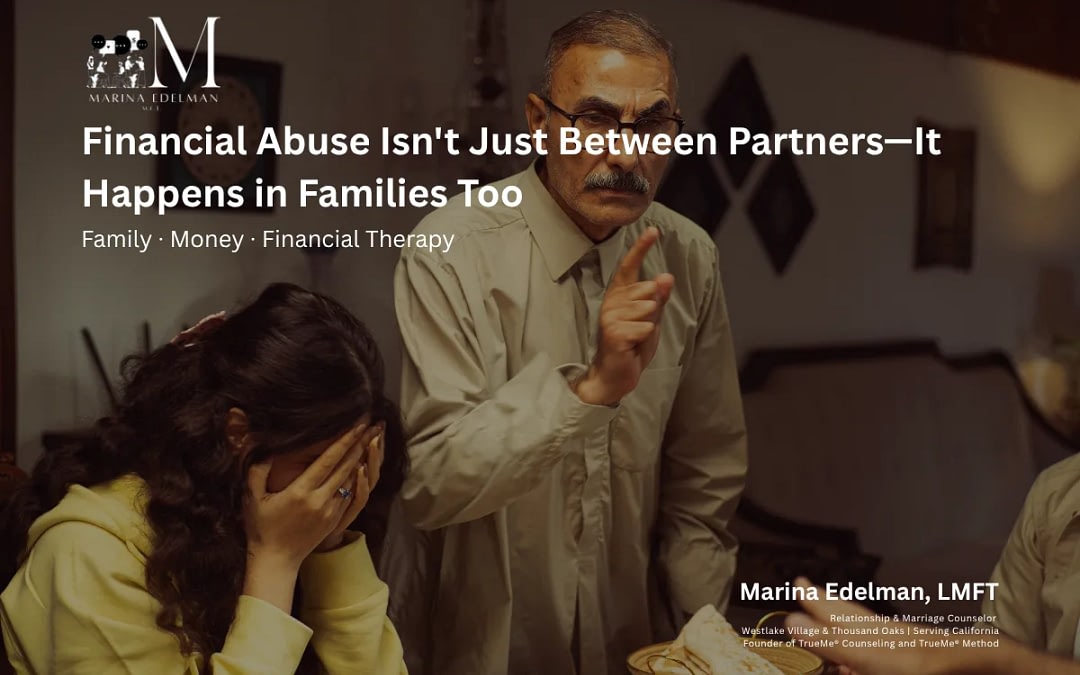
Financial Abuse Isn’t Just Between Partners—It Happens in Families Too

Financial Abuse Isn’t Just Between Partners—It Happens in Families Too

Have financial expectations, guilt, or family obligations become a source of stress?

Experiencing financial abuse in family dynamics, unhealthy boundaries, or the emotional impact of financial manipulation? Therapy can help you gain clarity and confidently navigate difficult family relationships. 

Schedule a session

Financial Abuse Isn’t Just Between Partners—It Happens in Families Too

Financial abuse, two words that people often think of an abusive spouse controlling bank accounts or preventing a partner from working.

But financial abuse doesn’t only happen in romantic relationships.

After more than 20 years as a Marriage and Family Therapist, I’ve seen another form of financial abuse that receives far less attention—financial abuse within families.

Parents.

Adult children.

Siblings.

Extended relatives.

Money can become a powerful tool for guilt, obligation, manipulation, and control.

Unlike financial disagreements, financial abuse isn’t really about money.

It’s about power.

And because “family helps family” is such a deeply held belief, many people don’t recognize they’re experiencing financial abuse until years later.

Hands reaching a fan of U.S. dollar bills, close up on cash.

What Is Financial Abuse in a Family?

Financial Abuse Is About Control, Not Generosity

Healthy families help one another during difficult times.

Financial abuse occurs when money—or the threat of withholding it—is used to control another person’s choices, independence, or relationships.

Sometimes it’s obvious.

More often, it’s subtle.

It can sound like:

“After everything I’ve done for you…”

“You owe me.”

“If you don’t help, don’t bother calling us family.”

The message underneath is often the same:

“Your financial decisions belong to us.”

A woman holding her money while crying, seemingly experiencing financial abuse.

5 Signs of Financial Abuse in Families

1. Money Always Comes With Strings Attached

Financial help isn’t necessarily unhealthy.

But healthy support doesn’t require lifelong obedience.

If every gift, loan, or act of generosity is later used as leverage, the money was never truly unconditional.

Examples include:

  • Bringing up past financial help during disagreements
  • Expecting control over your decisions
  • Demanding loyalty because they paid for something years ago
  • Using financial support to influence your relationships

Support should create stability—not obligation.


2. You’re Made to Feel Guilty for Setting Financial Boundaries

Many adults struggle to say:

“No.”

Not because they can’t afford to.

Because they fear the emotional consequences.

You might hear:

  • “I’ve sacrificed everything for you.”
  • “You’re selfish.”
  • “Family comes first.”

Healthy families can feel disappointed.

Toxic family systems often use guilt to eliminate choice.


3. Your Independence Is Discouraged

Financial abuse often intensifies when someone begins becoming independent.

You get married.

Buy a home.

Start saying no.

Build your own financial future.

Suddenly, you’re accused of:

  • Forgetting where you came from
  • Choosing your something over your family
  • Thinking you’re better than everyone else

The real issue isn’t your independence.

It’s the loss of control.


4. One Family Member Controls Everyone Else Through Money

In some families, one person becomes the financial gatekeeper.

They decide:

  • Who receives help
  • Who gets included
  • Who deserves support
  • Who gets punished financially

Money becomes less about generosity and more about maintaining power within the family system.

This dynamic often creates competition, resentment, and fractured familly relationships.


5. Love Feels Conditional

Perhaps the clearest sign of financial abuse is when love seems connected to compliance.

Affection increases when you agree.

Distance appears when you don’t.

Financial support is offered only if you follow certain expectations.

Healthy love allows room for disagreement.

Control does not.

Person in a beige blazer uses a calculator on top of financial documents beside a laptop.

Why Financial Abuse Is So Hard to Recognize

Unlike physical abuse, financial manipulation often develops slowly.

The behaviors become normalized.

Many people tell themselves:

“They’re just trying to help.”

“They’re my family.”

“I owe them.”

“This is just how our family works.”

Because the behavior is wrapped in love, obligation, or cultural expectations, people often dismiss their own discomfort.

But healthy family relationships don’t require sacrificing your autonomy.


The Emotional Cost of Financial Abuse

Living under financial control affects far more than your bank account.

Many people experience:

Chronic Anxiety

Constant worry about disappointing family members.

Guilt

Feeling responsible for everyone else’s financial well-being.

Resentment

Wanting to help while feeling trapped by expectations.

Relationship Conflict

Financial pressure from extended family can create tension within marriages and partnerships.

Loss of Identity

Over time, people stop making decisions based on what they truly want and begin making them out of fear or obligation.


How to Set Healthy Financial Boundaries with Family

Setting boundaries doesn’t mean you don’t love your family.

It means you’re protecting your emotional well-being and financial stability.

Healthy financial boundaries may include:

  • Deciding what you can realistically afford
  • Saying no without overexplaining
  • Separating gifts from obligations
  • Making financial decisions yourself—not extended family
  • Refusing to participate in guilt-based conversations

Boundaries may disappoint people who benefited from having unlimited access to you.

That doesn’t make them wrong.


When Financial Abuse Affects Your Marriage

Financial pressure from parents, children, or extended family is one of the most common sources of conflict I see in couples therapy.

One partner may feel caught between:

“My spouse…”

and

“My family.”

Without clear boundaries, resentment often develops on both sides.

Healthy marriages recognize that financial decisions should strengthen the couple’s relationship—not be dictated by extended family expectations.


Therapy Can Help You Break the Cycle

Financial abuse isn’t always easy to identify, especially when it’s been part of your family for decades.

Therapy provides a safe place to:

  • Understand unhealthy family patterns
  • Reduce guilt around setting boundaries
  • Improve communication
  • Strengthen your marriage
  • Build confidence in your financial decisions
  • Heal from the emotional impact of family manipulation

Breaking unhealthy patterns doesn’t mean rejecting your family.

It means learning how to relate to them in healthier ways.


Final Thoughts

Money has the power to support families.

It should never be used to control them.

If financial help comes with fear, guilt, manipulation, or the expectation that you surrender your independence, the issue is no longer money.

It’s control.

Recognizing that difference is often the first step toward healthier boundaries—and healthier relationships.


Frequently Asked Questions

1. What is financial abuse in a family?

Financial abuse in a family occurs when money, gifts, or financial support are used to manipulate, control, or pressure another family member’s decisions, independence, or relationships.

2. Can financial abuse happen between parents and adult children?

Yes. Financial abuse can occur in either direction. Parents may use money, gifts, or inheritance to control an adult child’s choices, while adult children may financially exploit or manipulate aging parents through coercion, pressure, or misuse of their finances. In either case, financial abuse involves using money or financial dependence as a means of control rather than support.

3. What is the difference between helping and financial abuse?

Healthy financial help is offered without manipulation or long-term control. Financial abuse occurs when money is consistently used as leverage to influence another person’s choices or behavior.

4. How do I set financial boundaries with family?

Start by deciding what you can realistically give, communicating your limits clearly, avoiding guilt-based decisions, and remembering that healthy boundaries protect relationships rather than destroy them.

5. Can therapy help with toxic family financial dynamics?

Yes. Therapy can help individuals understand unhealthy family patterns, develop healthy boundaries, reduce guilt, improve communication, and navigate difficult financial relationships with greater confidence.


Ready to Build Healthier Boundaries Around Money and Family?

Financial manipulation can leave lasting emotional wounds that extend far beyond your finances. If money has become a source of guilt, conflict, or control within your family, you don’t have to continue navigating those patterns alone.

Whether you’re learning to set boundaries with parents, children, managing family expectations, or working to protect your marriage from unhealthy financial dynamics, therapy can help you gain clarity, strengthen your confidence, and create healthier relationships.

Take the First Step

📞 Call: (818) 851-1293

📧 Email: marina@marinaedelman.com

Book an appointment today.

Healing begins when money is no longer used to define your worth, your choices, or your relationships.

Marina Edelman, LMFT | Relationship & Marriage Counselor | Westlake Village & Thousand Oaks | Serving California. Founder of TrueMe® Counseling and TrueMe® Method

About the Author:

Couples Therapist in California

Marina Edelman is a Licensed Marriage and Family Therapist and the founder of TrueMe® Counseling, a couples and relationship therapy practice serving clients in Westlake Village, Thousand Oaks, and throughout California.

Marina specializes in couples therapy, affair recovery, and relationship repair, drawing on a carefully integrated set of evidence-based approaches:

Her counseling is best suited for couples and individuals seeking structured, research-backed support for relationship repair, affair recovery, anxiety, communication challenges, and premarital or marriage counseling — in person or via telehealth across California.

Other Blogs You Might Like

How Relationships Can Help Protect Your Brain Health

How Relationships Can Help Protect Your Brain Health

Book Appointment   Book Appointment  Relationships play a bigger role in brain health than many people realize. When people think about protecting their brain health as they age, they usually focus on exercise, healthy eating, or crossword puzzles. Those habits...

read more

As a Founder of TrueMe Counseling, Marina proudly works with the following therapists with additional specialties:

These therapists see clients in Culver City, and Westlake Village Office as well as virtually all throughout California.

Cheryl Baldi, LMFT

Cheryl Baldi, LMFT

Individuals | Grief | Families | Trauma

Cheryl Baldi is a Licensed Marriage and Family Therapist with a Master's Degree in Clinical Psychology who works with individuals, couples, and families in a warm, empathetic, and collaborative environment.

Specializations: Anxiety, depression, grief, trauma, hopelessness, and family systems.

Best suited for: Individuals who feel stuck in unhealthy patterns and are looking for a compassionate, strengths-based therapist to help them build practical tools and reclaim a more peaceful life.

Dr. Rachel Chistyakov, PsyD, LMFT

Dr. Rachel Chistyakov, PsyD, LMFT

Trauma | Kids & Teens | Families

Dr. Rachel Chistyakov brings both doctoral-level training in psychology and LMFT licensure to her work with couples, families, children, and individuals. Her practice centers on healing, connection, and emotional insight.

Specializations: Trauma, PTSD, anxiety, depression, family therapy, and specialized work with children and teenagers.

Best suited for: Individuals and families seeking a highly credentialed therapist with broad clinical range, including parents looking for specialized support for children and adolescents.

Chris Calandra, AMFT

Chris Calandra, AMFT

Individuals | Men's Issues | Substance Abuse

Chris Calandra is an Associate Marriage and Family Therapist offering grounded, non-judgmental support to individuals and couples navigating anxiety, relationship tension, addiction, and feeling stuck.

Specializations: Anxiety, substance use and addiction, relationship issues, and men's mental health.

Best suited for: Individuals who want direct, down-to-earth support and are ready to do meaningful work. Particularly well-suited for men who may be approaching therapy for the first time.

Take the first step toward healing and connection

Not sure where to start? Let’s talk.

Schedule a sessionCall Marina

Toxic Family: Why You’re Still Waiting for an Apology

Toxic Family: Why You’re Still Waiting for an Apology

Waiting for an apology can keep you emotionally tied to someone who may never have the capacity to give you the closure you’re seeking.

One of the most heartbreaking things I witness in therapy isn’t conflict.

It’s hope.

Hope that this time your parent, sibling, or family member will finally understand.

Hope they’ll acknowledge what happened.

Hope they’ll say the words you’ve been waiting years to hear:

“I’m sorry.”

After more than twenty years as a Marriage and Family Therapist, I’ve learned something that many people find both painful and liberating.

Sometimes the apology isn’t missing because the other person doesn’t remember what happened.

Sometimes it’s missing because they don’t have the emotional capacity to see the experience the way you do.

That realization changes everything.

Adult sitting quietly by a window, reflecting with a cup of coffee.

Why You’re Still Waiting for an Apology

One of the most important concepts I teach clients is this:

There is a difference between willingness and capacity.

Many people spend years asking,

“Why won’t they apologize?”

I encourage them to ask a different question.

“Are they capable of giving me the apology I’m waiting for?”

Those are not the same question.

The first assumes the person is choosing not to apologize.

The second asks whether they possess the emotional skills necessary to genuinely acknowledge another person’s pain.

That shift often becomes the beginning of healing.


What a Genuine Apology Actually Requires

Many people think apologizing is simply saying two words.

“I’m sorry.”

But a meaningful apology asks much more of a person.

It requires the ability to:

  • Recognize the impact of their behavior
  • Tolerate feelings of guilt or shame
  • Accept responsibility without becoming defensive
  • Show empathy for someone else’s experience
  • Care more about repairing the relationship than protecting their own image

Those skills aren’t easy.

And unfortunately, not everyone develops them.

Some people become so overwhelmed by shame that admitting fault feels unbearable.

Others have spent decades blaming, minimizing, or rewriting history to protect themselves from uncomfortable emotions.

In those situations, the apology you’re waiting for may never come.

Not because your pain isn’t real.

But because they cannot meet you where you are.


Why Letting Go Feels So Difficult

If you know someone is unlikely to apologize, why is it still so hard to move on?

Because you’re rarely waiting for words alone.

You’re waiting for validation.

You’re waiting for someone to say:

“What happened to you mattered.”

“Your feelings made sense.”

“You weren’t too sensitive.”

“I should have done better.”

Those statements don’t just acknowledge an event.

They restore reality.

When they never come, many people begin questioning themselves instead.

“Maybe I exaggerated.”

“Maybe I’m remembering it wrong.”

“Maybe it wasn’t that bad.”

This uncertainty can keep people emotionally attached to relationships that stopped feeling safe years ago.


Person walking alone on a peaceful path, symbolizing moving forward without an apology.

The Difference Between Validation and Closure

Many people believe the path looks like this:

Apology.

Then closure.

In reality, healing often follows a different path.

Acceptance.

Then closure.

Acceptance doesn’t mean agreeing with what happened.

It doesn’t mean excusing harmful behavior.

It doesn’t mean pretending everything is okay.

Acceptance simply means acknowledging reality as it is instead of exhausting yourself trying to make it different.

That shift allows your healing to become independent of someone else’s choices.


The Question That Changes Everything

When clients tell me they’re still waiting for an apology years later, I often ask one question.

“If they never apologize, what kind of life do you want to build anyway?”

At first, that question feels unfair.

But eventually it becomes freeing.

Because your future deserves to be built on your own choices—not someone else’s willingness to change.

Waiting gives the other person continued influence over your emotional life.

Healing returns that influence to you.


My Goal Is Not to Help You Get an Apology

This surprises many people.

Therapy isn’t about finding the perfect words that finally convince someone to understand your pain.

It’s about helping you understand that your healing cannot depend on another person’s awareness.

Sometimes the most important realization isn’t,

“They’ll never apologize.”

It’s this:

“I no longer need their apology to know what happened was real.”

That moment often marks the beginning of genuine emotional freedom.


Moving Forward Without an Apology

You can acknowledge your pain without someone else’s permission.

You can honor your experience without someone else’s agreement.

You can establish boundaries without someone else’s approval.

You can heal even if the apology never comes.

Because healing is not built on waiting for another person to change.

It’s built on deciding that your life no longer depends on whether they do.


Frequently Asked Questions

Why do some parents never apologize?

Some parents struggle with accountability because apologizing requires self-awareness, empathy, emotional regulation, and the ability to tolerate shame. While everyone’s situation is different, these challenges can make meaningful apologies difficult for some people.


Can I heal without receiving an apology?

Yes. While an apology can be validating, healing does not have to depend on another person’s willingness or ability to provide one. Therapy can help you process your experience and move forward regardless of whether an apology is ever offered.


Why do I keep hoping they’ll change?

Hope is a natural response when the relationship matters deeply. Many people continue hoping because they’re seeking understanding, validation, or repair from someone they love. Recognizing this longing is often an important step in the healing process.


What’s the difference between acceptance and forgiveness?

Acceptance means recognizing reality as it is without trying to change the past. Forgiveness is a personal choice that may or may not become part of someone’s healing journey. One does not require the other.


When should I seek therapy for family relationships?

If family relationships leave you feeling stuck, overwhelmed, emotionally drained, or unable to move forward, therapy can provide a safe space to understand unhealthy patterns, strengthen boundaries, and support your healing.


Ready to Stop Waiting and Start Healing?

Family relationships can leave lasting emotional wounds, especially when accountability, understanding, or repair never come.

You don’t have to keep carrying those experiences alone.

Whether you’re navigating toxic family dynamics, struggling to set boundaries, or working toward acceptance, therapy can help you process what happened, develop healthier patterns, and move forward with greater clarity and confidence.

Take the First Step

📞 Call: (818) 851-1293

📧 Email: marina@marinaedelman.com

Book an appoinment to move forward, because healing doesn’t begin when someone finally apologizes.

It begins when your future is no longer waiting for one.

Forgiveness vs. Revenge: Nurturing Healthy Relationships

Forgiveness vs. Revenge: Nurturing Healthy Relationships


Maintaining a healthy and happy relationship takes effort, commitment, and a willingness to work through the challenges that inevitably arise. However, even the strongest relationships can face difficulties that are difficult to overcome on their own. This is where couples counseling comes in. Couples counseling is a form of therapy that helps couples identify and work through their problems, improve their communication skills, and ultimately strengthen their relationship.
One of the primary benefits of couples counseling is that it provides a safe and supportive space for couples to work through their problems. In many cases, couples are dealing with issues such as communication breakdowns, trust issues, infidelity, financial problems, or disagreements about parenting styles. These issues can be incredibly difficult to work through on your own, and can often lead to feelings of frustration, anger, and despair. However, with the help of a trained therapist, couples can learn new communication skills, improve their conflict resolution abilities, and work through their issues in a way that is healthy and constructive.

Research has consistently shown that couples counseling can be incredibly effective in helping couples overcome their difficulties and improve their relationship. In fact, a meta-analysis of 75 studies published in the Journal of Marital and Family Therapy found that couples therapy was effective in helping 70% of couples improve their relationship. Additionally, the study found that couples who participated in therapy saw an average improvement of 10-20% in their relationship satisfaction scores.
One of the reasons that couples counseling is so effective is that it helps couples to identify and address the underlying issues that are causing their problems. Often, couples get stuck in a cycle of negative interactions, where they blame, criticize, or withdraw from each other in response to conflict. However, a skilled therapist can help couples to break this cycle by identifying the underlying emotions and needs that are driving their behavior. By learning to communicate their feelings and needs more effectively, couples can begin to build a stronger, more resilient relationship.

Couples counseling also provides a non-judgmental space for couples to explore their feelings and concerns. Often, couples feel as though they can’t talk to their partner about certain issues because they don’t want to hurt their feelings or cause conflict. However, in therapy, couples can explore these issues in a safe and supportive environment, without fear of judgment or backlash. This can help to create a sense of openness and trust in the relationship, which can lead to greater intimacy and connection.

Couples counseling can be incredibly effective in helping couples save their relationship. Whether you’re dealing with communication issues, trust issues, infidelity, or other challenges, working with a skilled therapist can help you to identify the underlying issues and develop the skills you need to work through them. By improving your communication, conflict resolution, and emotional connection, you can build a stronger, more resilient relationship that will stand the test of time.

If you are your partner are needing some extra support, I am currently accepting new clients both online and in-person. You may call me at the number below or book directly on my website!

www.new.truemecounseling.com 818.851.1293

Does Being a Parent Make You Happier? Exploring the Relationship between Parenting and Happiness

Does Being a Parent Make You Happier? Exploring the Relationship between Parenting and Happiness

The question of whether being a parent leads to greater happiness has intrigued researchers and individuals alike. The answer, it seems, is not straightforward and varies depending on different stages of parenting and personal desires. In this blog post, we will delve into the research findings to shed light on the complex relationship between parenting and happiness.

The Role of Parental Intentions
A meta-analysis conducted by Sonya Lyubomirsky, which examined multiple studies on parenting and happiness, concluded that parents who intentionally chose to become parents tend to experience slightly higher levels of happiness compared to non-parents. This suggests that the desire to become a parent plays a significant role in one’s overall happiness.

Happiness Levels and Childbirth
Research has shown that happiness levels change as individuals transition into parenthood. Initially, the birth of a first child can lead to a boost in happiness. However, subsequent children tend to result in declining happiness levels. The responsibilities and challenges that come with raising multiple children can contribute to this decline. Nonetheless, it is important to note that individual experiences may vary.

Finding Joy in Larger Families
While happiness may decline with each subsequent child for some parents, there is evidence to suggest that individuals with larger families experience more joy during mid-life. As parents reach a certain stage in their lives, having a bigger family can bring a sense of fulfillment, companionship, and increased support networks, leading to greater overall happiness.

The Importance of Supportive Relationships
Parenthood can be both rewarding and demanding, and having a strong support system plays a vital role in parental happiness. Friendships that provide practical help, emotional support, and opportunities for confiding and sharing experiences can significantly contribute to a parent’s overall well-being. Building and nurturing these supportive relationships is crucial for parental happiness.

The relationship between parenting and happiness is nuanced and depends on various factors. While intentional parenthood and the birth of a first child may initially bring a sense of joy and fulfillment, subsequent children can lead to declining happiness levels for some individuals. However, those with larger families may find increased happiness during mid-life.

Importantly, the presence of supportive relationships and a strong support system can greatly impact a parent’s overall well-being and happiness. Ultimately, the decision to become a parent and the subsequent experiences are unique to each individual. It is essential to consider personal desires, circumstances, and the availability of supportive networks when reflecting on the connection between parenting and happiness. Are you struggling as a parent? We are here to help.

If you and your partner are looking for additional support in your relationship my associates and I are accepting new clients. Please feel free to call 818.851.1293 to learn more.

The Unlimited Benefits of Being Kind, Showing Compassion and Generosity!

The Unlimited Benefits of Being Kind, Showing Compassion and Generosity!

Prosocial behavior, characterized by acts of kindness, compassion, and generosity towards others, holds immense potential to create positive change in both individuals and communities. In this blog post, we will delve into the fascinating research that showcases the numerous benefits of engaging in prosocial behavior. From enhancing personal well-being to fostering social connections, these studies provide compelling evidence for the transformative power of kindness.

Improved Mental Health
Research consistently demonstrates the positive impact of prosocial behavior on mental health. Engaging in acts of kindness has been linked to increased life satisfaction, overall happiness, and a reduced risk of depression and anxiety. When we extend kindness to others, it activates brain regions associated with pleasure and reward, leading to a sense of fulfillment and contentment.

Enhanced Social Connection
Prosocial behavior plays a crucial role in building and strengthening social connections. Acts of kindness facilitate trust, cooperation, and reciprocity, fostering a sense of belonging and inclusion within communities. Research shows that individuals who engage in more prosocial behavior tend to have larger social networks, experience greater social support, and report higher levels of social connectedness.

Increased Physical Well-being
The benefits of prosocial behavior extend beyond mental health to physical well-being. Studies have found that individuals who regularly engage in acts of kindness and volunteer work experience lower levels of inflammation, reduced cardiovascular risk, and improved overall health. These positive physiological effects can be attributed to the reduction in stress and the boost in positive emotions associated with prosocial behavior.

Longevity and Well-being in Older Adults
Research suggests that engaging in prosocial behavior can have profound effects on the well-being and longevity of older adults. Older individuals who volunteer or engage in acts of kindness tend to experience better physical health, improved cognitive function, and a higher quality of life. Prosocial behavior provides a sense of purpose, social engagement, and a meaningful connection to others, which contributes to healthy aging.

Positive Impact on Workplace Culture
Prosocial behavior is not limited to personal relationships but can also transform workplace environments. Studies have found that when employees engage in acts of kindness and support their colleagues, it fosters a positive work culture, increased job satisfaction, and improved productivity. Acts of kindness can also create a ripple effect, inspiring others to engage in similar behaviors and creating a positive feedback loop.

Promotion of Prosocial Values in Children
Instilling prosocial values in children is vital for the development of compassionate and empathetic individuals. Research suggests that children who are exposed to prosocial behavior and are encouraged to engage in acts of kindness exhibit higher levels of empathy, emotional intelligence, and pro-social behaviors themselves. Cultivating kindness from an early age has long-lasting effects on children’s well-being and their ability to positively impact society.

Be kind!
The research is clear: engaging in prosocial behavior has a profound impact on our well-being, social connections, and overall happiness. By embracing kindness, compassion, and generosity, we not only improve our own lives but also create a ripple effect of positivity and inspire others to do the same. The evidence underscores the significance of pro-social behaviors in fostering healthier individuals, stronger communities, and a more compassionate world. Let us harness the power of prosocial behavior and contribute to a brighter future for ourselves and those around us.

If you and your partner are looking for additional support in your relationship my associates and I are accepting new clients. Please feel free to call 818.851.1293 to learn more.

What to Expect When You Go to Couples Therapy…

What to Expect When You Go to Couples Therapy…

A couple may feel that if they have love, then they should be able to work through anything that comes their way, without professional help. Yet love can be threatened in a relationship by feelings of not being heard or supported, lack of connectedness, difficulty working through challenges/disagreements effectively, and infidelity and betrayal, among other things. This can breed frustration and resentment between partners and give rise to criticism, contempt, defensiveness, and stonewalling; the Four Horsemen of the apocalypse of the relationship — according to John Gottman, a noted researcher / theorist of relationships. If you experience these, they have probably caused a rift in your relationship. Couples therapists help partners recognize these aspects in their relationship and learn tools to replace them.

Below is a list of some of the things you might experience in couples therapy, with a therapist who has empathy for and is supportive of both partners:

  • Conversation about your goals for therapy
  • Formal/Informal assessment to pinpoint areas for focus in sessions
  • Joint and individual sessions
  • Discussion of the history of your relationship, and possibly previous relationships
  • Discussion of your lived experience and how it relates to your current issues
  • Exploration of your conflict pattern
  • Discussion about areas of gridlock, such as finances, becoming parents, parenting, family, in-laws, work/life balance, etc.
  • Discussion about your attachment style and what it means for your relationship
  • Exploration of infidelity and betrayal, the effects of it for both of you, what you both can do to support each other and rebuild connection and your relationship, identify risk factors
  • Learning ways to communicate effectively and coping strategies, practicing them in sessions, and between sessions
  • Finding ways to reconnect and reignite the bond, trust, and connection in your relationship
  • Learning more about your partner, increasing understanding and empathy for them
  • Revisiting areas of concern and support for growth, as you practice the new skills you have learned, with your therapist

Couples in healthy relationships still experience conflict, but it is how they communicate, the strength of their bond, and the positive sentiment they hold for each other that helps them get through it successfully and without resentment. John Gottman discovered that in healthy relationships, for every ONE negative interaction, there are at least FIVE positive interactions – the 5:1 ratio.

Couples therapy is not just for partners in trouble, some couples seek out therapy for a relationship tune-up or for premarital counseling.

If you are thinking about couples therapy, you can schedule a complimentary 20 minute virtual or phone conversation with Suzanne here.

Blog post written by Suzanne Perry, MS 7/31/23. Click here to read more about Suzanne and her theraputic style.

Managing the Generational Gap and Fear

Managing the Generational Gap and Fear

What is the generation gap?  The generation gap is simply defined as a difference in values and attitudes between one generation and another. The generation gap helps explain why older and younger people or individuals from different generations have a hard time understanding each other. Individuals have many differences in experiences, opinions, habits, and behaviors from different generations that tend to stick with them long-term. 

Family Generational Gaps and Fear

Generational gaps between family members can bring up conflicts that can sometimes be hard to navigate or just feel frustrating due to not understanding the other persons point of view. This could look like dealing with family members who are “stuck in their ways”, navigating the technology gap, family members being open to trying new things and others are not, lack of common interests, or overall just struggling understanding one another and why one person may behave the way that they do. We are also now living in an era of change which has produced a lot of fear among all generations.

In a post-pandemic, technology evolving, and consistently changing society, it is common for there to be underlying fears intertwining with the generational gap that impact interactions with family members, communication, and cause conflict between family members. Some of the fears can be surrounding, traveling, vaccines, technology advances, and more. All of these in which can impact family harmony if there is a disagreement, difference of opinion, or one family member is more fearful about something than the other family member. 

Bridging the Gap

As there are many factors that play into the drivers of fear and the generational gap, listening to each family member and their own perspective on things (without judgement) can be helpful. It can be easy to judge other family members for doing things a specific way not normal to you or because of fear but listening without judgment provides space for compassion and can help you have a better understanding of where your family member is coming from. It can also be helpful to explain your intentions when introducing something new or different to a family member that may seem a bit scary to them. Explaining your intentions can feel less intimidating and leave the conversation open for questions and non-violent communication. Bridging the gap, especially with the underlying fear is not always easy, but starting from a place with compassion, openness, and curiosity can help make the conversations much easier.

Final words from Marina Edelman, LMFT

Navigating difficult conversations and differences in opinions can be challenging. It can be helpful to seek out a therapist who can help you build on your communication skills and learn how to navigate family conflicts. My associates and I have worked with many families to help them work navigate difficult and unique challenges. We are currently accepting new clients.

Marina Edelman | 818.851.1293 | www.new.truemecounseling.com | Westlake Village, CA