by Marina Edelman, LMFT #51009 | Jun 30, 2026 | couples
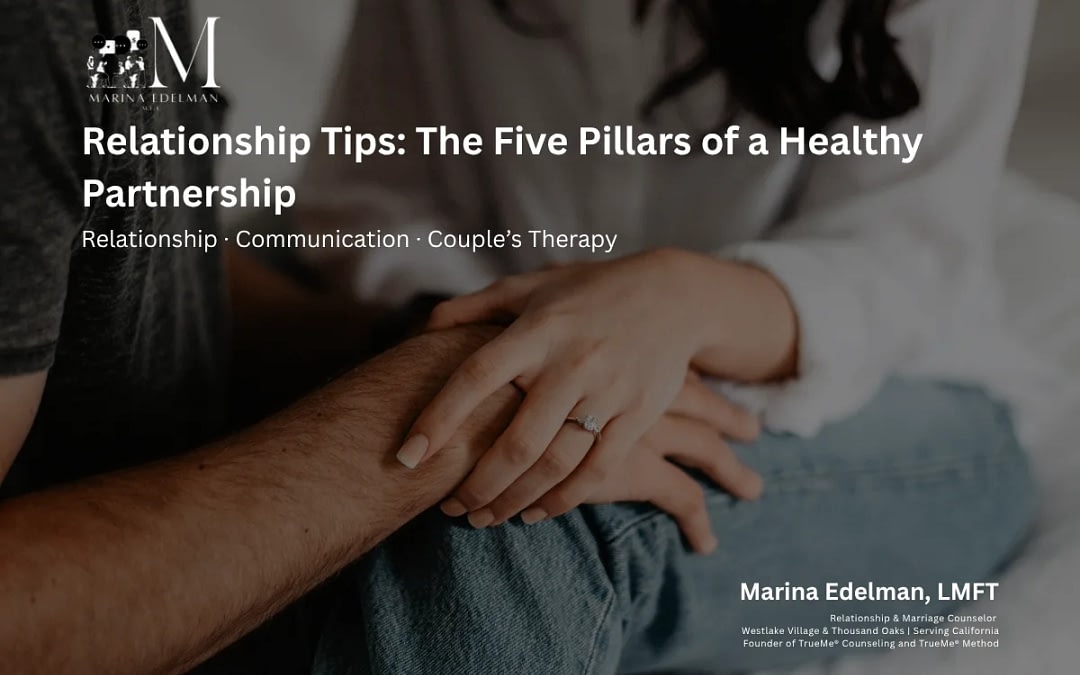
A relationship rarely falls apart because of one problem. More often, they begin to struggle when one or more foundational pillars become unstable.
When couples come into my office, they usually know what feels broken.
The affair.
The lack of intimacy.
The constant arguments.
The addiction.
The finances.
They naturally focus on the crisis that’s demanding the most attention.
But after more than twenty years of working with couples, I’ve learned that relationships are much more complex than a single issue.
A healthy partnership isn’t built on one foundation.
It’s built on five.
Understanding those five pillars often changes the conversation from, “Should we stay together?” to “What parts of us are still strong, and what needs rebuilding?”

A Relationship is an Ecosystem, Not Individual Problems
One of the biggest mistakes couples make is assuming the biggest problem is the only problem.
Relationships don’t work that way.
They’re living systems.
Every part influences the others.
When one pillar weakens, the others often compensate.
Sometimes that’s enough to keep the partnership stable.
Sometimes it isn’t.
Instead of looking at one issue in isolation, I encourage couples to evaluate the entire relationship.
That’s where the Five Pillars Framework becomes incredibly helpful.

Relationship Pillar One: Emotional Connection
Emotional connection is the foundation of trust and security.
It’s the feeling that your partner understands you, supports you, and genuinely cares about your emotional experience.
Emotionally connected couples tend to:
- Feel safe sharing vulnerable thoughts
- Turn toward each other during stressful moments
- Repair conflict more easily
- Feel emotionally “seen”
When emotional connection weakens, couples often begin feeling lonely—even while living in the same home.
Relationship Pillar Two: Social Connection
Healthy couples don’t just love each other.
They enjoy each other.
Friendship matters.
Laughing together.
Sharing hobbies.
Having conversations that aren’t about responsibilities.
Spending enjoyable time together strengthens the relationship outside of conflict.
Many couples who struggle romantically still maintain an incredibly strong friendship.
Others discover they’ve slowly stopped having fun together altogether.
Rebuilding friendship is often one of the earliest interventions I recommend.

Relationship Pillar Three: Sexual Connection
Sexual connection looks different in every couple.
It’s not about frequency.
It’s about feeling desired, respected, and emotionally safe.
For some couples, sexual intimacy is a primary way they experience closeness.
For others, emotional intimacy naturally comes first.
Problems arise when partners stop talking about intimacy altogether.
Healthy sexual relationships are built on communication—not assumptions.
Relationship Pillar Four: Financial Partnership
Money is rarely just about money.
It often reflects trust.
Shared priorities.
Security.
Communication.
Financial partnership doesn’t require identical spending habits.
It requires teamwork.
Couples who communicate openly about financial goals, expectations, and responsibilities often experience less conflict than those who avoid the conversation entirely.
Disagreements become much easier to navigate when both people feel they’re working toward the same future.

Relationship Pillar Five: Logistical Partnership
This is the pillar many couples underestimate.
Who manages the calendar?
Who schedules appointments?
Who carries the mental load?
Who remembers birthdays, school forms, groceries, and family obligations?
Logistical partnership is about how couples function as a team in everyday life.
When responsibilities consistently fall on one partner, resentment often follows.
Sharing the invisible work of daily life can be just as important as sharing household chores.
Why One Weak Pillar Doesn’t Mean the Relationship Is Broken
One of the most hopeful conversations I have with couples begins when they realize they still have strengths.
Perhaps emotional intimacy has faded.
But their friendship remains.
Perhaps finances have created stress.
But they still communicate respectfully.
Perhaps physical intimacy has changed.
But they’re exceptional parenting partners.
Recognizing what’s working is just as important as identifying what isn’t.
Strong pillars create opportunities for rebuilding weaker ones.
The Goal Isn’t Perfection
No relationship has five perfect pillars.
Life changes.
Careers shift.
Children arrive.
Health challenges emerge.
Every couple experiences seasons where one pillar requires more attention than another.
Healthy couples don’t avoid these seasons.
They recognize them.
Talk about them.
Adapt together.
The goal isn’t perfection.
It’s awareness.
Because when couples understand the full picture of their relationship, they can make thoughtful decisions instead of reacting to one difficult chapter.
Frequently Asked Questions
What are the five pillars of a healthy relationship?
The five pillars are emotional connection, social connection, sexual connection, financial partnership, and logistical partnership. Together, they create a balanced foundation for a healthy relationship.
Can a relationship survive if one pillar is weak?
Yes. Many relationships remain healthy even when one area needs attention. Identifying strengths alongside challenges helps couples focus on rebuilding rather than assuming the partnership is failing.
Which relationship pillar is most important?
There isn’t one pillar that’s more important than the others. Different relationships rely on different strengths, and the balance may change throughout different stages of life.
Why do couples focus on only one problem?
When conflict becomes intense, it’s natural to focus on the most immediate issue. Looking at the entire partnership often provides greater clarity and reveals strengths that might otherwise be overlooked.
Can couples therapy help strengthen these pillars?
Yes. Couples therapy can help partners understand how each pillar contributes to the overall health of the partnership while developing practical strategies to strengthen areas that need attention.
Ready to Strengthen Your Relationship?
Every couple has strengths.
Every couple has challenges.
The goal isn’t to build a perfect partnership—it’s to understand where your partnership is thriving, where it needs attention, and how to move forward together with greater clarity and intention.
If you and your partner feel stuck, couples therapy can help you evaluate your relationship’s health, improve communication, and strengthen the foundations that matter most.
Take the First Step
📞 Call:
📧 Email: marina@marinaedelman.com
Book an appoinment to move forward, because healthier relationships aren’t built by focusing only on what’s broken.
They’re built by strengthening the foundation that supports everything else.
by Marina Edelman, LMFT #51009 | Jun 25, 2026 | couples
Fights Are Rarely About What You’re Fighting About
Fights are normal. Most couples come into therapy convinced they know why they argue.
The dishes.
The money.
The children.
The in-laws.
The lack of intimacy.
The text message that wasn’t answered.
Those may be the topics of the argument, but they’re rarely the reason the argument exists.
After more than twenty years of working with couples, I’ve learned that most conflict isn’t about solving a problem.
It’s about meeting an emotional need.
The moment couples understand that, everything begins to change.

The Three Reasons Couples Fight
One of the concepts I teach most often is that people generally argue for three reasons.
To be heard.
To gain power.
To create connection.
Most couples immediately recognize the first two.
The third almost always surprises them.
Connection.
Because if someone is trying to connect, why would they criticize, complain, or start a fight?
The answer is simple.
Sometimes conflict becomes the only way two people know how to reach each other.

When Fights Becomes the Relationship
High-conflict couples rarely wake up wanting another argument.
But over time, the relationship begins to organize itself around conflict.
The fight becomes the conversation.
The criticism becomes the bid for attention.
The defensiveness becomes protection.
The silence becomes punishment.
Eventually, conflict becomes the primary way the relationship functions.
Not because either partner enjoys fighting.
Because it has become the only reliable form of emotional engagement.
Even negative attention can feel safer than no attention at all.

The Hidden Need Beneath Every Argument
When couples tell me,
“We keep having the same fight.”
I become curious.
Not about the argument itself.
About what each person is trying to communicate underneath it.
A complaint about household chores may actually be saying:
“I don’t feel appreciated.”
An argument about spending may really mean:
“I don’t feel secure.”
A disagreement about intimacy may be expressing:
“I don’t feel wanted anymore.”
The louder the conflict becomes, the more important it is to listen for what isn’t being said.
Why Criticism Is Often a Bid for Connection
One of the biggest shifts couples make in therapy is learning to hear criticism differently.
Most criticism begins as an unmet need.
Instead of saying,
“I miss you.”
Someone says,
“You’re always working.”
Instead of saying,
“I feel lonely.”
They say,
“You never pay attention to me.”
The words create distance.
The emotion underneath is asking for closeness.
That doesn’t make hurtful communication acceptable.
But it does make it understandable.
And understanding creates opportunities for change.

Replacing Fights with Connection
Healing doesn’t happen because couples stop disagreeing.
Healthy couples disagree all the time.
The difference is that they learn to communicate the need underneath the complaint.
Instead of asking,
“How do we stop fighting?”
I encourage couples to ask,
“What are we really trying to say?”
Often the answer is surprisingly simple.
“Notice me.”
“Choose me.”
“Reassure me.”
“Tell me I matter.”
Those conversations build connection.
Arguments rarely do.
My Goal Is Not to Eliminate Fights
Many people assume couples therapy is about stopping arguments.
It isn’t.
Conflict is part of every healthy relationship.
My goal is to help couples understand why they’re fighting and teach them healthier ways to express the needs beneath the conflict.
Because when couples learn to replace criticism with vulnerability, power struggles with curiosity, and assumptions with honest conversations, the relationship begins to change.
Not because life becomes easier.
But because they finally stop fighting against each other and start working together.
Frequently Asked Questions
Why do couples keep having the same fights?
Recurring arguments usually point to an unmet emotional need rather than an unresolved practical issue. The topic may change, but the underlying need often remains the same.
Are fights healthy in a relationship?
Conflict itself isn’t unhealthy. The way couples handle conflict matters more than how often they disagree. Healthy conflict can strengthen communication and deepen understanding.
Why does criticism make conflict worse?
Criticism often triggers defensiveness, making it harder for both partners to hear the vulnerable emotion underneath the complaint. Learning to express needs directly helps reduce conflict.
Can couples learn to communicate without fights?
Yes. With awareness and practice, couples can learn to replace blame and criticism with honesty, curiosity, and emotional vulnerability.
When should couples seek therapy for recurring fights?
If you find yourselves having the same arguments repeatedly, feeling unheard, or becoming emotionally disconnected after conflict, couples therapy can help identify unhealthy patterns and build healthier ways of communicating.
Ready to Change the Way You Communicate?
Every couple experiences conflict.
But conflict doesn’t have to become the foundation of your relationship.
When you understand what’s happening beneath the arguments, you can begin replacing cycles of criticism and defensiveness with conversations that build trust, understanding, and connection.
If you and your partner feel stuck in recurring conflict, couples therapy can help you uncover the patterns keeping you disconnected and develop healthier ways to communicate.
If you’re ready to strengthen your relationship, repair trust, or gain clarity about your path forward, I invite you to schedule a consultation.
📞 Call: (818) 851-1293
📧 Email: marina@marinaedelman.com

Because healing doesn’t begin when conflict disappears.
It begins when two people become willing to understand themselves—and each other—in a new way.
by Marina Edelman, LMFT #51009 | Jun 16, 2026 | couples
Physical Touch as a Love Language
Touch may be one of the most underestimated forms of communication in a relationship. When couples come into my office feeling disconnected, they often assume the solution is going to be a complicated one. Maybe they need better communication skills. Maybe they need more date nights. Maybe they need to resolve a long-standing conflict that’s been sitting between them for years. While all of those things can be important, I often find that one of the most powerful tools for rebuilding connection has been available to them all along:
Physical touch.
Not grand romantic gestures.
Not elaborate plans.
Not even sex.
I’m talking about the small, everyday moments of connection that remind your partner, “I’m here. I see you. We’re okay.”
A hand on their shoulder when they’re stressed.
Holding hands while walking through a parking lot.
A hug before leaving for work.
Leaning into each other on the couch after a long day.
These moments may seem insignificant, but they often carry an emotional weight that words alone cannot.
The key, however, isn’t simply touching more.
The key is attunement.

Physical Touch Is About More Than Romance
One of the biggest misconceptions I see is that people equate physical affection exclusively with romance or sexual intimacy.
While physical affection can certainly be romantic, its deeper purpose is often emotional.
Touch has a unique ability to communicate comfort, reassurance, support, and safety.
Think about how naturally we reach for someone we love when they’re hurting. We hug grieving friends. We hold a child’s hand when they’re scared. We place a reassuring hand on someone’s back when they’re overwhelmed.
We instinctively understand that touching can communicate things words struggle to express.
Yet somewhere along the way, many couples stop using it as a form of everyday emotional connection and begin reserving it for specific moments or circumstances.
Over time, those missed opportunities can quietly create distance.
The Secret Isn’t More Touch—It’s More Attuned Touch
If there is one thing I wish more couples understood, it’s this:
The most meaningful touch isn’t about frequency.
It’s about understanding.
Many relationship articles encourage couples to hug more, kiss more, or hold hands more often. While those suggestions aren’t necessarily wrong, they can miss an important piece of the puzzle.
Not all touch feels connecting.
A hug when someone is overwhelmed may feel comforting—or it may feel intrusive.
Holding someone’s hand may feel reassuring—or it may feel like pressure if they’re emotionally flooded.
What creates connection isn’t the gesture itself.
It’s whether the gesture is attuned to the person receiving it.
Attunement means paying attention.
It means noticing your partner’s emotional state.
It means understanding their comfort level.
It means respecting their boundaries while still finding ways to express affection and care.
In many ways, attuned touch says:
“I care enough to understand what you need right now.”
And that’s what makes it so powerful.
Why Understanding Your Partner’s Touch Preferences Matters
One of the easiest ways couples unintentionally disconnect is by assuming their partner experiences affection the same way they do.
In reality, people have vastly different relationships with physical affection.
Some people feel deeply connected through frequent physical affection.
Others enjoy it but need more personal space.
Some seek physical closeness during difficult moments.
Others need a little time before they’re ready for connection.
None of these preferences are wrong.
The goal isn’t to convince your partner to experience touch the way you do.
The goal is curiosity.
I often encourage couples to ask questions such as:
- What types of touch help you feel loved?
- When do you feel most connected to me?
- What kinds of affection feel comforting?
- When do you prefer space?
- What makes touch feel meaningful rather than routine?
These conversations can be surprisingly eye-opening.
Many couples discover they’ve been making assumptions for years.
Small Moments Create Big Connection
We often think intimacy is built through major milestones.
Vacations.
Anniversaries.
Special celebrations.
And while those moments matter, I find that long-term connection is usually built in much smaller ways.
It’s built in the ordinary moments.
The goodbye kiss before work.
The quick hug in the kitchen.
The hand squeeze during a stressful conversation.
The decision to sit close instead of across the room.
These moments are easy to overlook because they seem small.
But relationships are often shaped by the accumulation of small experiences.
Just as emotional distance rarely happens overnight, emotional closeness is usually built one small moment at a time.

Why Some Couples Struggle With Physical Connection using Touch
When physical affection decreases, many couples assume something is wrong.
Sometimes there are deeper issues that need attention.
But often, the explanation is much simpler.
Life gets busy.
Stress increases.
Children require attention.
Work becomes demanding.
Energy becomes limited.
The challenge is that physical connection is often one of the first things to disappear when life feels overwhelming.
Unfortunately, it’s also one of the things we need most during those seasons.
This doesn’t mean couples need to force affection when they’re exhausted.
Rather, it means becoming more intentional about preserving moments of connection, even when life feels chaotic.
Just like I often tell couples that emotional intimacy shouldn’t be postponed until life slows down, physical connection shouldn’t be either.
Respecting Touch Boundaries Strengthens Connection
One of the most important aspects of attuned touch is understanding that affection and boundaries can coexist.
In fact, healthy boundaries often strengthen intimacy.
When people know their comfort levels will be respected, they tend to feel safer.
And when people feel safer, connection becomes easier.
Attuned touch isn’t about getting your partner to accept affection.
It’s about offering affection in a way that feels caring, welcome, and respectful.
The healthiest relationships are not built on obligation.
They’re built on mutual understanding.
You Don’t Need More Time—You Need More Presence
One thing I consistently see in couples counseling is the belief that connection requires large amounts of uninterrupted time.
While dedicated time together is valuable, meaningful connection often happens in moments.
A thirty-second hug.
A hand on a knee during dinner.
A warm greeting when your partner walks through the door.
These gestures don’t require a complete schedule overhaul.
They simply require presence.
And presence is often what we’re truly craving from one another.
Not perfection.
Not grand gestures.
Just the feeling that our partner is emotionally with us.

Physical Touch Is Ultimately About Emotional Safety
At its core, meaningful touch isn’t really about touch at all.
It’s about what the touch communicates.
Safety.
Acceptance.
Care.
Understanding.
Belonging.
When physical affection is rooted in attunement, it becomes one of the most powerful ways couples can nurture emotional intimacy.
Not because it’s dramatic.
But because it’s consistent.
And in healthy relationships, consistency is often far more impactful than intensity.
The couples who stay connected aren’t necessarily the couples who have the most time, the least stress, or the fewest challenges.
They’re often the couples who continue finding small ways to say:
“I’m here.”
“I see you.”
“We’re still a team.”
Sometimes that message comes through words.
And sometimes, it comes through a simple touch that says everything that needs to be said.
Frequently Asked Questions
Why is physical touch important in a relationship?
Physical touch can help create emotional safety, reduce stress, reinforce affection, and strengthen a couple’s sense of connection. When touch is attuned to a partner’s needs and comfort level, it often deepens emotional intimacy.
What does attunement mean in a relationship?
Attunement is the ability to recognize and respond to your partner’s emotional experience. It involves paying attention to their feelings, needs, and nonverbal cues so they feel understood and supported.
Can a relationship survive without physical touch?
Every relationship is unique, but physical affection is often an important component of emotional connection. If physical touch has significantly decreased, it may be helpful for couples to explore what’s contributing to the shift.
What if my partner and I have different comfort levels with touch?
Differences in touch preferences are incredibly common. The goal isn’t to change your partner’s preferences but to understand them and find ways of connecting that feel comfortable and meaningful for both people.
How can busy couples stay physically connected through touch?
Small moments matter. A hug before work, holding hands during a walk, sitting close together, or offering a reassuring touch during a stressful moment can all help maintain connection even during busy seasons.
When should couples seek therapy for intimacy and connection issues?
If emotional distance, recurring misunderstandings, or difficulties with affection and intimacy are creating strain in the relationship, couples counseling can provide a supportive space to better understand each other’s needs and rebuild connection.
Final Thoughts
Physical touch is one of the most overlooked forms of emotional communication in relationships.
Not because couples don’t care about each other.
But because it’s easy to forget how powerful small moments can be.
The most meaningful touch isn’t necessarily the most frequent. It’s the touch that communicates understanding, respect, warmth, and presence.
When couples learn to approach physical affection with curiosity and attunement, they often discover that connection isn’t something they have to chase.
It’s something they can create in the ordinary moments they’re already sharing.
And sometimes, those ordinary moments become the ones that matter most. Learn the 10 ways to express love uusing touch here.
Ready to Strengthen Your Relationship and Communicate Properly?
Healthy relationships aren’t built on avoiding difficult conversations—they’re built on partners who are willing to communicate with honesty, empathy, and respect.
If you and your partner are struggling to express your needs, navigate recurring conflicts, or reconnect emotionally, professional support can help you develop the tools needed for healthier, more meaningful communication.
You don’t have to figure it out alone. Learn more on Relationship Counseling and Therapy!
Take the first step toward a stronger, more connected relationship by scheduling a consultation today. Together, you can learn how to communicate openly, listen with compassion, and create the trust and intimacy your relationship deserves.
Contact Marina today to start building a healthier, happier partnership—one conversation at a time. ❤️
Schedule Your Consultation
📞 Call: (818) 851 1293
📧 Email: marina@marinaedelman.com
Because every great relationship begins with understanding—and every meaningful conversation is an opportunity to grow closer.
by Marina Edelman, LMFT | Jun 11, 2026 | couples, couples counseling
Honest Conversations, Stronger Love: How to Communicate with Your Partner with Honesty and Compassion
Communicate the truth and strengthen a relationship—but only when it’s delivered with care.
Many couples believe they have only two choices when facing difficult conversations: be brutally honest or avoid the truth to keep the peace. In reality, the healthiest relationships are built on a third option—honest communication delivered with compassion.
Whether you’re discussing unmet needs, relationship concerns, financial stress, parenting challenges, or emotional wounds, the way you communicate can either create connection or deepen distance. Honesty without compassion can feel like criticism. Compassion without honesty can lead to resentment. Lasting intimacy requires both.
Just as structured communication helps couples navigate relationship crises and rebuild trust, healthy conversations create emotional safety and understanding long before problems become overwhelming.

Why Honesty Matters in a Relationship
Honesty is the foundation of trust. Without it, partners are left guessing what the other person truly thinks, feels, or needs.
When couples avoid difficult conversations, they often experience:
- Growing resentment
- Emotional disconnection
- Misunderstandings
- Repeated arguments
- Unmet expectations
Many people stay silent because they fear conflict or worry about hurting their partner. Ironically, avoiding the truth often causes more damage than addressing it directly.
Healthy honesty allows both partners to:
- Feel emotionally safe
- Understand each other’s needs
- Solve problems together
- Build deeper intimacy
- Strengthen trust over time
The goal isn’t simply to tell the truth—it’s to tell it in a way your partner can actually hear.
The Missing Ingredient: Communicate with Compassion
Compassion means considering your partner’s feelings while expressing your own truth.
Compassionate communication doesn’t water down your message or avoid accountability. Instead, it acknowledges that both people matter.
For example:
Without Compassion:
“You never listen to me. You’re always on your phone.”
With Compassion:
“I’ve been feeling disconnected lately, and when we’re together but focused on our phones, I miss feeling close to you.”
The message is similar, but the delivery invites connection instead of defensiveness.
How People Communicate and What Can Go Wrong
Many relationship conversations become unproductive because partners enter them emotionally flooded.
When emotions run high, people tend to:
- Attack
- Defend
- Withdraw
- Blame
- Interrupt
- Stop listening
Research and clinical experience consistently show that emotional escalation makes productive communication nearly impossible. Couples often end up having the same argument repeatedly without resolving the underlying issue.
The solution isn’t avoiding difficult conversations—it’s learning how to have them differently.

A Simple Framework to Communicate with Honesty and Compassion
Step 1: Regulate Yourself First
Before initiating an important conversation, ask yourself:
- Am I calm enough to communicate clearly?
- Am I seeking understanding or trying to win?
- What outcome do I want from this conversation?
If emotions are overwhelming, take time to calm your nervous system before engaging.
A conversation held in frustration often creates more problems than it solves.
Step 2: Lead with Your Feelings, Not Accusations
Accusations trigger defensiveness.
Instead of saying:
“You don’t care about me.”
Try:
“I’ve been feeling lonely lately, and I miss spending quality time together.”
This approach keeps the focus on your experience rather than attacking your partner’s character.
Step 3: Be Specific
Vague complaints create confusion.
Instead of:
“Things haven’t been good between us.”
Try:
“I’ve noticed we haven’t had meaningful conversations in weeks, and I miss that connection.”
Specific examples give your partner something concrete to understand and address.
Step 4: Practice Reflective Listening
Compassionate communication requires listening as much as speaking.
After your partner shares, try reflecting back:
“What I’m hearing is that you’ve been feeling overwhelmed at work and haven’t had much emotional energy left.”
This simple practice helps your partner feel seen and reduces misunderstandings.
Step 5: Stay Curious
Many couples assume they already know why their partner behaves a certain way.
Curiosity creates space for understanding.
Ask questions like:
- “Can you help me understand what you’re experiencing?”
- “What does this situation feel like from your perspective?”
- “What do you need from me right now?”
Understanding often emerges when judgment steps aside.

The Difference Between Brutal Honesty and Loving Honesty
Some people pride themselves on being “brutally honest.”
The problem is that the emphasis is often on the brutality rather than the honesty.
Loving honesty sounds different.
Brutal Honesty:
“You’re impossible to talk to.”
Loving Honesty:
“Sometimes I feel discouraged because our conversations become tense, and I’d love for us to find a better way to communicate.”
One creates shame.
The other creates an opportunity for growth.
What Honest and Compassionate Communication Creates
When practiced consistently, honest communication with compassion leads to:
Greater Trust
Partners know they can rely on each other for truth and transparency.
Emotional Safety
Both people feel comfortable sharing fears, needs, and vulnerabilities.
Stronger Conflict Resolution
Problems get addressed before they become major issues.
Deeper Intimacy
Authenticity creates connection.
Healthier Long-Term Relationships
Couples who communicate openly are better equipped to navigate life’s inevitable challenges together.
Frequently Asked Questions (FAQs)
Why is honesty important in a romantic relationship?
Honesty builds trust, strengthens emotional intimacy, and helps partners understand each other’s needs. When couples communicate openly, they can address issues before they become larger problems and create a stronger foundation for long-term connection.
How to communicate and can honesty hurt a relationship?
Honesty itself is not usually the problem—it’s often the delivery. Being truthful without empathy can feel harsh or critical. Honest communication paired with compassion allows partners to express concerns while maintaining respect and emotional safety.
What is compassionate communication?
Compassionate communication means expressing your thoughts, feelings, and needs while considering your partner’s emotions and perspective. It focuses on understanding rather than blaming, helping both partners feel heard and valued.
How can I communicate a difficult topic without starting an argument?
Choose a calm time to talk, focus on your feelings rather than accusations, and use “I” statements. For example, say, “I’ve been feeling disconnected lately,” instead of, “You never spend time with me.” This reduces defensiveness and encourages productive dialogue.
How can we communicate better as a couple?
Regular check-ins, active listening, empathy, and honest conversations can significantly improve communication. Many couples also benefit from creating dedicated time each week to discuss feelings, goals, and concerns without distractions.
Ready to Strengthen Your Relationship and Communicate Properly?
Healthy relationships aren’t built on avoiding difficult conversations—they’re built on partners who are willing to communicate with honesty, empathy, and respect.
If you and your partner are struggling to express your needs, navigate recurring conflicts, or reconnect emotionally, professional support can help you develop the tools needed for healthier, more meaningful communication.
You don’t have to figure it out alone. Learn more on Relationship Counseling and Therapy!
Take the first step toward a stronger, more connected relationship by scheduling a consultation today. Together, you can learn how to communicate openly, listen with compassion, and create the trust and intimacy your relationship deserves.
Contact Marina today to start building a healthier, happier partnership—one conversation at a time. ❤️
Schedule Your Consultation
📞 Call: (818) 851 1293
📧 Email: marina@marinaedelman.com
Because every great relationship begins with understanding—and every meaningful conversation is an opportunity to grow closer.
by Marina Edelman, LMFT | Apr 10, 2026 | Blog, couples, couples counseling, love, marriage
Why People Stay After Infidelity: A Psychological Perspective on Attachment and Betrayal
Staying after infidelity is not irrational—it is deeply human.
Infidelity is often viewed in binary terms: leave or stay. Yet for those inside the experience, the decision is rarely simple.
From a psychological perspective, infidelity is not just a breach of trust. It is an attachment injury—one that disrupts a person’s sense of safety, identity, and emotional grounding within the relationship.
Infidelity as an Attachment Injury
Attachment theory helps explain why betrayal feels so destabilizing.
Romantic relationships function as primary attachment bonds in adulthood. When that bond is violated, the nervous system responds similarly to other forms of relational trauma—through heightened anxiety, vigilance, or withdrawal.
Why People Stay after Infidelity
Emotional attachment persists even in the presence of betrayal.
Ending the relationship often means losing a shared life structure, future plans, and identity.
Children, finances, and community ties introduce additional layers of complexity.
Long-term relationships become intertwined with one’s sense of self.
The Emotional Paradox of Staying
Individuals often experience:
- simultaneous love and anger
- hope alongside profound distrust
- a desire for repair coupled with fear of further harm
When Staying Becomes Harmful
Without structured repair, staying can reinforce:
- chronic hypervigilance
- emotional dysregulation
- repeated cycles of conflict
What Healing Actually Requires
Research-informed approaches emphasize:
- accountability from the partner who violated trust
- transparency and consistency
- emotional processing of the injury
- rebuilding of secure attachment
Can Relationships Recover after Infidelity?
Yes—but recovery is not passive. It is an active, structured process that unfolds over time.
Couples Therapist in California
Marina Edelman is a Licensed Marriage and Family Therapist and the founder of TrueMe® Counseling, a couples and relationship therapy practice serving clients in Westlake Village, Thousand Oaks, and throughout California.
Marina specializes in couples therapy, affair recovery, and relationship repair, drawing on a carefully integrated set of evidence-based approaches:
Her counseling is best suited for couples and individuals seeking structured, research-backed support for relationship repair, affair recovery, anxiety, communication challenges, and premarital or marriage counseling — in person or via telehealth across California.
As a Founder of TrueMe Counseling, Marina proudly works with the following therapists with additional specialties:
These therapists see clients in Culver City, and Westlake Village Office as well as virtually all throughout California.
Individuals | Grief | Families | Trauma
Cheryl Baldi is a Licensed Marriage and Family Therapist with a Master's Degree in Clinical Psychology who works with individuals, couples, and families in a warm, empathetic, and collaborative environment.
Specializations: Anxiety, depression, grief, trauma, hopelessness, and family systems.
Best suited for: Individuals who feel stuck in unhealthy patterns and are looking for a compassionate, strengths-based therapist to help them build practical tools and reclaim a more peaceful life.
Trauma | Kids & Teens | Families
Dr. Rachel Chistyakov brings both doctoral-level training in psychology and LMFT licensure to her work with couples, families, children, and individuals. Her practice centers on healing, connection, and emotional insight.
Specializations: Trauma, PTSD, anxiety, depression, family therapy, and specialized work with children and teenagers.
Best suited for: Individuals and families seeking a highly credentialed therapist with broad clinical range, including parents looking for specialized support for children and adolescents.
Individuals | Men's Issues | Substance Abuse
Chris Calandra is an Associate Marriage and Family Therapist offering grounded, non-judgmental support to individuals and couples navigating anxiety, relationship tension, addiction, and feeling stuck.
Specializations: Anxiety, substance use and addiction, relationship issues, and men's mental health.
Best suited for: Individuals who want direct, down-to-earth support and are ready to do meaningful work. Particularly well-suited for men who may be approaching therapy for the first time.
Frequently Asked Questions About Couples Therapy
Explore answers to frequently asked questions about the benefits and processes of couples therapy.
What issues can couples therapy help with?
Couples therapy can help with communication issues, emotional disconnection, infidelity, and conflict patterns.
Is online therapy effective?
Yes—research shows online therapy can be just as effective as in-person sessions for many couples.
What approach do you use?
I integrate Emotionally Focused Therapy (EFT) and the Gottman Method, both research-backed approaches.
The question is not simply whether to stay—but whether the relationship can transform into something emotionally safe again.
If you are navigating infidelity, structured support can make the difference between prolonged distress and meaningful repair.
Learn more or schedule a consultation at MarinaEdelman.com
Rebuild Emotional Intimacy Today
by Marina Edelman, LMFT | Mar 19, 2026 | Blog, couples, couples counseling, marriage
Best Couples Therapists in Westlake Village & Thousand Oaks
Healthy relationships require communication, trust, and emotional connection. Even strong couples can experience periods of conflict, stress, or disconnection due to life transitions, parenting pressures, financial concerns, or unresolved emotional patterns.
Working with a qualified couples therapist can help partners develop healthier communication skills, rebuild emotional intimacy, and better understand the underlying dynamics that influence their relationship.
The Westlake Village and Thousand Oaks area has several experienced therapists who specialize in couples counseling and relationship therapy. The professionals listed below represent a range of therapeutic approaches and specialties.
Relationship & Marriage Counselor
Website: www.marinaedelman.com
Psychology Today: www.psychologytoday.com/profile/70050
Instagram: www.instagram.com/marina.on.marriage
Marina Edelman, founder of TrueMe® Counseling, is a licensed Marriage and Family Therapist with more than 20 years of experience working with couples, individuals, and families. Her practice focuses on helping clients build happiness, harmony, resilience, and stronger emotional connection within relationships.
She offers both in-person sessions in the Westlake Village / Thousand Oaks area as well as online therapy, allowing clients throughout California to access support.
Marina works with couples experiencing a wide range of relationship concerns, including:
-
- Interpersonal relationships
- Financial infidelity or financial stress
- Communication difficulties
- Emotional disconnection
- Intimacy concerns
- Life transitions affecting relationships
- Premarital counseling
Her clinical approach integrates several well-established evidence-based therapies.
Emotionally Focused Therapy (EFT)
Emotionally Focused Therapy is one of the most widely studied approaches to couples therapy. The American Psychological Association has recognized EFT as a gold-standard evidence-based treatment for relationship distress.
Research has shown that 70–75% of couples move from distress to recovery, and approximately 90% experience meaningful improvements in relationship satisfaction.
EFT focuses on identifying emotional patterns that contribute to conflict and helping partners develop stronger emotional bonds and attachment security.
Gottman Method Couples Therapy
Marina also uses the Gottman Method, a research-based framework developed from more than 40 years of research with thousands of couples.
Key goals of the Gottman Method include:
-
- Reducing negative communication cycles
- Increasing emotional and physical intimacy
- Addressing underlying sources of conflict
- Building empathy, trust, and mutual understanding
Couples in therapy often complete a brief online relationship assessment before beginning sessions. This helps identify specific relationship strengths and areas that may need attention, allowing therapy to be more focused and effective.
Marina also offers workshops based on the Gottman 7 Principles for Making Marriage Work, which provide couples with practical skills to strengthen communication and emotional connection.
Individual and Family Therapy
In addition to couples therapy, Marina works with individuals experiencing:
-
- Anxiety
- Depression
- Career or life transitions
- Co-parenting challenges and divorce adjustment
For these concerns, she frequently incorporates Cognitive Behavioral Therapy (CBT), which helps clients recognize unhelpful thought patterns and develop healthier coping strategies.
Her approach to therapy is collaborative and supportive, creating a space where clients can communicate openly, increase self-awareness, and work toward meaningful personal and relational growth.
2. Nicole Barkhordari, LMFT
Nicole Barkhordari is a licensed marriage and family therapist who specializes in relationship counseling and intimacy issues. Her practice focuses on helping couples navigate challenges related to communication, sexual compatibility, and life transitions.
Areas of focus often include:
-
- Premarital counseling
- Couples communication difficulties
- Sexual health and intimacy
- Relationship transitions and growth
Her work integrates elements of attachment theory and modern relationship psychology to help couples develop stronger emotional and physical connection.
Relationship and Stress Counseling
Amanda Prince provides therapy for couples and individuals dealing with relationship stress, anxiety, and emotional disconnection.
Her clinical work often focuses on:
-
- Couples conflict resolution
- Emotional regulation skills
- Stress management within relationships
- Improving communication patterns
She works with couples at different stages of relationships, from premarital counseling to long-term partnership challenges.
Ashley Prechtl is a licensed therapist who works with couples, families, and individuals seeking to improve relational dynamics and emotional well-being.
Her therapy approach often incorporates:
-
- Attachment-based therapy
- Emotional regulation techniques
- Communication skill development
- Relationship pattern awareness
Her goal is to help couples better understand their relational patterns while building healthier and more supportive partnerships.
Relationship & Family Counseling
Julie Norvilas works with couples who want to improve emotional communication and create healthier relationship dynamics.
Her work focuses on helping couples:
-
- Identify recurring relationship patterns
- Develop more effective communication strategies
- Improve emotional awareness within partnerships
She often uses collaborative therapy approaches that help partners understand how personal history and emotional experiences influence current relationship patterns.
How to Choose the Right Therapist:
Choosing a therapist is a personal decision, and the right fit can make a meaningful difference in the outcome of therapy. Many people begin their search feeling unsure about what to look for, especially when comparing different therapists or treatment approaches.
Below are five commonly recommended questions to consider when looking for a therapist.
1. What Are the Therapist’s Credentials and Training?
One of the first things to review is a therapist’s professional credentials and training. Licensed professionals such as Marriage and Family Therapists (MFTs), psychologists, or licensed clinical social workers complete extensive clinical training and supervised experience before practicing independently.
Specialized certifications can also provide insight into a therapist’s expertise. For example, therapists who work with couples may have training in approaches such as Emotionally Focused Therapy (EFT) or the Gottman Method, which are widely used in relationship counseling.
2. What Therapy Approach Do They Use?
Different therapists use different clinical approaches. Some focus on structured methods that address thinking patterns and behaviors, while others emphasize emotional processing or relationship dynamics.
Examples include:
- – Cognitive Behavioral Therapy (CBT) – helps identify and change unhelpful thought patterns and behaviorsGottman Method — Couples Therapy – research-based techniques for improving communication and resolving conflict
- – Emotionally Focused Therapy (EFT) – focuses on emotional connection and attachment patterns in relationships
Understanding a therapist’s approach can help clients decide whether the style aligns with their goals.
3. Do They Have Experience With Your Specific Concerns?
Therapists often specialize in certain areas, such as:
- – Relationship and marital conflict
– Anxiety and depression
- – Divorce or co-parenting concerns
- – Family dynamics or parenting challenges
- – Trauma and early life experiences
Choosing a therapist with experience in the issues you are facing can make therapy more focused and effective.
4. What Is the Therapist’s Style?
Some therapists are highly structured and goal-oriented, while others emphasize open exploration and emotional insight.
It can be helpful to ask:
A good therapeutic relationship often depends on feeling comfortable, supported, and understood.
5. Do You Feel Comfortable Talking With Them?
Research consistently shows that the therapeutic relationship itself is one of the strongest predictors of successful therapy outcomes. Feeling safe, heard, and respected can make it easier to discuss difficult topics and work toward meaningful change.
Many therapists offer an initial consultation or introductory session so clients can determine whether the fit feels right.
Online, In-Person, or Messaging Therapy
Over the past decade, therapy has expanded beyond traditional office visits. Many therapists now offer multiple ways to receive support, including in-person sessions, video therapy, and text-based therapy platforms.
Each format has advantages depending on a person’s schedule, comfort level, and therapeutic goals.
Traditional in-office therapy allows clients to meet face-to-face with a therapist in a private office setting.
Benefits often include:
-
- Stronger nonverbal communication and body language cues
- A dedicated space for reflection away from daily distractions
- A structured environment that helps some people focus more deeply on therapy
For individuals who prefer a more personal interaction, face-to-face therapy can feel more engaging and emotionally connected.
Some research also suggests that in-person therapy may be especially helpful for complex psychological concerns that benefit from deeper interpersonal interaction.
Online therapy—sometimes called teletherapy—allows clients to meet with a therapist through secure video platforms.
This format has grown significantly in recent years because of its convenience and accessibility.
Benefits often include:
-
- Attending therapy from home
- Easier scheduling for busy professionals or parents
- Access to therapists who may not be located nearby
Research has found that video-based psychotherapy can produce outcomes similar to in-person therapy for many mental health conditions, including anxiety and depression.
Online therapy can also reduce barriers such as travel time, transportation costs, or childcare challenges.
Messaging or Chat-Based Therapy
Some digital therapy platforms allow clients to communicate with therapists through text messaging or asynchronous chat.
These services are sometimes used by people who prefer a more flexible way to communicate about emotional challenges.
Potential benefits include:
-
- The ability to write messages at any time
- More time to reflect before responding
- A lower barrier for people who may feel uncomfortable speaking about sensitive issues initially
However, messaging therapy may not provide the same level of real-time interaction as video or in-person therapy, which is why many clinicians recommend it as a supplement rather than a replacement for traditional sessions.
Choosing the Format That Works Best for You
Ultimately, the best therapy format depends on personal preference, lifestyle, and therapeutic goals.
Some clients prefer the structure of in-person sessions, while others appreciate the convenience of online therapy. Many therapists now offer both options, allowing clients to choose the format that feels most comfortable and supportive.
The most important factor is finding a therapist with whom you feel safe, understood, and motivated to work toward positive change.
Marina Edelman is a Licensed Marriage and Family Therapist and the founder of TrueMe® Counseling, a couples and relationship therapy practice serving clients in Westlake Village, Thousand Oaks, and throughout California.
Marina specializes in couples therapy, affair recovery, and relationship repair, drawing on a carefully integrated set of evidence-based approaches:
Her counseling is best suited for couples and individuals seeking structured, research-backed support for relationship repair, affair recovery, anxiety, communication challenges, and premarital or marriage counseling — in person or via telehealth across California.
Frequently Asked Questions
What types of relationship issues can couples therapy help with?
Couples therapy can address a wide range of concerns, including communication difficulties, emotional disconnection, intimacy issues, financial stress or financial infidelity, life transitions, and premarital counseling. A skilled therapist helps partners identify the underlying patterns driving conflict and build stronger emotional connection.
What is Emotionally Focused Therapy (EFT), and why is it recommended for couples?
EFT is one of the most rigorously studied approaches to couples therapy and is recognized by the American Psychological Association as a gold-standard evidence-based treatment. Research shows that 70–75% of couples move from distress to recovery using this method, with approximately 90% experiencing meaningful improvements in relationship satisfaction. It works by helping partners identify emotional cycles that fuel conflict and rebuild secure attachment.
How do I choose the right couples therapist for me?
Start by reviewing a therapist’s credentials, specialized training, and clinical approach. Consider whether they have experience with your specific concerns, and pay attention to their style — some therapists are structured and goal-oriented, while others are more exploratory. Most importantly, trust how you feel in that first conversation. Research consistently shows that the quality of the therapeutic relationship is one of the strongest predictors of successful outcomes.
Is online couples therapy as effective as in-person sessions?
For many couples, yes. Research has found that video-based therapy produces outcomes comparable to in-person therapy for a wide range of concerns. Online therapy also removes common barriers like commute time, scheduling conflicts, and childcare challenges — making it easier for busy couples to stay consistent with sessions.
What should couples expect before starting therapy?
Many therapists recommend completing a brief relationship assessment before the first session. This helps identify specific strengths and areas of concern, so therapy can be more focused and effective from the start. Some therapists also offer workshops — such as those based on the Gottman 7 Principles — as a complement to individual sessions, giving couples practical tools to apply between appointments.
by Marina Edelman, LMFT | Mar 11, 2026 | Blog, couples, couples counseling, love, marriage, Uncategorized
Understanding Relationship Challenges
When a Good Relationship Starts to Break Down
Explore the underlying reasons why even the most loving relationship can face difficulties, and discover how professional guidance can help navigate these challenges.
Reignite Your Connection Today
The Dynamics of Love and Challenges
You still love each other. That has never really been the question. And yet somewhere along the way, conversations started ending in frustration. Silences grew longer. You stopped reaching for each other the way you used to. Now you find yourselves living side by side, wondering how two people who care so deeply can feel so far apart.
This is one of the most painful — and most common — experiences that bring couples to therapy. Not hatred. Not indifference. Love that is very much still present, but somehow no longer enough to bridge the growing distance.
If this sounds familiar, you are not alone. As a couples therapist in Westlake Village, I work with couples every week who are stuck in exactly this place. They are not bad partners. They are not failing. They are caught in patterns that, without the right support, have a quiet but powerful way of eroding even the strongest relationships over time.
Understanding why good relationships break down — despite real love — is the first step toward changing the pattern. In this article, I walk through the three most common dynamics I see in couples therapy, and what it looks like to actually move through them.
The Three Patterns That Quietly Erode Good Relationships
1. Communication Breakdown: When Talking Makes Things Worse
Most couples who come to therapy don’t have a shortage of conversations. They have a shortage of conversations that work.
What I see consistently in my work as a couples therapist is that communication breakdown rarely looks like two people refusing to talk. More often, it looks like two people trying very hard to be heard — and consistently failing to feel understood.
Over time, couples develop what researchers at The Gottman Institute call negative sentiment override: a state in which past hurts and frustrations color how partners interpret each other’s words and intentions, even when those words are neutral or even kind. A simple question like “Did you call the plumber?” gets heard as criticism. A gentle suggestion becomes an attack. Both partners are genuinely trying — and yet every conversation seems to end the same way.
This is not a character flaw. It is a pattern. And patterns can be changed.
In couples therapy using the Gottman Method, one of the first areas of focus is helping couples identify the specific ways their communication has gone off track — the Four Horsemen that predict relationship decline (criticism, contempt, defensiveness, and stonewalling) — and replacing those patterns with tools for softer start-ups, repair attempts, and genuine dialogue.
The goal is not to eliminate conflict. Conflict is a healthy and necessary part of any close relationship. The goal is to make conflict productive — something that brings you closer rather than driving you further apart.
2. Emotional Disconnection: The Distance That Grows in Silence
Of all the patterns I see in couples therapy, emotional disconnection may be the most quietly devastating — precisely because it rarely announces itself.
It does not arrive with a dramatic fight or a clear turning point. It builds slowly, over months or years, as small bids for connection go unnoticed. A hand reached for and not taken. A worry mentioned in passing and not followed up on. A moment of tenderness that felt too risky to express.
Dr. Sue Johnson, the developer of Emotionally Focused Therapy (EFT), describes this as an attachment injury — the cumulative effect of moments in which one or both partners began to feel emotionally unsafe reaching toward the other. Over time, both partners pull back. The relationship begins to feel more like a functional partnership than an intimate bond.
What makes this pattern particularly difficult is that it can coexist with a great deal of genuine love. Partners who are emotionally disconnected often describe still caring deeply for each other. What has been lost is not the feeling — it is the expression of it. The reaching. The risk.
In EFT-informed couples therapy, we work to identify the underlying emotions that have been buried beneath the surface conflict or distance — fear, longing, grief, the desire to matter — and create the conditions in which both partners can begin to reach toward each other again with some degree of safety.
This is slow, careful work. But it is some of the most meaningful work I do.
3. Unresolved Resentment: The Weight of Everything That Was Never Said
Resentment is what happens when hurt goes unaddressed long enough.
It is rarely the result of one large event. More often, it accumulates quietly — a series of moments in which one partner felt dismissed, unseen, overburdened, or taken for granted, and chose (or felt unable) to say so. Over time, those unspoken grievances calcify into something harder: a running mental tally, a reflexive brace for disappointment, a protective pulling-away that can look, from the outside, like coldness or indifference.
In my work with couples in Westlake Village and throughout California, I find that resentment is often the presenting issue but rarely the root one. Beneath the resentment, there is almost always a story of unmet needs — connection, appreciation, fairness, safety — that never found language.
One of the most important things couples therapy can offer is a structured space to excavate that story. Not to relitigate old grievances, but to understand what they meant — what they said about each partner’s needs, fears, and deep longings in the relationship. When both partners can hear that story with curiosity rather than defensiveness, something often shifts.
Resentment does not require a villain. It requires understanding. And understanding, in a safe therapeutic space, is something that is genuinely possible — even for couples who have been carrying this weight for years.
Working Through These Patterns: What Couples Therapy Actually Looks Like
Understanding patterns is a starting point. Changing them is the work.
Insight alone is rarely enough. Changing deeply ingrained relationship patterns requires practice, repetition, and the support of a skilled therapist — especially in the moments when old habits pull hardest.
Effective couples therapy is not about refereeing arguments. It is a structured, evidence-based process with three clear goals:
- Identifying the dynamics keeping a couple stuck
- Understanding the emotional needs beneath those dynamics
- Building new ways of relating that are more secure, more connected, and more resilient
This is the work Marina Edelman, LMFT does every day — and it is work she believes in deeply.
Love is rarely the problem.
The couples Marina sees in her Westlake Village therapy practice are not struggling because they stopped caring. They are struggling because they are human — caught in patterns of communication, disconnection, and unspoken hurt that, without the right support, have a way of quietly winning.
The good news: these patterns are not permanent. They are learned. And what is learned can be unlearned — with the right tools, the right space, and the right guide.
If you and your partner are loving each other but not quite reaching each other, couples therapy may be the most important investment you make in your relationship this year.
Marina Edelman, LMFT is a couples therapist serving Westlake Village, Thousand Oaks, and clients throughout California — in person and via telehealth.
To learn more or schedule a consultation: Book an Appointment | 818-851-1293
Couples Therapist in California
Marina Edelman is a Licensed Marriage and Family Therapist and the founder of TrueMe® Counseling, a couples and relationship therapy practice serving clients in Westlake Village, Thousand Oaks, and throughout California.
Marina specializes in couples therapy, affair recovery, and relationship repair, drawing on a carefully integrated set of evidence-based approaches:
Her counseling is best suited for couples and individuals seeking structured, research-backed support for relationship repair, affair recovery, anxiety, communication challenges, and premarital or marriage counseling — in person or via telehealth across California.
As a Founder of TrueMe Counseling, Marina proudly works with the following therapists with additional specialties:
These therapists see clients in Culver City, and Westlake Village Office as well as virtually all throughout California.
Individuals | Grief | Families | Trauma
Cheryl Baldi is a Licensed Marriage and Family Therapist with a Master's Degree in Clinical Psychology who works with individuals, couples, and families in a warm, empathetic, and collaborative environment.
Specializations: Anxiety, depression, grief, trauma, hopelessness, and family systems.
Best suited for: Individuals who feel stuck in unhealthy patterns and are looking for a compassionate, strengths-based therapist to help them build practical tools and reclaim a more peaceful life.
Trauma | Kids & Teens | Families
Dr. Rachel Chistyakov brings both doctoral-level training in psychology and LMFT licensure to her work with couples, families, children, and individuals. Her practice centers on healing, connection, and emotional insight.
Specializations: Trauma, PTSD, anxiety, depression, family therapy, and specialized work with children and teenagers.
Best suited for: Individuals and families seeking a highly credentialed therapist with broad clinical range, including parents looking for specialized support for children and adolescents.
Individuals | Men's Issues | Substance Abuse
Chris Calandra is an Associate Marriage and Family Therapist offering grounded, non-judgmental support to individuals and couples navigating anxiety, relationship tension, addiction, and feeling stuck.
Specializations: Anxiety, substance use and addiction, relationship issues, and men's mental health.
Best suited for: Individuals who want direct, down-to-earth support and are ready to do meaningful work. Particularly well-suited for men who may be approaching therapy for the first time.
Can couples therapy actually help if we still love each other but feel stuck?
Yes — and this is actually one of the most promising situations for couples therapy. When love is present but the relationship feels disconnected, it usually means the underlying bond is intact. The real issue is a set of learned patterns that are no longer serving the couple.
Marina Edelman, LMFT uses the Gottman Method — a research-based approach developed from over four decades of study on what makes relationships succeed or fail. It helps couples identify the specific negative patterns driving their conflict, replace them with healthier ways of communicating, and rebuild trust and emotional intimacy from the ground up. Rather than simply managing conflict, the Gottman Method works to strengthen the entire foundation of the relationship. Many couples find that therapy not only resolves the immediate struggle but deepens their connection in ways they hadn’t expected.
How do I know if communication breakdown is serious enough to need therapy?
If your conversations regularly end in frustration, withdrawal, or a sense of not being heard — and if attempts to “talk it out” seem to make things worse rather than better — those are meaningful signs that you’ve developed a negative communication pattern. You don’t need to be in crisis to benefit from couples therapy. The earlier these patterns are addressed, the easier they are to shift.
What causes emotional disconnection in long-term relationships?
Emotional disconnection typically builds gradually over time as small moments of missed connection accumulate. Busy schedules, unaddressed hurts, the weight of parenting or financial stress, and the natural evolution of life transitions can all contribute. It is rarely the result of one event or one person’s failure. It is usually a relational pattern — and, crucially, it is one that can be reversed with intentional, supported work.
Is resentment in a relationship a sign it's too late to repair?
Not at all. Resentment is painful, but it is also a signal — one that points toward unmet needs and unspoken feelings that have never had a proper hearing. In my experience as a couples therapist, resentment that is worked through with skilled support can actually become a turning point in a relationship. The key is creating enough safety for both partners to move from accusation to vulnerability.
How long does couples therapy typically take to see results?
Many couples notice meaningful shifts within 6 –12 sessions, though the full course of therapy varies depending on the complexity of the issues and both partners’ commitment to the process. Affair recovery and deep-rooted resentment may require a longer investment. Your therapist should offer a clear sense of goals and progress from early on in the work.
Schedule a consultation today to discover how our therapy can help you and your partner build a healthier, more fulfilling relationship.