by Marina Edelman, LMFT | Nov 12, 2019 | couples, marriage
Being a newlywed can be a time of uninterrupted bliss, or it can be a nightmare.
The combining of families can be a very trying time and can hurt a very new relationship between two newlyweds. It’s easier for men to mix with a bride’s family because he is not analyzing his relationship with his in-laws as closely as the bride is to hers. Men don’t take certain things personally, the way women do. If a woman is not close to her in-laws, she is analyzing why she is not. If a man is not close to his in-laws, there’s a big chance that he is not as disturbed by it. Whether you love or hate your in-laws, your relationship with them, negative or positive, can have a lasting effect on your marriage. In more severe circumstances, it could even tear your marriage apart.
According to CNN, when a man reported having a close relationship with his wife’s parents, the couple’s risk of divorce decreased by 20%. Yet women who said they had a close relationship with their husbands’ parents saw their risk of divorce rise by 20%. This is simply because studies have shown that when a man is close to his in-laws, it reinforces his relationship with his wife by showing her that she is important to him. But when a woman is close to her husband’s family, it can prevent her from growing a strong bond with him in those crucial, early years of marriage.
Here are some ways to be close with your in-laws without having them interfere in your new marriage.
- Show an interest in them as people, and not just your in-laws. Don’t wait till the holidays to spend time with your in-laws, because that’s a time of year when everyone may be feeling more stressed.
- Spend time with them socially and frequently, and get to know them as people. This is
very important if you’re a man because showing your wife that you care for her parents shows her that you care for her, too.
- Set Boundaries. As a couple, let your in-laws know that you want a strong relationship with them, but that you also need to set some boundaries. You don’t have to share everything with them. This is especially true for families with kids.
- Don’t let in-laws use their desire to see your children as a way to invade your space, and don’t allow them to place judgment on your parenting skills.
- Keep it Kind, and Friendly. Don’t insult or talk about your in-laws, even behind their backs. If you have an issue with them, speak reasonably about it to your partner. Even if your spouse is complaining about his or her parents, don’t offer any opinion. No one likes having their parents attacked.
- Put your relationship first. Stand united against outside threats, even if that means your in-laws. There are a lot of behaviors that exhibit married couples letting their spouse take the heat against their families, and showing no support. If this kind of behavior persists, it can hurt a marriage, maybe permanently. Make it clear that you expect your spouse to defend you.
Remember, you married your spouse, not his or her family. But you can make things easier in your marriage and your life, by showing an interest, showing love, and setting clear boundaries.

by Marina Edelman, LMFT | Oct 4, 2019 | Blog, couples, divorce, marriage
Fighting is a common practice in relationships. Couples fight and disagree all the time. The smallest disagreement can boil over into World War III. Make sure you are fighting about real things and not assumptions.
Common reasons couples fight are:
- Lack of Sex.
- Lack of Money. There are so many different fights that couples can get into when it comes to money. …
- Kids
- Timing
- Quality Time
- Lack of Romance
- Chores. …who does what?
- Pet Peeves
But are we really listening to our significant other’s reasoning and are we giving them the benefit of the doubt that they sometimes deserve? Why do we spend so much time fighting because of our own hurt egos, assumptions, and pride?
The question we should really be asking ourselves is, why do we make assumptions? Easy. People make assumptions naturally to fill in the blanks or holes in situations. It’s kind of like Rational Choice Theory – Rational choice theory states that individuals rely on rational calculations to make rational choices that result in outcomes aligned with their own best interests.
Five Major Assumptions that Couples Make!
- “If you love me, you’ll know what I’m thinking.”
One of the biggest assumptions couples make is that their partners can read their minds. If and WHEN they can’t, then the next assumption is that they must not love or care about them.
- “We’d be happier if our sex life was better.”
Even bigger than a lackluster sex life is that the problem may be a lack of trust or emotional attachment.
- “If you’d just do X or Y, everything would work out.”
This assumption happens when a person does not want to look at themselves as wrong. They don’t want to look deeper into their own issues and seek help, so they point blame to their partner. It’s easier to blame someone else instead of looking at our own faults.
- “You should put me first.”
With this assumption, there is an expectation that it’s your partner’s duty to make you happy. Your happiness should actually be your own responsibility. Find your happiness, then share it together with your partner.
- “We should be able to figure this out already.”
This is an unattainable expectation. All couples think that they should be farther along in their relationship than they are, when the reality is that relationships are hard work, all the time.
What are the benefits of giving your partner the benefit of the doubt? Less fighting!
Giving your partner the benefit of the doubt not only helps you to avoid these hurt feelings, it encourages positivity and patience in your relationship. Giving your partner the benefit of the doubt will keep your partner from jumping into defensive mode, therefore avoiding an unnecessary argument. It will show them that you trust and appreciate them. So next time you feel like jumping to conclusions and turning something into a fight, sit back and really have an in-depth conversation with your partner, ask the right questions, and get the true answers. Clarity equals peace in all relationships. Peace and happiness is priceless, and should always be a goal in any relationship.
When was the last time you had a relationship check-up – maybe it’s time to schedule a check up appointment.
by Marina Edelman, LMFT | Sep 17, 2019 | affair
This a third installment of three part series. Earlier I wrote about women’s motives for affairs as well as outlined generally why affairs happen. This blog will focus on men.
There are a number of reasons why men have affairs and cheat on their wives. It’s actually not that hard to decipher why men cheat. A very common reason for why men stray has to do with adding more people into the mix. Also known as, children. A common scenario is that the couple had children, and the men stopped feeling important in the relationship. Period.
However, there are a number of reasons why men would cheat.
- Immaturity: Basically, he lacks the experience of being in a monogamous, long term relationship.
- Recurring issues such as drugs and alcohol that affect his decision making abilities. A party-goer with tons of substances and stimulants in their system does not make a good combination for a good decision making skills.
- He has a sexual addiction, meaning he compulsively engages in sexual fantasies and behaviors instead of facing life’s challenges.
- Insecurities. He uses sex and women to feel better about himself.
- He may want to end his current relationship, but instead of being honest, he cheats and makes his women do the “breaking off” of the relationship. Or he may want to already have someone lined up because he’s afraid to be alone.
- Lack of Male Social relationships – friends: He may be expecting a male friend in his woman partner, and when she can’t fulfill that need, he looks elsewhere.
- He’s confused about commitment and long term love.
- Childhood Abuse – the trauma of abuse can last a lifetime without the proper help. And the side effects of childhood abuse not only affects the abused, but all the people in their life as well.
- Selfishness – he wants his cake and eat it too. He wants ALL the toys. He wants everything!
- Narcissism – he feels the rules do not apply to him. He feels that he is above the laws of monogamy, and that the woman should have realized that about him before entering a relationship with him.
- Impulsiveness – pure impulsiveness. The wrong place, the wrong time, with the wrong people, and making a bad decision.
- Anger and Revenge – maybe the woman cheated first and his knee jerk reaction is to cheat as well. Even the odds.
These are just a number of different reasons why men would cheat. And everyone’s situation is unique to their relationship. Sometimes it is not just a singular reason, but a mix of different reasons. Maybe the relationship didn’t start out on the best terms, and didn’t have the best foundation. Don’t single out these reasons, or go looking for them in your relationship if you feel like your partner has been unfaithful. Instead seek help from a therapist, and communicate with your partner.
Usually men want the physical aspects of their affair, but it stems from wanting to be desired. Men also want to feel needed, desired, and important. They want to be the hero. Women AND men both want to be desired in their marriages, and when the other partner is absent from the marriage, and not making an effort, affairs happen.
by Marina Edelman, LMFT | Aug 8, 2019 | affair, couples, divorce, marriage
Women cheat and have affairs. They do. Even though it’s not as talked about as men, and in some ways, a lot more unacceptable in society, women do cheat. Why? Usually when women have their eyes set on their guy, it’s forever. She will stick by her man through thick and thin. So what would make a woman turn her back on her life with her current partner, and stray?
Below are various reasons why this would happen
- Women sometimes feel underappreciated, neglected, or ignored. Inadvertently, they feel more like a housekeeper, or nanny, than a wife or girlfriend. So they seek validation of their true selves outside of their current relationship. They want to be valued not for their casseroles, but for being women.
- They crave intimacy. Women tend to feel a connection to their significant other through other ways that does not involve sex. Situations that involve talking, having fun together, building a home and social life together usually make up their definition of intimacy. So when they don’t have this, they feel disconnected.
- She is not fulfilled by her current situation and feels overwhelmed and stressed. Studies have shown that even though some women were in very healthy, loving relationships, life’s stressors triggered a need to stray outside of their marriage.
- Loneliness can lead to affairs. Women can experience loneliness in a relationship for any number of reasons. Maybe their spouse works long hours or travels for business on a regular basis, or maybe their spouse is emotionally unavailable. When this happens, women will try to fill the void elsewhere.
- Unrealistic expectations. They expect their significant other to meet their every need 24/7, 365 days a year, and when that doesn’t happen, they seek attention elsewhere. They want it all, they need it all. All the attention, all the time. This is probably feeding into some kind of insecurity issue – or codependency issue that they may have.
- Childhood or early adulthood abuse. Sometimes women who experienced profound early-life (or adult) trauma, especially sexual trauma, will re-enact that trauma as a way of trying to master or control it.
- They’re not having enough satisfying sex at home. Not only men enjoy sex, this is a common misconception. Women also enjoy sex, and will seek it elsewhere if it’s not being given at home. Sex should be fun, and common, in a relationship. It’s a deep intimacy that allows partners to fully explore and connect to each other.
Women stray too. That’s a fact. When the needs of woman is not met, she will also find them elsewhere. At the end of the day, we are all human. Men, women, all humans. And we need to feel that love and connection, that desire, with our partner. We need to feel like they are all in, as we all should be. GIving love, support, and helping each other grow. Without the connection between two people, the relationship is sort of stagnant, and not growing. When a relationship grows stagnant, it becomes suffocating. Which will develop a need for a person to want to seek other means of love and connection elsewhere.
There is a way to affair proof your relationship. If you are considering betraying your partner, see a therapist first. Therapy can help you understand what is driving your unhappiness and come up with ways to talk to your partner about lack of fulfillment. Some things cannot be undone – an affair is one of them. Managing your impulses will help you not feel guilt and shame in the long run.
by Marina Edelman, LMFT | Aug 1, 2019 | affair, Blog, couples
When we are newly married, happy, and carefree, usually a time before children are in our lives, the thought of an affair seems impossible! Why would anyone stray from this marriage? This person? The person you married is incredible, sexy, and fun!
However, a few years down the line could potentially paint a different picture! Imagine your beautiful, sexy, fun wife as a tired, rundown, working mother with a full time job and a toddler. OR is she a stay at home mom with multiple schedules, children, a newborn baby, and a house to take care of! A husband who feels like he doesn’t see himself in his wife’s eyes anymore. A husband who feels insecure and invisible to his wife when the kids are involved.
Sometimes in a marriage, the fun disappears. The validation disappears. You no longer feel wanted or needed by your spouse. Or you feel insignificant as a person, and you are no longer receiving the validation and security that you used to feel from your spouse. So you stray.
This is a three part series. Next blog will explore in greater detail why do women and men cheat. Some reasons overlap and some are unique to the gender.
In marriage, there are three different reasons why people have affairs.
- When affairs begin, a person is falling in love with an imagined way of life, an imaginary person who they think will fill their needs.
- Affairs signify validation, and the need to be wanted or needed by another person.
- That “NEW” feeling. The beginning of something exciting, and also the need to be bad sometimes is very alluring. Usually the need to be in a situation that is considered taboo, and the thought of getting “caught” brings excitement to one’s life. But the feelings of others involved is not usually considered.
What can we do to prevent an affair from destroying our marriage?
- Appreciate your partner/spouse
- Be intimate – not just with sex. Share your innermost desires and thoughts with each other.
- Be empathetic – sometimes the most you can do is listen and provide an empathetic ear.
- Support each other’s friendships outside of the marriage – we need friendship.
- Grow together! Personal growth is necessary in all stages of life, support each other through your personal growth journey.
- NO subject is off limits – talk about everything, anything, all the time! Communication is Key!
- Be Active together! Find an activity that you both enjoy and want to do together regularly.
- Independence – this is important! Have a life outside of your marriage that features all the things that make you, YOU!
The most important thing to remember is that an affair usually means a deep longing for your own identity. A sense of self. You are not getting something that you used to from your spouse – validation. You can give yourself validation, so that your spouse no longer has to provide that for you, and you will also not have a longing to stray! Be good to yourselves and each other. Remember the person you were that your spouse fell in love with, and remember your spouse and the good times you had in the past. The memory of those good times can help to rekindle a flame that is dying out. The validation of knowing who you are and gaining the security you need can help you to fix anything that may be breaking up your marriage.
Couples counseling
Couples counseling can help prevent affairs before they start, but it can also help heal from an affair. Understanding the unique needs of each couple and creating marriage 2.0 is my strength. Contact me to find out how I can help create a relationship of your dreams!
by Marina Edelman, LMFT | Jun 4, 2019 | Blog
Let’s talk about adult attachment!
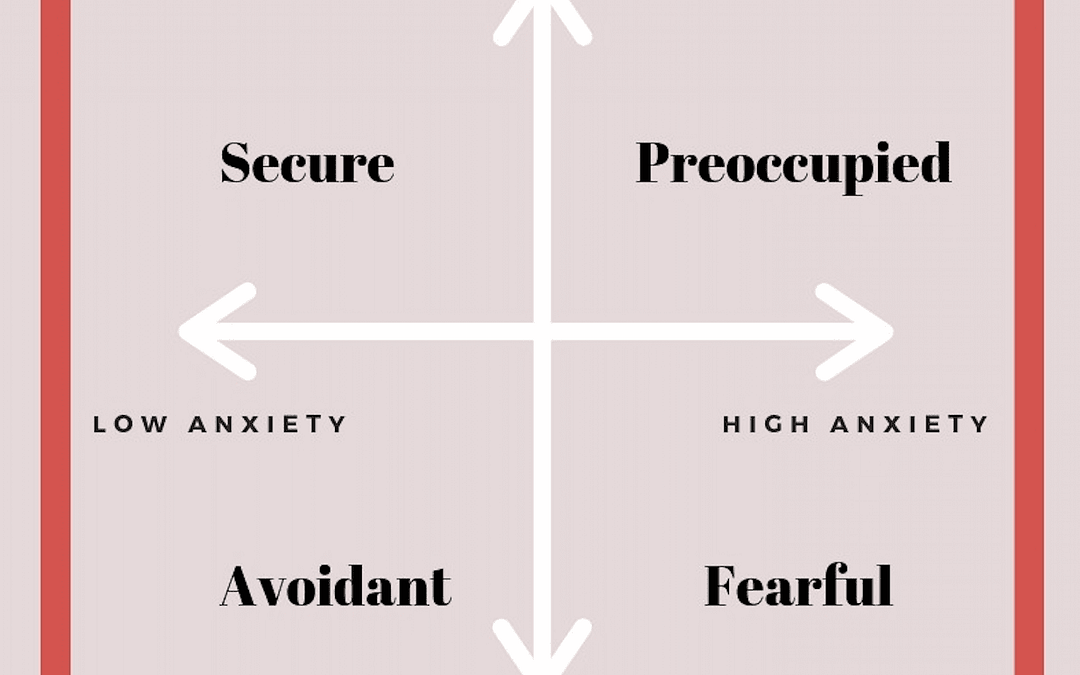
Similar to the way that we attach to our primary caregivers as infants, there are four attachment styles that we may exhibit in our adult romantic relationships or in our adult friendships – secure, preoccupied, avoidant, and fearful.
These four styles lie on a spectrum characterized by low or high avoidance, and low or high anxiety. The amount of anxiety you feel and the amount of avoidance you partake in determine your attachment style. With a secure attachment, there is low anxiety and low avoidance; you feel close to your partner, you’re able to talk about difficult topics without negative emotions and without needing to leave, and have a consistent outlook on the relationship. In contrast, an avoidant attachment style is characterized by low anxiety and high avoidance; you may avoid any serious topic of conversation, and when you find yourself in a serious situation or feeling high levels of emotions, you may need to physically and emotionally detach from your partner, sometimes without warning and for a long period of time.
As a couples therapist, it’s important for me to help my clients identify their adult attachment styles and to find ways to work towards a secure attachment. Attachment style isn’t permanent – we have the capacity to change it!
by Marina Edelman, LMFT | May 31, 2019 | Blog, couples, divorce, mediation
Divorce is not easy for anyone, especially those with children. We establish a life around our families, and divorce forces us to redirect that life and create a new one. Collaborating on vacation ideas as divorced parents is tough.
The one constant factor in all of the chaos, of course, is the children. We need to be reminded constantly, that this kind of change can be detrimental to the children. Families can still be considered combined units, given the correct amicable terms. We can still communicate effectively and co-parent in ways that make the sting of divorce a little less unbearable.
The two things that families struggle with are holidays and vacations. Summer vacation is a prolonged amount of time where the children are not in school and therefore, the adults must work together in a compassionate and understanding manner to co-parent and work around each other’s schedules.
Below are some tips and ideas that may help the process along:
- Plan ahead – nothing makes things easier than a plan. Planning ahead and making sure that the plan works for both parents and children is best. Use tools such as Google Calendar to collaborate effectively.
- Let older children and teens help in the planning process. Make sure that this is done in a transparent way with everyone involved so that your family will still hold on to that united front, and feel combined.
- Communicate effectively – this ensures that everyone is heard, understood, and the plan will be able to proceed.
- Celebrate each other’s efforts in the planning process.
- Avoid the phrase “My Time” when referring to your parenting period with the children.
- Use the summer to maximize spending time with your child. At the times that you do have your children, try one of the items below:
- Beach Day
- Library Day
- Picnics
- Ice Cream Day
- Visit the Zoo
- Go to the park and fly kites!
- Playdays in the yard followed by a hot dog bbq
- Water Balloon Fights!
- Gardening Days
- Movie Nights
- Be Sensitive to important events such as birthdays, fathers day, etc.
- Welcome your children’s friends over at all times. The extra company over the summer may act as a buffer and help your child transition better to their new way of life.
- Make plans for your own relaxing “me-time” when your child is visiting with the other parent. This may be fun and something you look forward to.
- Let the “VEGGING” period begin. Let your child sleep in, watch tv all day, and veg out if needed.
- Relax and just spend time with your children. Concentrate on what’s most important to you, and make beautiful memories!
In conclusion, your family doesn’t have to be split up, the dynamic is only changing, but you are still very much a family, and your ex-spouse is still very much a part of your life as well as your children’s lives. Make the transition and shift easier for everyone by not holding on to bitter feelings, and try your best to be amicable at all times. The results will be a successful co-parented, united family, with happy children, and parents who are very good friends.