by Marina Edelman, LMFT #51009 | Jun 25, 2026 | couples
Fights Are Rarely About What You’re Fighting About
Fights are normal. Most couples come into therapy convinced they know why they argue.
The dishes.
The money.
The children.
The in-laws.
The lack of intimacy.
The text message that wasn’t answered.
Those may be the topics of the argument, but they’re rarely the reason the argument exists.
After more than twenty years of working with couples, I’ve learned that most conflict isn’t about solving a problem.
It’s about meeting an emotional need.
The moment couples understand that, everything begins to change.

The Three Reasons Couples Fight
One of the concepts I teach most often is that people generally argue for three reasons.
To be heard.
To gain power.
To create connection.
Most couples immediately recognize the first two.
The third almost always surprises them.
Connection.
Because if someone is trying to connect, why would they criticize, complain, or start a fight?
The answer is simple.
Sometimes conflict becomes the only way two people know how to reach each other.

When Fights Becomes the Relationship
High-conflict couples rarely wake up wanting another argument.
But over time, the relationship begins to organize itself around conflict.
The fight becomes the conversation.
The criticism becomes the bid for attention.
The defensiveness becomes protection.
The silence becomes punishment.
Eventually, conflict becomes the primary way the relationship functions.
Not because either partner enjoys fighting.
Because it has become the only reliable form of emotional engagement.
Even negative attention can feel safer than no attention at all.

The Hidden Need Beneath Every Argument
When couples tell me,
“We keep having the same fight.”
I become curious.
Not about the argument itself.
About what each person is trying to communicate underneath it.
A complaint about household chores may actually be saying:
“I don’t feel appreciated.”
An argument about spending may really mean:
“I don’t feel secure.”
A disagreement about intimacy may be expressing:
“I don’t feel wanted anymore.”
The louder the conflict becomes, the more important it is to listen for what isn’t being said.
Why Criticism Is Often a Bid for Connection
One of the biggest shifts couples make in therapy is learning to hear criticism differently.
Most criticism begins as an unmet need.
Instead of saying,
“I miss you.”
Someone says,
“You’re always working.”
Instead of saying,
“I feel lonely.”
They say,
“You never pay attention to me.”
The words create distance.
The emotion underneath is asking for closeness.
That doesn’t make hurtful communication acceptable.
But it does make it understandable.
And understanding creates opportunities for change.

Replacing Fights with Connection
Healing doesn’t happen because couples stop disagreeing.
Healthy couples disagree all the time.
The difference is that they learn to communicate the need underneath the complaint.
Instead of asking,
“How do we stop fighting?”
I encourage couples to ask,
“What are we really trying to say?”
Often the answer is surprisingly simple.
“Notice me.”
“Choose me.”
“Reassure me.”
“Tell me I matter.”
Those conversations build connection.
Arguments rarely do.
My Goal Is Not to Eliminate Fights
Many people assume couples therapy is about stopping arguments.
It isn’t.
Conflict is part of every healthy relationship.
My goal is to help couples understand why they’re fighting and teach them healthier ways to express the needs beneath the conflict.
Because when couples learn to replace criticism with vulnerability, power struggles with curiosity, and assumptions with honest conversations, the relationship begins to change.
Not because life becomes easier.
But because they finally stop fighting against each other and start working together.
Frequently Asked Questions
Why do couples keep having the same fights?
Recurring arguments usually point to an unmet emotional need rather than an unresolved practical issue. The topic may change, but the underlying need often remains the same.
Are fights healthy in a relationship?
Conflict itself isn’t unhealthy. The way couples handle conflict matters more than how often they disagree. Healthy conflict can strengthen communication and deepen understanding.
Why does criticism make conflict worse?
Criticism often triggers defensiveness, making it harder for both partners to hear the vulnerable emotion underneath the complaint. Learning to express needs directly helps reduce conflict.
Can couples learn to communicate without fights?
Yes. With awareness and practice, couples can learn to replace blame and criticism with honesty, curiosity, and emotional vulnerability.
When should couples seek therapy for recurring fights?
If you find yourselves having the same arguments repeatedly, feeling unheard, or becoming emotionally disconnected after conflict, couples therapy can help identify unhealthy patterns and build healthier ways of communicating.
Ready to Change the Way You Communicate?
Every couple experiences conflict.
But conflict doesn’t have to become the foundation of your relationship.
When you understand what’s happening beneath the arguments, you can begin replacing cycles of criticism and defensiveness with conversations that build trust, understanding, and connection.
If you and your partner feel stuck in recurring conflict, couples therapy can help you uncover the patterns keeping you disconnected and develop healthier ways to communicate.
If you’re ready to strengthen your relationship, repair trust, or gain clarity about your path forward, I invite you to schedule a consultation.
📞 Call: (818) 851-1293
📧 Email: marina@marinaedelman.com
Because healing doesn’t begin when conflict disappears.
It begins when two people become willing to understand themselves—and each other—in a new way.

by Marina Edelman, LMFT #51009 | Jun 22, 2026 | affair
Why an Affair Is a Symptom, Not the Disease
Affair recovery often begins with a question most couples never think to ask: Why did the affair become possible in the first place?
When couples come to my office after an affair, they usually believe the affair is the problem.
It makes sense. An affair can shatter trust, create profound emotional pain, and leave both partners questioning everything they thought they knew about their relationship.
But after twenty years of working with couples, I’ve learned that an affair is rarely the root issue.
The affair, the emotional relationship, the hidden messages, the secret spending, or the double life are often symptoms of a much larger problem within the relationship—and within the individual.
The real work begins when we stop asking, “What happened?” and start asking, “What made this possible?”

Understanding What Makes an Affair Possible
Most couples arrive looking for answers.
They want timelines, confessions, proof, and details.
While these conversations matter, they rarely create healing on their own.
Healing happens when we begin to understand the relationship system that allowed the affair to exist.
A relationship is a living system. Every interaction either strengthens trust or weakens it. Every pattern either creates connection or distance.
When I work with couples affected by chronic infidelity and high conflict, I am not focused on isolated events. I am looking for recurring patterns.
- How do they communicate when they’re hurt?
- How do they handle vulnerability?
- How do they regulate difficult emotions?
- How do they respond to shame, rejection, loneliness, or disappointment?
The answers to those questions often reveal far more about the future of the relationship than the affair itself.

Understanding its Emotional Impact
Many betrayed partners develop extraordinary awareness.
They can detect subtle shifts in tone.
Micro-expressions.
Changes in behavior.
Inconsistencies.
They become experts at reading people.
Most assume this hypervigilance was created by infidelity.
Usually, it wasn’t.
Infidelity simply activates a survival strategy that existed long before the relationship.
Hypervigilance is often a childhood adaptation.
It develops when safety feels unpredictable.
As therapists, we must understand that trust repair is not simply about convincing someone their partner has changed.
It is also about helping them learn that they no longer need to live in constant danger detection.
Otherwise, even healthy relationships can feel unsafe.

Why I Slow Down the Affair Recovery Process
One of the most powerful interventions I use with high-conflict couples is surprisingly simple:
Slow everything down.
Most couples struggling with betrayal are seeking immediate relief.
- Immediate reassurance.
- Immediate forgiveness.
- Immediate intimacy.
- Immediate certainty.
Unfortunately, urgency is often what created the problem in the first place.
Impulsive behavior destroys trust.
Intentional behavior rebuilds it.
Trust is restored through repeated experiences of restraint.
Not because someone could act on an impulse.
But because they chose not to.
The ability to tolerate discomfort is one of the strongest predictors of long-term recovery.

Rebuilding Trust Begins with Friendship
Many couples assume reconciliation begins with romance.
I disagree.
Reconciliation begins with friendship.
Friendship creates emotional safety.
Friendship creates curiosity.
Friendship creates respect.
Friendship allows two people to rediscover one another without the pressure of performing as spouses.
In some situations, I encourage couples to temporarily remove the romantic and physical components of the relationship entirely.
Not as punishment.
As protection.
When physical chemistry becomes the primary source of connection, couples often mistake intensity for healing.
The relationship feels better.
But the underlying injuries remain untouched.
Friendship allows trust to be rebuilt slowly, intentionally, and authentically.

It Requires More Than Monitoring
One of the most difficult conversations I have with betrayed partners involves surveillance.
Checking phones.
Tracking locations.
Monitoring finances.
Seeking constant reassurance.
These behaviors are understandable. They are attempts to create safety after an affair.
But eventually, every couple reaches a crossroads.
Monitoring cannot become trust.
Transparency is healthy.
Surveillance is exhausting.
My goal is not to create a relationship where one partner becomes a detective.
My goal is to help create a relationship where accountability becomes voluntary and honesty becomes consistent.
Trust returns when someone repeatedly chooses integrity—not when they are forced into it.
Affair Recovery Requires Radical Honesty
After an affair, most couples focus on whether trust can be rebuilt.
A different question often matters more:
Can both people become honest enough to create a different relationship than the one that existed before?
Affairs thrive in secrecy.
Recovery requires transparency.
Not perfection.
Not constant reassurance.
Not promises about the future.
Honesty.
Honesty about fears.
Honesty about needs.
Honesty about resentments.
Honesty about loneliness.
Honesty about desires that have gone unspoken for years.
Many couples spend tremendous energy trying to determine whether the affair will happen again.
While that concern is understandable, lasting recovery is rarely built on prediction.
It is built on truth.
The more honest two people become with themselves and with each other, the less room there is for secrets, avoidance, and disconnection.
For me, affair recovery is not simply about preventing another betrayal.
It is about helping two people build a relationship where honesty becomes safer than hiding.
My Goal Is Not to Save Every Marriage
This may surprises people.
I am profoundly pro-relationship.
I believe people can heal.
I believe trust can be rebuilt.
I believe marriages can recover from extraordinary injuries.
But my job is not to save every marriage.
My job is to help people tell the truth.
The truth about their wounds.
The truth about their patterns.
The truth about their desires.
The truth about what they are willing—or unwilling—to change.
Sometimes that truth leads to reconciliation.
Sometimes it leads to separation.
Both can be healthy outcomes.
What matters most is whether people leave therapy more self-aware, more accountable, and more capable of creating secure relationships than when they arrived.
Because ultimately, healing after infidelity is not about returning to the relationship that existed before.
It is about creating something entirely different.
Something built on honesty rather than fear.
Connection rather than conflict.
And responsibility rather than blame.
Frequently Asked Questions about Affair
1. Can a relationship survive an affair?
Yes, many relationships can survive affairs, but survival and healing are not the same thing.
True recovery requires accountability, transparency, and a willingness to understand what made the betrayal possible in the first place. Rebuilding trust takes time, consistency, and often professional guidance. While some couples emerge stronger, others discover that the healthiest path is separation. Every situation is unique.
2. How long does it take to rebuild trust after betrayal and affair?
There is no universal timeline.
Trust is rebuilt through repeated experiences of honesty, reliability, and emotional safety. For some couples, meaningful progress can happen within months. For others, especially when there have been multiple betrayals or addiction issues, the process may take years.
The focus should not be on how quickly trust returns, but on whether both partners are consistently doing the work required to rebuild it.
3. Can addiction cause an affair?
Addiction and infidelity often coexist, but addiction does not excuse betrayal.
Substance abuse can lower inhibitions, increase impulsivity, and contribute to poor decision-making. However, lasting recovery requires addressing both the addictive behavior and the underlying emotional patterns that contribute to relationship betrayal.
In many cases, healing cannot begin until addiction is actively being treated.
4. Why do we keep having the same argument over and over again?
Recurring arguments are often a sign that the deeper issue has not been addressed.
Most couples believe they are fighting about money, communication, intimacy, or trust. More often, they are fighting about feeling unseen, unheard, unsafe, or disconnected.
When couples learn to identify the vulnerable emotions underneath the conflict, the conversation changes—and so does the relationship.
5. Is couples therapy worth it if we’re not sure we want to stay together after an affair?
Absolutely.
Couples therapy is not only for saving relationships. It can help partners gain clarity, improve communication, understand unhealthy patterns, and make thoughtful decisions about the future.
Whether a couple chooses reconciliation or separation, therapy can provide a healthier path forward and reduce the pain, confusion, and conflict that often accompany major relationship decisions.
Ready to Create Lasting Change in Your Relationship?
Most couples don’t struggle because they don’t love each other.
They struggle because they become trapped in patterns of conflict, defensiveness, disconnection, resentment, or mistrust. Over time, those patterns can make even the strongest relationships feel exhausting.
The good news is that relationships can heal.
With the right support, couples can learn to communicate more honestly, rebuild trust after betrayal, navigate addiction and attachment wounds, and create a deeper sense of emotional safety and connection.
Whether you’re facing infidelity, recurring conflict, emotional distance, or simply feeling stuck, therapy can help you understand what’s happening beneath the surface and give you practical tools to create meaningful change.
You don’t have to keep repeating the same painful cycle.
Together, we can uncover the patterns that are keeping you disconnected and build a healthier foundation rooted in honesty, accountability, empathy, and trust.
Take the First Step
If you’re ready to strengthen your relationship, repair trust, or gain clarity about your path forward, I invite you to schedule a consultation.
📞 Call: (818) 851-1293
📧 Email: marina@marinaedelman.com
Because healing doesn’t begin when conflict disappears.
It begins when two people become willing to understand themselves—and each other—in a new way.
And sometimes, one honest conversation can change everything.
by Marina Edelman, LMFT #51009 | Jun 16, 2026 | couples
Physical Touch as a Love Language
Touch may be one of the most underestimated forms of communication in a relationship. When couples come into my office feeling disconnected, they often assume the solution is going to be a complicated one. Maybe they need better communication skills. Maybe they need more date nights. Maybe they need to resolve a long-standing conflict that’s been sitting between them for years. While all of those things can be important, I often find that one of the most powerful tools for rebuilding connection has been available to them all along:
Physical touch.
Not grand romantic gestures.
Not elaborate plans.
Not even sex.
I’m talking about the small, everyday moments of connection that remind your partner, “I’m here. I see you. We’re okay.”
A hand on their shoulder when they’re stressed.
Holding hands while walking through a parking lot.
A hug before leaving for work.
Leaning into each other on the couch after a long day.
These moments may seem insignificant, but they often carry an emotional weight that words alone cannot.
The key, however, isn’t simply touching more.
The key is attunement.

Physical Touch Is About More Than Romance
One of the biggest misconceptions I see is that people equate physical affection exclusively with romance or sexual intimacy.
While physical affection can certainly be romantic, its deeper purpose is often emotional.
Touch has a unique ability to communicate comfort, reassurance, support, and safety.
Think about how naturally we reach for someone we love when they’re hurting. We hug grieving friends. We hold a child’s hand when they’re scared. We place a reassuring hand on someone’s back when they’re overwhelmed.
We instinctively understand that touching can communicate things words struggle to express.
Yet somewhere along the way, many couples stop using it as a form of everyday emotional connection and begin reserving it for specific moments or circumstances.
Over time, those missed opportunities can quietly create distance.
The Secret Isn’t More Touch—It’s More Attuned Touch
If there is one thing I wish more couples understood, it’s this:
The most meaningful touch isn’t about frequency.
It’s about understanding.
Many relationship articles encourage couples to hug more, kiss more, or hold hands more often. While those suggestions aren’t necessarily wrong, they can miss an important piece of the puzzle.
Not all touch feels connecting.
A hug when someone is overwhelmed may feel comforting—or it may feel intrusive.
Holding someone’s hand may feel reassuring—or it may feel like pressure if they’re emotionally flooded.
What creates connection isn’t the gesture itself.
It’s whether the gesture is attuned to the person receiving it.
Attunement means paying attention.
It means noticing your partner’s emotional state.
It means understanding their comfort level.
It means respecting their boundaries while still finding ways to express affection and care.
In many ways, attuned touch says:
“I care enough to understand what you need right now.”
And that’s what makes it so powerful.
Why Understanding Your Partner’s Touch Preferences Matters
One of the easiest ways couples unintentionally disconnect is by assuming their partner experiences affection the same way they do.
In reality, people have vastly different relationships with physical affection.
Some people feel deeply connected through frequent physical affection.
Others enjoy it but need more personal space.
Some seek physical closeness during difficult moments.
Others need a little time before they’re ready for connection.
None of these preferences are wrong.
The goal isn’t to convince your partner to experience touch the way you do.
The goal is curiosity.
I often encourage couples to ask questions such as:
- What types of touch help you feel loved?
- When do you feel most connected to me?
- What kinds of affection feel comforting?
- When do you prefer space?
- What makes touch feel meaningful rather than routine?
These conversations can be surprisingly eye-opening.
Many couples discover they’ve been making assumptions for years.
Small Moments Create Big Connection
We often think intimacy is built through major milestones.
Vacations.
Anniversaries.
Special celebrations.
And while those moments matter, I find that long-term connection is usually built in much smaller ways.
It’s built in the ordinary moments.
The goodbye kiss before work.
The quick hug in the kitchen.
The hand squeeze during a stressful conversation.
The decision to sit close instead of across the room.
These moments are easy to overlook because they seem small.
But relationships are often shaped by the accumulation of small experiences.
Just as emotional distance rarely happens overnight, emotional closeness is usually built one small moment at a time.

Why Some Couples Struggle With Physical Connection using Touch
When physical affection decreases, many couples assume something is wrong.
Sometimes there are deeper issues that need attention.
But often, the explanation is much simpler.
Life gets busy.
Stress increases.
Children require attention.
Work becomes demanding.
Energy becomes limited.
The challenge is that physical connection is often one of the first things to disappear when life feels overwhelming.
Unfortunately, it’s also one of the things we need most during those seasons.
This doesn’t mean couples need to force affection when they’re exhausted.
Rather, it means becoming more intentional about preserving moments of connection, even when life feels chaotic.
Just like I often tell couples that emotional intimacy shouldn’t be postponed until life slows down, physical connection shouldn’t be either.
Respecting Touch Boundaries Strengthens Connection
One of the most important aspects of attuned touch is understanding that affection and boundaries can coexist.
In fact, healthy boundaries often strengthen intimacy.
When people know their comfort levels will be respected, they tend to feel safer.
And when people feel safer, connection becomes easier.
Attuned touch isn’t about getting your partner to accept affection.
It’s about offering affection in a way that feels caring, welcome, and respectful.
The healthiest relationships are not built on obligation.
They’re built on mutual understanding.
You Don’t Need More Time—You Need More Presence
One thing I consistently see in couples counseling is the belief that connection requires large amounts of uninterrupted time.
While dedicated time together is valuable, meaningful connection often happens in moments.
A thirty-second hug.
A hand on a knee during dinner.
A warm greeting when your partner walks through the door.
These gestures don’t require a complete schedule overhaul.
They simply require presence.
And presence is often what we’re truly craving from one another.
Not perfection.
Not grand gestures.
Just the feeling that our partner is emotionally with us.

Physical Touch Is Ultimately About Emotional Safety
At its core, meaningful touch isn’t really about touch at all.
It’s about what the touch communicates.
Safety.
Acceptance.
Care.
Understanding.
Belonging.
When physical affection is rooted in attunement, it becomes one of the most powerful ways couples can nurture emotional intimacy.
Not because it’s dramatic.
But because it’s consistent.
And in healthy relationships, consistency is often far more impactful than intensity.
The couples who stay connected aren’t necessarily the couples who have the most time, the least stress, or the fewest challenges.
They’re often the couples who continue finding small ways to say:
“I’m here.”
“I see you.”
“We’re still a team.”
Sometimes that message comes through words.
And sometimes, it comes through a simple touch that says everything that needs to be said.
Frequently Asked Questions
Why is physical touch important in a relationship?
Physical touch can help create emotional safety, reduce stress, reinforce affection, and strengthen a couple’s sense of connection. When touch is attuned to a partner’s needs and comfort level, it often deepens emotional intimacy.
What does attunement mean in a relationship?
Attunement is the ability to recognize and respond to your partner’s emotional experience. It involves paying attention to their feelings, needs, and nonverbal cues so they feel understood and supported.
Can a relationship survive without physical touch?
Every relationship is unique, but physical affection is often an important component of emotional connection. If physical touch has significantly decreased, it may be helpful for couples to explore what’s contributing to the shift.
What if my partner and I have different comfort levels with touch?
Differences in touch preferences are incredibly common. The goal isn’t to change your partner’s preferences but to understand them and find ways of connecting that feel comfortable and meaningful for both people.
How can busy couples stay physically connected through touch?
Small moments matter. A hug before work, holding hands during a walk, sitting close together, or offering a reassuring touch during a stressful moment can all help maintain connection even during busy seasons.
When should couples seek therapy for intimacy and connection issues?
If emotional distance, recurring misunderstandings, or difficulties with affection and intimacy are creating strain in the relationship, couples counseling can provide a supportive space to better understand each other’s needs and rebuild connection.
Final Thoughts
Physical touch is one of the most overlooked forms of emotional communication in relationships.
Not because couples don’t care about each other.
But because it’s easy to forget how powerful small moments can be.
The most meaningful touch isn’t necessarily the most frequent. It’s the touch that communicates understanding, respect, warmth, and presence.
When couples learn to approach physical affection with curiosity and attunement, they often discover that connection isn’t something they have to chase.
It’s something they can create in the ordinary moments they’re already sharing.
And sometimes, those ordinary moments become the ones that matter most. Learn the 10 ways to express love uusing touch here.
Ready to Strengthen Your Relationship and Communicate Properly?
Healthy relationships aren’t built on avoiding difficult conversations—they’re built on partners who are willing to communicate with honesty, empathy, and respect.
If you and your partner are struggling to express your needs, navigate recurring conflicts, or reconnect emotionally, professional support can help you develop the tools needed for healthier, more meaningful communication.
You don’t have to figure it out alone. Learn more on Relationship Counseling and Therapy!
Take the first step toward a stronger, more connected relationship by scheduling a consultation today. Together, you can learn how to communicate openly, listen with compassion, and create the trust and intimacy your relationship deserves.
Contact Marina today to start building a healthier, happier partnership—one conversation at a time. ❤️
Schedule Your Consultation
📞 Call: (818) 851 1293
📧 Email: marina@marinaedelman.com
Because every great relationship begins with understanding—and every meaningful conversation is an opportunity to grow closer.
by Marina Edelman, LMFT #51009 | Jun 2, 2026 | Blog, mom
Quick Answer: Why Is Your Toddler Rejecting Mom?
If your toddler screams “no!”, pushes you away, or only wants the other parent, you’re experiencing what therapists call the toddler rejection phase. The short version:
- It is developmentally normal
- It is temporary
- It does not mean you are a bad mom
- It is also one of the most painful and least talked-about parts of motherhood
You are not broken. You are not failing. And you do not have to go through it alone.

“My Toddler Hates Me.” If You’re a Mom Who’s Whispered This, Read On.
There’s a particular kind of heartbreak no one prepares you for. It doesn’t come during the newborn fog, the sleep deprivation, or even the colicky months. It arrives quietly – sometime between 18 months and 4 years – when the child you grew, fed, soothed, and adored suddenly… does not want you.
They want dad. Or grandma. Or anyone but you.
They scream when you try to help. They push you away at bedtime. They light up for someone else and turn cold when you walk in the room.
You smile through it in public. You cry about it in the car. You google “why does my toddler hate me” at 11 p.m. and feel a wave of shame just typing the words.
This is not a failure of love. This is a developmental phase. And it deserves real support – not platitudes.
That’s exactly why we created this group.
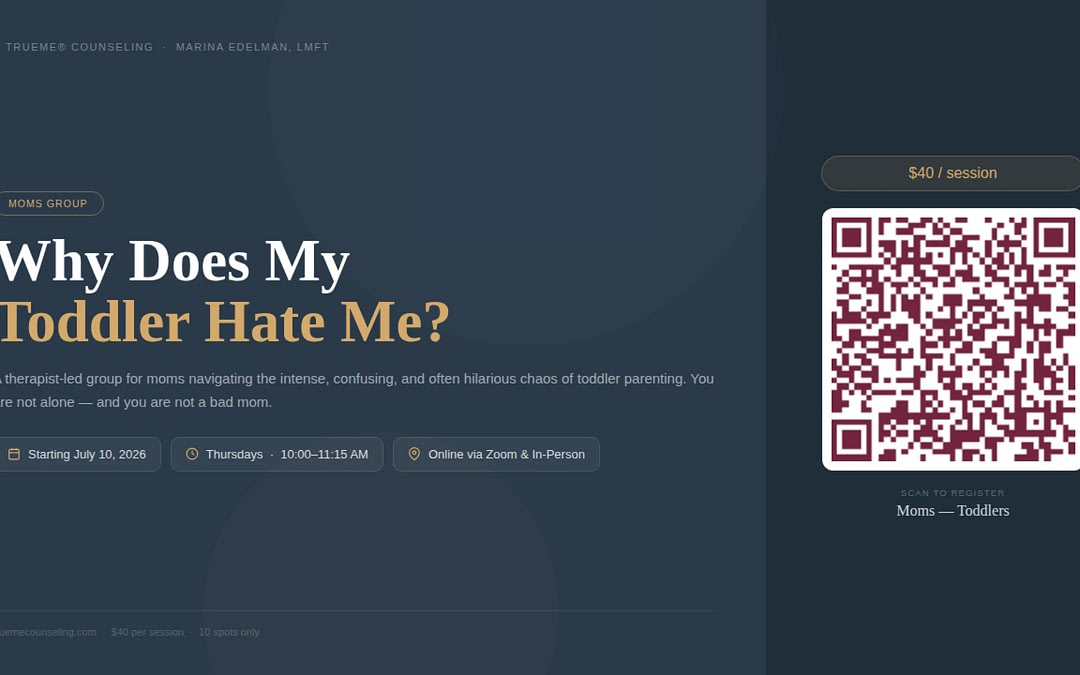
Introducing: Why Does My Toddler Hate Me? — A Support Group for a Mom in the Trenches
A warm, judgment-free group for moms navigating the toddler “mommy rejection” phase – because this is harder than anyone admits.
📋 Group Details for Moms at a Glance
| Detail |
Info |
| Format |
Closed group · 8 sessions |
| Session length |
75 minutes |
| Day & time |
Thursdays · 10:00 – 11:15 AM (starting soon: July 9, 2026) |
| Group size |
10 moms maximum |
| Setting |
Confidential, supportive, professionally facilitated |
This is not a parenting class. This is not a vent session. This is a structured, therapist-led space designed to help you process the pain, understand the science, and reconnect with yourself and your child.
What Is the “Toddler Rejection Phase for their Moms,” Really?
Toddler rejection – sometimes called parent preference – is a normal developmental stage where your child fixates on one caregiver and pushes the other away. The painful twist: the “rejected” parent is most often the one the child feels safest with.
In other words, your toddler is not rejecting you because you’ve done something wrong. They are rejecting you because you are safe enough to reject.
That insight changes everything – but it doesn’t make the daily reality less painful. That’s where group work helps.
The 8-Week Journey: What a Mom Will Explore
Each session is intentionally sequenced to take you from raw pain to grounded reconnection.
Week 1 — You Are Not Alone: What “Toddler Rejection” Really Is
We start by naming the experience. You’ll meet other moms going through the exact same thing and finally feel the relief of being understood.
Week 2 — The Developmental Science: Why This Is Normal and Temporary
We unpack the psychology behind parent preference, attachment, and why your toddler’s behavior is actually a sign of secure bonding – not the opposite.
Week 3 — The Grief of Feeling Rejected by Your Own Child
Yes, it is grief. We make space for the sadness, anger, and shame that come with this phase, without judgment.
Week 4 — Your Identity: Mom, Woman, Person
When so much of your day is about being needed (or unneeded), it’s easy to lose yourself. This session reconnects you with who you are beyond the role.
Week 5 — Partner Dynamics During This Phase
When your toddler prefers your partner, resentment, jealousy, and tension can quietly build. We talk about how to navigate this together rather than apart.
Week 6 — Self-Compassion Practices That Actually Work
No toxic positivity. Real, evidence-based tools to soften the inner critic and steady your nervous system on the hard days.
Week 7 — Communication With Your Toddler & Co-Parenting Strategies
Practical, age-appropriate language and approaches that help you stay calm, connected, and consistent – even mid-meltdown.
Week 8 — Staying Connected: Tools to Carry Forward
You’ll leave with a personalized toolkit, a stronger sense of self, and a community of moms who truly get it.
Who This Mom Support Group Is For
This group is designed for moms who:
- Feel rejected, replaced, or invisible to their toddler
- Are smiling through public moments but breaking down privately
- Feel guilty for resenting their partner or their child
- Are tired of advice that minimizes the pain (“they’re just a toddler!”)
- Want a space where they can be honest without being judged
- Believe community heals what isolation makes worse
You do not need to have a diagnosis. You do not need to have it “all together.” You just need to want support.
Why a Mom Group (Not Just Individual Therapy)?
Individual therapy is powerful – and we offer that too. But there is something irreplaceable about being in a room (or virtual room) with other women who are living the same quiet heartbreak.
In group, you discover:
- You are not the only one
- Your reaction is not “too much”
- Other moms are quietly struggling exactly like you
- Healing accelerates when shame is replaced with connection
The science is clear: isolation deepens parental distress. Community softens it.
Why Clients Choose Marina Edelman
- Licensed California therapists specializing in motherhood, anxiety, and family dynamics
- Evidence-based, judgment-free care
- In-person and secure virtual options across California
- Warm, professionally facilitated groups – never preachy, never performative
- A community of women who actually understand
Frequently Asked Questions
Is the toddler rejection phase a real thing?
Yes. Therapists and developmental psychologists recognize parent preference as a normal stage in toddlerhood, typically appearing between 18 months and 4 years. It does not reflect a problem with your parenting or your bond.
Does my toddler actually hate me?
No. In fact, the parent a toddler “rejects” is most often the one they feel safest enough with to express big, uncomfortable feelings around. It is a sign of secure attachment, not broken connection.
How long does the toddler rejection phase last?
It varies. For some families it lasts a few weeks; for others, several months on and off. It is temporary – but the emotional toll on moms is often underestimated.
Will the group help if I’m also struggling with anxiety or low mood?
Yes. Many moms in this phase experience anxiety, depressive symptoms, and identity strain. The group provides meaningful support and can be combined with individual therapy if more comprehensive care is helpful.
Is the group confidential?
Yes. All members sign a confidentiality agreement, and the group is professionally facilitated by a licensed clinician.
What if I can’t make every session?
Because this is a closed group with a structured curriculum, regular attendance is strongly encouraged. We’ll talk through any scheduling concerns during your screening call.
How do I join?
Spots are limited to 10 moms. After a brief screening conversation to make sure the group is the right fit, you’ll be welcomed in.
Ready to Feel Seen?
You do not have to keep crying in the car. You do not have to keep pretending you’re fine. And you do not have to figure this out alone.
If something inside you exhaled when you read this page, that’s worth listening to.
👉 Reserve your spot in the Why Does My Toddler Hate Me? group – or book a free 20-minute call to see if it’s the right fit. To learn more about the group, check our Moms’ Support Group Page!
Spots are limited to 10 moms. Thursdays · 10:00 – 11:15 AM ·
by Marina Edelman, LMFT #51009 | May 27, 2026 | affair
Quick Answer: When Does Infidelity Cross Into Emotional Abuse?
Infidelity becomes emotional abuse when the betrayal is accompanied by ongoing patterns such as:
- Persistent lying or gaslighting about the affair
- Blaming you for the betrayal
- Minimizing your pain or dismissing your intuition
- Threats, intimidation, or public shaming
- Turning friends, family, or community against you
If any of these patterns sound familiar, healing requires more than apology – it requires safety, clarity, and specialized trauma-informed therapy.

Why Clarity Feels Impossible After Betrayal
Infidelity shatters trust. When it is layered with manipulation, denial, and shifting blame, it shatters something even deeper – your ability to trust your own perceptions. Many people describe feeling foggy, disoriented, and unable to separate what actually happened from what their partner is telling them happened.
This is not weakness. It is the predictable result of betrayal trauma combined with emotional abuse.
As an evidence-based trauma and relationship specialist serving Westlake Village, Thousand Oaks, and clients throughout California, Marina Edelman, LMFT guides individuals and couples through this recovery process – helping clients recognize unhealthy patterns, rebuild self-trust, and set boundaries that restore emotional safety.
What Is Emotional Abuse After Infidelity?
Infidelity is a breach of trust. Emotional abuse is a pattern of behavior designed to erode your confidence, autonomy, or sense of reality. When the two appear together, the harm compounds.
Common signs that infidelity has crossed into emotional abuse include:
- Gaslighting: denying obvious evidence, rewriting history, calling your memory unreliable
- Blame-shifting: making the affair your fault
- Minimization: treating your pain as overreaction
- Coercion: using guilt, family, religion, or culture to pressure you into silence
- Retaliation: threats, intimidation, or smearing your reputation to mutual contacts
These behaviors create long-term psychological harm and are a strong signal to seek professional support before deciding whether reconciliation is even appropriate.
How Therapy Creates Clarity After Infidelity
Therapy with Marina Edelman, LMFT offers a structured path through the chaos. Rather than rushing to “fix” the relationship, the work begins with stabilization and clarity – separating fact from manipulation, organizing what you know, and rebuilding trust in your own judgment.
Whether the path forward is reconciliation or independent recovery, clarity must come first.
A 5-Step Framework for Regaining Clarity After Infidelity
1. Identify the Emotional Abuse Patterns
The first step is naming what is actually happening. Patterns often include:
- Persistent lying or secrecy around the affair
- Denial of obvious evidence
- Blame, shame, or minimization of your pain
- Pressure from outside influences (family, culture, religion) to stay silent
- Retaliatory threats or alienation tactics
Naming these dynamics openly reduces shame and gives you language for experiences that have felt impossible to describe.
2. Build a Detailed Relationship Timeline
Mapping the chronology – major incidents, discoveries, conversations, and shifts in your partner’s behavior – turns chaos into clarity. Timelines reveal patterns of escalation, denial, and manipulation that are hard to see in the moment.
This step also surfaces the areas that need the strongest boundaries.
3. Separate Reality From Self-Doubt
Repeated deception erodes self-trust. Therapy strengthens internal clarity by helping you:
- Track physical and emotional cues you may have been ignoring
- Distinguish present-day threats from old wounds being reactivated
- Challenge invalidating statements with grounded evidence
- Reconnect with your own memory, intuition, and decision-making
4. Establish Boundaries That Restore Safety
Boundaries return agency to you. Productive boundaries after infidelity may include:
- Full transparency expectations
- Rules around digital communication and contact with the affair partner
- Defined no-contact structures where appropriate
- Pausing relationship work entirely until harmful behaviors stop
Therapy supports defining, communicating, and holding these boundaries even under pressure.
5. Decide When (or If) Couples Therapy Is Appropriate
Many people rush into couples counseling immediately after disclosure. Sometimes that is right. Often it is not.
If your partner is still actively lying, coercing, or showing abusive behavior, individual stabilization must come first. Marina Edelman, LMFT helps clients honestly assess whether the relationship environment is safe for joint work – or whether trauma recovery needs to happen on its own first.

How Infidelity Trauma Affects Mental Health
After infidelity layered with emotional abuse, many clients experience:
- Intrusive thoughts and flashbacks
- Anxiety and hypervigilance
- Sleep disruption and exhaustion
- Difficulty making routine decisions
- A persistent sense of unreality or “fog”
This is known as betrayal trauma, and the nervous system can stay in a state of high alert for months. Therapy provides immediate coping strategies while addressing the deeper root – so symptoms ease and clarity returns.
Best Practices for Navigating Infidelity Recovery
- Document incidents and conversations to maintain an objective record
- Share concerns with a qualified counselor, focusing on safety and facts
- Define immediate boundaries that prioritize emotional and physical safety
- Allow space for grief, anger, and confusion rather than suppressing them
- Explore both individual and couples therapy options if accountability is present on both sides
- Educate yourself on betrayal trauma so the symptoms feel less frightening
How to Prepare for Your First Infidelity Recovery Therapy Session
To make your first session as productive as possible, bring:
- A timeline or notes of key betrayals and deceptive behaviors
- Examples of comments or patterns that left you doubting yourself
- Questions about safety, boundaries, and short-term goals
- Concerns related to children, finances, or living arrangements
Arriving prepared allows therapy to focus on the deepest pain points from session one.
Why Clarity Matters Before Making Any Big Decision
Few experiences are as destabilizing as the aftermath of betrayal. Internal urgency and outside pressure often push people to forgive quickly, reconcile, or “move on” before they have had time to assess what is actually safe and true.
Therapy with Marina Edelman, LMFT slows this process down. Clarity about your partner’s current behavior, your own emotional state, and what you actually need creates the foundation for any decision that follows – whether that is repair, separation, or something in between.
Why Clients Choose Marina Edelman, LMFT
- Licensed evidence-based trauma and relationship specialist
- Specialized in infidelity, affair recovery, and betrayal trauma
- In-person sessions in Westlake Village, serving Thousand Oaks
- Secure telehealth throughout California
- Personalized care for individuals and couples – no rushed timelines
Frequently Asked Questions
What is the difference between infidelity and emotional abuse?
Infidelity is a breach of an agreement around fidelity or exclusivity. Emotional abuse is an ongoing pattern of manipulation, invalidation, or control. When infidelity involves persistent lying, gaslighting, or blame-shifting, it can meet the criteria for emotional abuse.
What are warning signs that infidelity has crossed into emotional abuse?
Warning signs include repeated denial of obvious facts, minimizing your pain, blame-shifting, threats, pressure to stay silent, and turning friends or family against you.
Will couples therapy fix the relationship after betrayal and emotional abuse?
Couples therapy can support recovery when both partners are committed to transparency and accountability. If lying, intimidation, or coercion continue, individual stabilization needs to come first. Safety always comes before relational repair.
How do I rebuild self-trust after being repeatedly deceived?
Therapy helps you clarify what is true, name gaslighting for what it is, and stay grounded in your own perceptions. With time, your confidence and decision-making capacity return.
When should I seek immediate help?
Any threatening behavior, stalking, verbal aggression, or attempts to turn others against you signals the need for professional support. If physical safety is at risk, contact emergency services immediately.
Does Marina Edelman, LMFT offer virtual therapy in California?
Yes. Marina Edelman, LMFT offers secure telehealth sessions to clients throughout California, in addition to in-person sessions in Westlake Village.
Take the First Step Toward Clarity
You do not have to navigate this alone, and you do not have to decide anything before you are ready. Specialized therapy with Marina Edelman, LMFT in Westlake Village and via telehealth throughout California offers a focused, evidence-based pathway to emotional safety, self-understanding, and recovery.
👉 Visit the Couples Counseling page or contact Marina directly to schedule a confidential consultation.
by Marina Edelman, LMFT #51009 | May 21, 2026 | affair
Betrayal Trauma Therapy in Westlake Village: A Specialist’s Guide to Healing After Infidelity
Betrayal trauma — a documented clinical response to a major attachment rupture, and one of the most painful experiences a nervous system can move through. That’s not weakness.
Three days after discovery, my new clients almost always arrive in the same condition: not sleeping, not eating, unable to think in straight lines. They apologize for crying. They say they don’t recognize themselves.
The good news: it has a name, a pattern, and an evidence-based path forward. I’m Marina Edelman, LMFT — a licensed marriage and family therapist specializing in affair recovery and betrayal trauma therapy in Westlake Village, Thousand Oaks, and throughout California. This is what the work actually involves, what healing looks like, and what to do in the first week — before the wrong choices get made.
Quick Answer: What Is Betrayal Trauma Therapy?
Betrayal trauma therapy is a specialized form of trauma-informed counseling for people experiencing intense psychological symptoms after the discovery of infidelity or other major trust violations. It combines structured stabilization, supported disclosure, attachment-focused couples work, and trauma processing — often using EMDR, the Gottman Method, and Emotionally Focused Therapy — to help individuals and couples move through what is, clinically, a trauma response. Not a “communication problem.”
It’s Not “Just” Heartbreak — It’s a Trauma Response
The reason standard relationship advice fails so spectacularly after an affair is simple: discovery activates the same biological systems as any major shock. Hypervigilance. Intrusive imagery. Disrupted sleep. Difficulty regulating emotion. A felt sense of unreality.
Clinicians now recognize betrayal trauma as a distinct clinical experience — closely related to PTSD, but with specific features that come from the violation happening inside an attachment bond rather than outside of it. The wound is not just “what they did.” It’s who they were to you.
In my work, the symptoms cluster in predictable ways:
- Hypervigilance and checking — phones, schedules, social media, locations
- Intrusive imagery — looping mental videos of what you imagine happened
- Sleep and appetite collapse — sometimes for weeks
- Emotional whiplash — rage, grief, numbness, longing, all within an hour
- Identity shock — “Who am I now? Who was I to them?”
- Loss of judgment confidence — “How did I miss this? Can I trust myself again?”
These are not signs you’re falling apart. They’re signs your nervous system is doing exactly what it’s designed to do after a major attachment injury. The work isn’t to make these symptoms stop through willpower. It’s to give them a structured container so they can resolve.
What to Do in the First 72 Hours After Discovery
Some of the most lasting damage after an affair happens in the first three days — not from the affair itself, but from decisions made in a dysregulated state. The first phase of the TrueMe® Method I developed is built around exactly this window. It’s the framework I give every new client who reaches out in crisis:
- Press pause. Make no irreversible decisions for 72 hours — no moving out, no calling lawyers, no public disclosures — unless there’s a safety concern.
- Write only what you know. List facts you’ve confirmed. Leave assumptions, fears, and worst-case scenarios off the list. This alone reduces spiraling.
- Stabilize your body first. Food, water, sleep, movement — in that order. Trauma resolves in regulated nervous systems, not depleted ones.
- Choose one confidant. One trusted person, not a group chat. Wide disclosure now will complicate every decision later.
- Get specialized support. A general therapist is not the same as a betrayal trauma specialist. Early specialized intervention significantly changes outcomes.
The Betrayal Trauma Recovery Timeline
Recovery isn’t linear, but it has a shape. Here’s what I most often see in my Westlake Village and Thousand Oaks practice.
Weeks 1–4: Acute Crisis
The work is stabilization. We establish safety, clarify temporary agreements (contact with the affair partner, sleeping arrangements, what gets discussed and when), and reduce the most overwhelming symptoms. No major decisions get made here.
Weeks 4–8: Information and Disclosure
The betrayed partner needs the truth — not in a trickle, but in a structured, contained format with a therapist present. This is one of the most clinically important parts of the process, and one of the most commonly mishandled outside of specialty care. Trickled disclosure is one of the strongest predictors of long-term relationship failure.
Weeks 8–16: Deeper Repair
Attachment wounds, long-standing resentments, intimacy disruptions, and the emotional patterns that predated the affair come into focus. This is also when trauma symptoms typically peak — even as real healing is happening underneath them. Most couples mistake this stage for failure and give up. They shouldn’t.
Months 3–6 and Beyond: New Foundations
Couples who continue rebuild trust as a behavior — through consistency, transparency, and repeated repair. Many emerge with a level of honesty and connection that didn’t exist before the affair. Those who choose separation move toward respectful closure with significantly less long-term harm.
The outcome research is striking. Studies show roughly 74% of couples who pursue specialized therapy after infidelity successfully rebuild their relationship. And couples who disclose the affair openly in therapy have divorce rates around 43% at five years, compared to roughly 80% for those who hide it. Secrecy, not the affair itself, is what most reliably destroys marriages.
What Therapy with Me Looks Like after Betrayal Trauma
I’m a licensed marriage and family therapist with advanced training in the Gottman Method, Emotionally Focused Therapy, and Cognitive Behavioral Therapy, with a clinical focus on infidelity, betrayal trauma, and high-conflict relationship dynamics. My approach is:
- Active, not passive. I guide sessions rather than letting couples re-enact the same conflict in front of me.
- Trauma-informed at every step. Every intervention is paced to your nervous system, not an arbitrary timeline.
- Honest about both outcomes. Whether the path is reconciliation or thoughtful separation, I support the choice you make — with structure and dignity.
- Practical between sessions. You’ll leave each meeting with something specific to do, practice, or notice.
Sessions are available in person in Westlake Village and Thousand Oaks, or virtually anywhere in California.
What Healing Actually Looks Like after Betrayal
Successful outcomes in betrayal trauma therapy generally include:
- Significant reduction in trauma symptoms (hypervigilance, intrusive thoughts, sleep disruption)
- Restored emotional regulation
- Clear, mutually agreed-upon transparency practices
- The ability to talk about the affair without it derailing the relationship
- Rebuilt physical and emotional intimacy
- For some couples: a stronger marriage than existed before the betrayal
- For others: a respectful, less traumatic separation
Healing doesn’t mean forgetting. It means the affair stops being the central organizing fact of your life.
Healing Practices Between Sessions
The work outside of sessions matters as much as the work in them. The practices I recommend most often:
- A fixed 15-minute daily check-in — same time, low stakes
- Written agreements about transparency and boundaries (clarity reduces anxiety more than reassurance does)
- No conflict conversations within an hour of bedtime
- One shared calming activity per week — walk, meal, quiet time
- Daily basics protected: food, hydration, movement, sleep
- Limited alcohol — it amplifies trauma reactivity
Small consistent actions outweigh dramatic gestures, every time.
When You Need Immediate Help after the Betrayal
Please seek urgent support if you experience:
- Panic attacks that don’t resolve
- Thoughts of self-harm or suicide
- Inability to function at work or care for yourself or your children
- Escalating conflict that feels physically or emotionally unsafe
- Severe insomnia lasting more than a few nights
If you are in immediate crisis, call or text 988 (Suicide & Crisis Lifeline) or go to your nearest emergency room.
Why Local Clients Choose Specialty Care
Westlake Village and Thousand Oaks are full of excellent generalist therapists. Betrayal trauma is different. It requires a clinician trained in the specific protocols for disclosure, the rhythm of nervous-system stabilization, and the modalities that actually work for relational trauma — not just good listening and general couples counseling.
Local clients come to my practice for direct guidance, specialized training, and a structured methodology — the TrueMe® Method — designed exactly for this kind of crisis. The work is paced, contained, and held in a calm clinical space, in person or via secure telehealth across California.
Frequently Asked Questions About Betrayal Trauma Therapy
Is betrayal trauma a real clinical condition? Yes. While it isn’t yet a standalone DSM diagnosis, betrayal trauma is a well-documented clinical phenomenon recognized across attachment, trauma, and couples-therapy research. Many clients meet criteria for acute stress disorder or PTSD after discovery.
How long does betrayal trauma therapy take? Most clients see significant symptom relief within 8–12 weeks. Full integration — where the affair becomes part of your story rather than the center of it — typically takes 18 months to 3 years with consistent work.
What’s the difference between betrayal trauma therapy and regular couples counseling? General couples counseling treats relationship distress as a communication problem. Betrayal trauma therapy treats discovery as a trauma event first, with specific protocols for stabilization, disclosure, and attachment repair that need to happen before standard couples work can be effective.
Can a relationship really survive infidelity? Yes — research consistently shows that around 74% of couples who pursue specialized therapy after an affair successfully rebuild, and many report a stronger, more honest relationship than they had before.
Should I tell my friends and family about the affair? In the early weeks, most therapists recommend choosing one or two trusted confidants rather than wide disclosure. Outside opinions during a crisis often complicate the couple’s own decision-making and can make later reconciliation harder if that’s the path you eventually choose.
Begin Healing on Solid Ground
You don’t need to know whether your marriage will survive. You don’t need to have answers. You just need a place where someone who has done this work many times can help you steady yourself, think clearly, and make the next right decision — not the next desperate one.
I offer a complimentary 20-minute consultation so you can ask questions, get a sense of how I work, and decide whether we’re the right fit. No pressure, no obligation.
👉 Schedule your consultation or learn more about my couples therapy services.
Whatever path is right for you, you don’t have to walk it alone.
— Marina Edelman, LMFT Relationship & Marriage Counselor Westlake Village & Thousand Oaks | Serving California Founder of TrueMe® Counseling and TrueMe® Method
by Marina Edelman, LMFT #51009 | May 21, 2026 | affair
The 6 Stages of Healing After Infidelity (And Why Most Couples Get Stuck on Stage 3)
In infidelity, most couples expect affair recovery to look like this: a few terrible weeks, a hard conversation, an apology, and slowly moving on.
Real healing looks nothing like that.
In more than a decade of working with couples after betrayal, I’ve seen something most people aren’t told: the affair itself rarely ends the relationship. The gap between what couples expect recovery to feel like — and what it actually looks like — is what does.
This is what infidelity recovery actually looks like, why most couples stall at the same point, and what it takes to come out the other side.
Quick Answer: How Long Does It Take to Heal From Infidelity?
Most couples need 18 months to 3 years to fully heal from infidelity, moving through six predictable stages of recovery. If you’re wondering why you still can’t move on even after the affair ended, it’s because the pace isn’t linear — it loops, regresses, and surges — and the timeline depends far more on disclosure quality and structured support than on willpower or “wanting it badly enough.” With professional therapy, research shows up to 70–74% of couples successfully rebuild trust and report a stronger relationship than before the affair.
What the Research Actually Says about Infidelity
The numbers are more hopeful than most people believe.
A widely cited 2012 American Association for Marriage and Family Therapy (AAMFT) survey found that approximately 74% of couples who engaged in therapy after infidelity were able to rebuild their relationship. A landmark longitudinal study by Marín, Christensen, and Atkins followed couples for five years post-discovery and found that couples who reconciled in structured therapy reported satisfaction levels comparable to couples who had never experienced infidelity at all.
The difference between couples who heal and couples who don’t isn’t love. It isn’t even remorse. It’s structure — having a clear, evidence-based path through a process that, on its own, feels chaotic and bottomless.
One of the most striking findings: couples who disclosed the affair and worked through it openly in therapy had a roughly 43% divorce rate at five years, while couples who hid or minimized it had divorce rates closer to 80%. Secrecy, not the affair itself, is what most reliably destroys marriages.
Why Infidelity Recovery Isn’t a Straight Line
Discovering infidelity is, clinically speaking, a relational trauma. The betrayed partner doesn’t just feel hurt — their nervous system responds the way it would to any major shock: hypervigilance, intrusive thoughts, sleep disruption, sudden waves of grief, and triggers from things as small as a song, a smell, or the time on the clock.
This is why willpower-based advice (“just communicate,” “just forgive,” “just move on”) consistently fails. You can’t think your way out of a trauma response. You have to move through it, in stages, with the right support.
Here’s what those stages actually look like.
The 6 Stages of Healing After Infidelity
Stage 1: Shock and Crisis (Days 1–30)
The discovery phase. Sleep collapses. Appetite disappears. The betrayed partner cycles between rage, sobbing, numbness, and obsessive questioning. The unfaithful partner often oscillates between guilt, defensiveness, and minimizing.
This is not the stage for big decisions. It’s the stage for stabilizing — making sure both partners are safe, eating, sleeping, and not making permanent choices in a temporary emotional state.
Stage 2: Information and Disclosure (Weeks 2–8)
The betrayed partner needs the truth. Not a slow drip of details revealed only when caught — but a structured, complete disclosure of what happened, with a therapist present whenever possible.
This stage feels brutal and counterintuitive. Couples often want to “skip ahead.” But research is clear: incomplete or trickled disclosure is one of the strongest predictors of relapse and divorce. The truth, told once and completely, is far less destructive than the truth that keeps emerging in pieces over years.
Stage 3: The Stuck Stage — Trauma Triggers and Emotional Whiplash (Months 2–9)
This is where the majority of couples get stuck.
The initial crisis has passed. The affair has been disclosed. The unfaithful partner is “doing the work” — answering questions, showing up, being remorseful. And yet the betrayed partner is more triggered, not less. They cry randomly. They have nightmares. They check the phone obsessively. They feel “crazy.”
The unfaithful partner, meanwhile, feels like nothing they do is enough. They start to feel hopeless, defensive, or quietly resentful: “How long is this going to last?”
This is the stage where the relationship most often dies — not from the affair, but from the misunderstanding of this stage. Couples interpret the ongoing trauma response as proof the relationship can’t recover. It’s actually proof that healing is happening — slowly, biologically, and exactly on schedule.
Stage 4: Meaning-Making (Months 6–12)
If a couple survives Stage 3, something shifts. The questions evolve from “How could you?” to “What was going on in us, in you, in our marriage that made this possible?”
This isn’t about blaming the betrayed partner for the affair — the responsibility for that always belongs to the person who broke the agreement. But it is about both partners getting honest about the relationship that existed before the betrayal: what was missing, what was avoided, what neither person wanted to look at.
This is the stage where real change becomes possible. Not before.
Stage 5: Rebuilding Trust (Months 12–18)
Trust isn’t restored through promises. It’s restored through thousands of small consistent actions — being where you said you’d be, sharing information without being asked, tolerating questions without defensiveness, and showing up reliably during the betrayed partner’s hard moments.
In my work with couples, I describe trust at this stage as a behavior, not a feeling. Couples who try to rush it through verbal reassurance almost always slide backward. Couples who treat it as a daily practice slowly rebuild something more stable than what existed before.
Stage 6: Integration and Post-Traumatic Growth (Months 18+)
The affair becomes part of the couple’s story rather than the center of it. Triggers still happen, but they’re manageable. Difficult anniversaries are acknowledged rather than feared. Intimacy returns, often with surprising depth.
This is where the research on post-traumatic growth shows up clinically: many couples who do the full work report feeling more connected, more honest, and more deeply known than they were before the affair. Not because the affair was “worth it” — it never is — but because rebuilding from the ground up created a level of honesty most relationships never reach.

Why Most Couples Get Stuck on Stage 3 after an Infidelity
Stage 3 is where the work feels endless and the results feel invisible. Several specific dynamics keep couples trapped here:
The unfaithful partner runs out of patience. They believe remorse should be enough. When triggers continue at month four, month five, month seven, they start to feel attacked or defeated.
The betrayed partner can’t access calm. Their nervous system is in a sustained trauma response. The more they try to “just be okay,” the more dysregulated they become.
Both partners isolate. Shame keeps them from telling friends or family the truth, so they have no outside support — and no one to normalize how long this actually takes.
They try to do it alone. Without an experienced affair-recovery therapist, the couple has no map. Every setback feels like proof they should give up.
The way out of Stage 3 isn’t faster healing. It’s correctly understanding the stage — and getting support designed for it.
What Actually Helps Couples Heal
In structured couples therapy, the modalities with the strongest research support for affair recovery include:
- Emotionally Focused Therapy (EFT) — for repairing the attachment wound
- The Gottman Method’s Trust Revival approach — for the practical rebuilding of trust through specific behaviors
- EMDR or trauma-focused therapy — for the betrayed partner’s individual trauma response, often done in parallel with couples work
- Structured disclosure protocols — so the truth gets told once, completely, in a contained environment
These aren’t interchangeable with general couples counseling. Affair recovery is a specialty, and outcomes vary significantly depending on whether the therapist has been trained specifically in this work.
When to Seek Professional Support about Infidelity
Reach out to a qualified couples therapist if:
- The discovery happened within the last 90 days
- One or both partners are experiencing symptoms of trauma (intrusive thoughts, sleep disruption, panic)
- Conversations about the affair end in escalation or shutdown
- One partner is considering separation but hasn’t decided
- You’ve been “trying to work through it” for more than three months with no progress
- Children are picking up on the tension
- There’s a history of repeat infidelity
Getting help in the first six months meaningfully changes the outcome. Many couples wait years — and by then, the patterns have hardened.
How I Help Couples Heal After Infidelity
My approach is integrative and trauma-informed — combining Emotionally Focused Therapy, the Gottman Method, and EMDR — with structured pacing designed specifically for the six-stage process described above. I see couples in person in Westlake Village and Thousand Oaks, and virtually throughout California.
Every couple’s path is different. But the framework is consistent: stabilize the crisis, contain the disclosure, build tolerance for Stage 3, do the meaning-making work, rebuild trust as a behavior, and integrate the experience into a stronger, more honest partnership. This is the foundation of the TrueMe® Method — the framework I developed and use with every couple I work with.
Frequently Asked Questions About Healing From Infidelity
Can a marriage really survive infidelity?
Yes — research consistently shows that 60–75% of couples who pursue professional therapy after an affair successfully rebuild their relationship, and many report greater satisfaction than before the betrayal.
How long does it take to heal from an affair?
Most couples need 18 months to 3 years for full integration, though the most intense symptoms usually ease within 9–12 months of consistent work.
Is it normal to still be triggered months after the affair?
Yes. Triggers in months 3–9 are not a sign of failure — they’re a predictable feature of Stage 3 and the body’s trauma response to betrayal.
Should we tell friends and family?
This is highly individual. Most therapists recommend choosing one or two trusted people for support rather than wide disclosure, especially early in the process, since outside opinions can complicate the couple’s own decision-making.
What if my partner won’t go to therapy?
Individual therapy for the betrayed partner is still highly effective — for processing trauma, regaining clarity, and making informed decisions about the relationship. Many couples eventually enter therapy together once one partner has started the work.
Does an emotional affair count?
Yes. Research and clinical experience consistently show that emotional affairs can be as destabilizing as physical ones — sometimes more so, because the betrayal involves intimacy, attention, and emotional energy that belonged to the relationship.
You Don’t Have to Figure This Out Alone
Healing from infidelity isn’t about who was right, who was wrong, or whether you should stay. It’s about giving your nervous system, your partner, and your relationship the structured support they need to move through a process that — left alone — keeps couples stuck for years.
I specialize in affair recovery, relational trauma, and the deep work of rebuilding trust. I offer a complimentary 20-minute consultation so you can ask questions, get a feel for how I work, and decide whether we’re the right fit — without any pressure.
👉 Schedule your consultation or learn more about my couples therapy services.
Whatever stage you’re in, you’re not as far from healing as it feels right now.
Related reading: How to Stabilize Your Relationship in the First Month After an Affair · Top 10 Signs a Partner Feels Remorse After Infidelity
Couples Therapist in California
Marina Edelman is a Licensed Marriage and Family Therapist and the founder of TrueMe® Counseling, a couples and relationship therapy practice serving clients in Westlake Village, Thousand Oaks, and throughout California.
Marina specializes in couples therapy, affair recovery, and relationship repair, drawing on a carefully integrated set of evidence-based approaches:
Her counseling is best suited for couples and individuals seeking structured, research-backed support for relationship repair, affair recovery, anxiety, communication challenges, and premarital or marriage counseling — in person or via telehealth across California.